Showing posts with label Cormac McCarthy. Show all posts

Thursday, September 3, 2015

The way of the world is to bloom and to flower and die but in the affairs of men there is no waning and the noon of his expression signals the onset of night. His spirit is exhausted at the peak of its achievement. His meridian is at once his darkening and the evening of his day.”

Blood Meridian, or the Evening Redness in the WestBlood Meridian, or the Evening Redness in the West by Cormac McCarthy
My rating: 4 of 5 stars

Cormac McCarthy has been one of my favourite authors ever since I read All The Pretty Horses back in 2012 (I read The Road first, but it was The Border Trilogy that won me over). So, after having buzzed through four McCarthy books in under half a year, I decided that - in order to preserve/lengthen the magic of reading the rest of his oeuvre - I would have to establish a "Cormac McCarthy Reading Plan" and pace myself with his novels in order to always have some new McCarthy to return to whenever I need the bare honesty, dark beauty and astonishing landscapes he delivers with such stark detail.  According to my CMRP, the summer before college would be reserved for reading Blood Meridian, so that I'd have plenty of time to digest it (or recover from it in case of nightmares). And that's just what I've done! I finished Blood Meridian two days ago and it's been haunting me since. (warning: it is not for the faint of heart).

The novel is a bildungsroman, but the most violent one that McCarthy has written yet. It takes place in the brutal Wild West, during the mid-1800s, a time when savage "scalp hunters" would murder Indians along the Mexican and American border and then - quite literally - collect their scalps as evidence of the massacre. Our protagonist, "the kid," runs away from home at 14 to become "a solitary migrant" and a worker in a diptheria pesthouse before finally ending up with the scalp-hunting "Glanton Gang" - led by none other than the enigmatic and terrifying Judge Holden.

The judge, who is "close on to seven feet in height," "bald as a stone," adept at coin tricks and exceptionally knowledgeable about geography/history/science, belongs on an inaccessible tier. As he says, "Whatever in creation exists without my knowledge exists without my consent.” Yet it is only at the end, when he is dancing, young as ever, vowing that "he never sleeps" and saying "he'll never die," that readers believe he may be supernatural. And perhaps it is true that only a demon could have done the things he did - doom the innocent (even a preacher!), commit brutal murders, abduct children. At one point in the novel, the kid asks this about the judge: "judge of what?" For this is a 'judge' that does not subscribe to standard, legal laws, but rather believes in bloodshed through war:
“This is the nature of war, whose stake is at once the game and the authority and the justification. Seen so, war is the truest form of divination. It is the testing of one's will and the will of another within that larger will which because it binds them is therefore forced to select. War is the ultimate game because war is at last a forcing of the unity of existence.War is god.”
“War was always here. Before man was, war waited for him. The ultimate trade awaiting its ultimate practitioner.”
Such an acceptance of war echoes the 'normalcy' with which the horrors of the novel are portrayed. The following sentence, for example, is delivered so casually despite all its terrifying implications: “They passed through small villages doffing their hats to folk whom they would murder before the month was out." Moreover, McCarthy describes the Glanton Gang parading through a town with human heads on splinters while their arrival is celebrated by a "fantasy of music and flowers" (amazing juxtaposition). Even more chilling is how the children, accustomed to this culture of violence, eat "pastry skulls" at the parade while the judge tries to tempt them with his pockets full of "little candy deathsheads"(CHILLLLSSSS).

The language of the book itself accounts for much of its appeal. And I don't just mean McCarthy's delightful use of arcane plant terminology ("golden grounsel and zinnia"), but also the form of the prose itself. In the opening chapter, for example, the unforgettable and monosyllabic opening words introduce us to the kid: "See the child. He is pale and thin, he wears a thin and ragged linen shirt." Blunt, stark and brilliant. As with his other novels, McCarthy also beautifully weaves the darkness of the times with the landscape his characters trespass:  "in the long red sunsets the sheets of water on the plain below them lay like tidepools of primal blood." They pass the "blackened bones of trees." Amazing.

As mentioned earlier, Blood Meridian is a bildungsroman. At the beginning, "the child's face is curiously untouched behind the scars, the eyes oddly innocent," but he is shot below the heart on page two and then "finally divested of all that he has been." There is a poignant moment near the end of the book where the kid sees an old woman bent over in the desert, speaks to her for a long time, tells her that "he would convey her to a safe place," but then realizes that she had been "dead in that place for years" and is nothing but "a dried shell." The hopelessness of the place hits home right there.

"The kid" is not a child for long, even though he is called "the kid" until the end of the novel. Indeed, despite all the fighting he engages in, he never reaches the level of violence that the men around him do. He cannot shoot the judge and he cannot leave the ex-priest to die (by the way, this is the ~2nd ex-priest I have come across in McCarthy's works. Brilliant symbol of loss of faith.)  The judge even says that he loves the kid "like a son."

So that brings us to the end of the novel, where "the kid" becomes "a man." The ending is terrifying. And, given all that the judge is capable of doing to children and men, I am going with the worst-case scenario regarding the kid's fate. The judge "gathered him in his arms against his immense and terrible flesh.” That carnal imagery suggests at much, although we never know what truly happens to him, except that whoever sees him at the end can only comment, "good god almighty."

Blood Meridian is stunning, especially as so much of it is historically backed (scalp hunting, the Glanton gang, even Judge Holden himself). Reading it was like living in a trance - in some chapters, nothing seems to be happening except moving through barren terrain (thankfully, the synoptic chapter headings help one keep track of the plot). I think this is the main shortcoming of the novel. In other chapters, evil is described so explicitly, you don't want to believe what you read (I swore outloud so many times while reading this book).

But regardless of how shocking and horrifying the story becomes, McCarthy's magic never diminishes - the sheer beauty of his prose, his ability to etch out bygone landscapes with stunning believability. Blood Meridian is a book that will leave you speechless, restless and astounded.
Rumor has it that McCarthy's The Passenger may be out next year. Yes!!!
“The truth about the world, he said, is that anything is possible. Had you not seen it all from birth and thereby bled it of its strangeness it would appear to you for what it is, a hat trick in a medicine show, a fevered dream, a trance bepopulate with chimeras having neither analogue nor precedent, an itinerant carnival, a migratory tentshow whose ultimate destination after many a pitch in many a mudded field is unspeakable and calamitous beyond reckoning.
The universe is no narrow thing and the order within it is not constrained by any latitude in its conception to repeat what exists in one part in any other part. Even in this world more things exist without our knowledge than with it and the order in creation which you see is that which you have put there, like a string in a maze, so that you shall not lose your way. For existence has its own order and that no man's mind can compass, that mind itself being but a fact among others.”
The smallest crumb can devour us. Any smallest thing beneath yon rock out of men's knowing. Only nature can enslave man and only when the existence of each last entity is routed out and made to stand naked before him will he be properly suzerain of the earth.” 
The man who believes that the secrets of the world are forever hidden lives in mystery and fear. Superstition will drag him down. The rain will erode the deeds of his life. But that man who sets himself the task of singling out the thread of order from the tapestry will by the decision alone have taken charge of the world and it is only by such taking charge that he will effect a way to dictate the terms of his own fate.


View all my reviews

Sunday, July 20, 2014

If a dream can tell the future it can also thwart the future

Happy Birthday, Cormac McCarthy! 81 and still writing!!
Thanks for everything.

Sunday, August 18, 2013

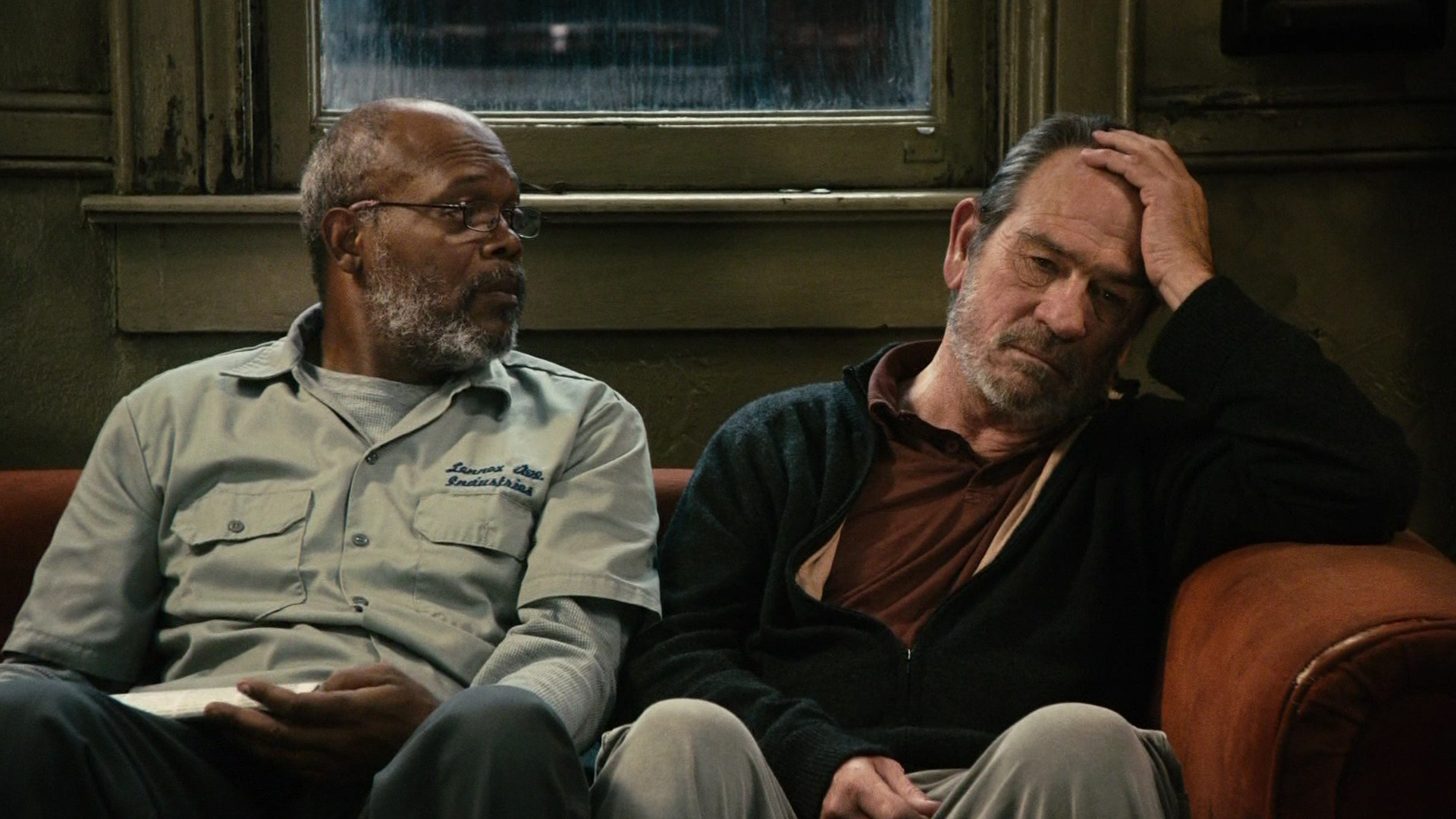
The Sunset Limited

The first attractive factor of The Sunset Limited is the fact that it's based on the screenplay written by Cormac McCarthy (who, if it isn't already evident from here, here, here, etc.), is one of my favorite authors); in other words, the whole movie is essentially a gamut of golden (like 24 carat) lines.

The second factor (and truly the only other one required to pull you in if the first factor wasn't tempting enough) is the fact that the movie stars Tommy Lee Jones (who is also the director) AND Samuel L. Jackson, aka AGENT K AND MACE WINDU, delegates from two nations on the map of my childhood (MIB and Star Wars)!!

I've never seen Mace Windu  Samuel L. Jackson more animated/passionated than he was in this film; neither have I seen Tommy Lee Jones looking so despondent (not even when Laura returns to Zartha).
Essentially, like all plays, The Sunset Limited's success depends on its screenplay and its actors'  performance; therefore, as the three people involved are Cormac McCarthy, Agent K and Mace Windu, the film didn't go very wrong.

The Sunset Limited opens with Black and White (I'm not being racist, those are really their names) sitting at a table, White looking depressed and Black consolatory. We learn that White planned on jumping in front a train, the Sunset Limited, and would have succeeded had Black not yanked him out of harm's way.

For the remainder of the night, the two dispute over many thing, at the core of which is the veracity of the Bible. Perhaps the most expedient way of understanding the film is to simply make the direct (albeit pithy) connection that the Sunset Limited = death, yet to White, death = more than just the Sunset Limited. In a line that will remain in my head forever, White claims that all despondent beings are merely "terminal commuters in a moral leper colony" and death is the  reprieve. Black disagrees, and attempts (with a slew of jailhouse stories) to waylay White's escape attempts and convert him. But White is resolute and acclimatized to sorrow. Ultimately, he is the one 'wins' the argument, leaving Black alone to wonder why the God he trusted did not arrive to settle the conflict. in his favor.


I don't regard my state of mind as some pessimistic view of the world. I regard it as the world itself. Evolution cannot avoidbringing intelligent life ultimately to an awareness of one thing, and one thing above all else. And that one thing is futility.
Show me a religion that prepares one for nothingness, for death. That's a church I might enter.Yours prepares one only for more life, for dreams and illusions and lies. Banish the fear of death from men's hearts...They wouldn't live a day. Who would want this nightmare but for fear of the next? The shadow of the axe hangs over every joy. Every road ends in death, every friendship, every love. Torment, loss, betrayal, pain, suffering, age, indignity, hideous lingering illness...and all of it with a single conclusion for you and every one and every thing you have ever chosen to care for. That is the true brotherhood, the true fellowship. And everybody is a member for life. You tell me that my brother is my salvation? My salvation? Well, then damn him. Damn him in every shape and guise and form. Do I see myself in him? Yes, I do. And what I see sickens me.

I want the dead to be dead - forever. And I want to be one of them. Except that of course you can't be one of them. You can't be one of the dead, because what has no existence can have no community.

White is not repudiating the antediluvian beliefs known to men, neither is he merely 'upset.' Cognizant that death is the terminus for everything on earth, the one for which we are not prepared for, perhaps he seeks death simply (ok, understatement) because the passage of life is a redundancy. To White, death is a nostrum for the "futility" of life. In Black's perspective, White's presentiment is a dark pessimism, but to White, it is the truth. Who is correct? As it is aptly stated on the film's epigram, "nothing is ever Black or White."


Ah, McCarthy gives one such substance to mull over.


Monday, December 31, 2012

Fate of whole galaxies against their imminent ruin

I finished The Orchard Keeper! I should have posted more quotes, but, um, I lost the sheet of paper that had all the important page numbers on it (which is totally the first time this has happened), so there's only one below. Anyway, this could be good, I don't want to be giving too much away anyway. There isn't much to give away, though. It may even help to know 50% of the plot before delving in (READ THAT BLURB), it will make your understanding miles easier. Plot isn't the big thing in this novel, but language and style is strongly established. Heaps of arcane words, fluid prose stuffed with complex vernacular, italics - McCarthy trademarks!
Tumblr_m6z59v7ui91r8kwlqo1_500_large
So, enjoy it for that!
The old man, clutching his cane, holding the dirty little sack between his knees, looked back at the dog still standing there like some atavistic symbol or brute herald of all questions ever pressed upon humanity and beyond understanding, until the dog raised his head to clear the folds above his milky eyes and set out behind them at a staggering trot.

Books, glorious books

With each passing set of 24 hours, 2012 is teetering to a halt, and the doors to 2013
are gradually creaking open. I created a goodreads account this year, and
participated in the 2012 reading challenge - I've read 40 books this year and have
decided to evaluate my favourites, as a commemoration to the power of literature.
So, here are the top 6 new books I've read this year...
Tumblr_mfgjhtyn961r0i9t4o1_500_large

1) The Crossing
Hello McCarthy! Truthfully, the entire Border Trilogy was wonderful, but The Crossing was my favourite because it was the longest (haha) and therefore contained the largest number of beautiful and inspirational passages. Click here to read the quotes I loved from it.

2) On the Road
I debated about this one, but it seems unfair to leave out Kerouac's masterpiece when it was the one book that I zipped through almost non-stop and thoroughly enjoyed this year. All the characters are mad, but madly in love with life, and the pulse of this book was so rigorously steady in its own crazy way that I finished it with fond memories. Plus, the movie seems fantastic. Click this to see my review of the book. 

3) Emma
My favourite Austen novel to date! At times, Emma reminded me of myself, and at other times, someone I'd love to sit down and seriously discuss life priorities and estimation issues with. I remember why I read Emma - I was sick of the depressing endings of books I was reading beforehand and made sure that Emma ended WELL, and also frankly missed Austen's eloquent (and romantic) writing style and female-themed novels. Boom, reviews here.

4) To Kill a Mockingbird
I remember reading the first few pages of this book 2 years back and finding it whoppingly difficult, but studied it this year for English class and seriously ended up LOVING it. The tone is so friendly, the parallels drawn genius, and theme deadly serious that this is a book that will impact any human that touches it. Here's my review.

5) Villette
My favourite Brontë novel, and more proof that Charlotte is the best Brontë (I have to stop saying this). The intricacy of her writing is sublime, and although the book was about a depressed (BUT INDEPENDENCE-STRIVING) woman, I enjoyed it immensely. The plot of the book was ingeniously planned, as well as the character development. The language was just stunning (allow me to reiterate). The book was a present from one of my best friends, and I love her for it (as well as other things)! Review here.

6) The Road
Last but definitely not least, THE ROAD was the book that opened the doors to the McCarthy-craze I've been going through for months now. I wept at the end of The Road (a book that makes you cry is a good book). The language, as I've rambled about enough, was so lovely. McCarthy's fluid style, the pulse of the words, the sound and rhythm of each syllable... Reading this book was hands-down one of the best decisions I made all year. Reviews here.

2012 was a fantastic and rewarding reading book for me. Hopefully 2013 will be even better!!

Tuesday, December 25, 2012

A barren spot, bright in the moonwash, mercurial and luminescent as a sea

I dropped The Orchard Keeper for about 3/4 days and picking up where I left off, I feel like I should be re-reading it completely... it took me about 78 pages in to finally grasp the fact that McCarthy's change of perspectives was inclusive of the animal kingdom... which of course complicates matters further... Oh, it's so confusing. The latter McCarthy books are definitely easier to understand. Just found out that the James Tait Black Prize went to Angela Carter instead of McCarthy... argh well.
F09b04922d_90539748_o2_large
Anyhow, here are the quotes I collected from my last read -
From a lightwire overhead, dangling head downward and hollowed to the weight of ashened feathers and fluted bones, a small owl hung in an attitude of forlorn exhortation, its wizened talons locked about the single strand of wire. It stared down from dark and empty sockets, penduluming softly in the bitter wind.
'hollowed to the weight,' 'fluted bowns,' 'forlorn exhortation, 'wizened talons' 'penduluming softly' ... only McCarthy, truly.
A warm wind on the mountain and the sky darkening, the clouds looping black underbellies until a huge ulcer folded out of the mass and a crack like the earth’s core rending rattled panes from Winkle Hollow to Bay’s Mountain. And the wind rising and gone colder until the trees bent as if borne forward on some violent acceleration of the earth’s turning and then that too ceased and with a clatter and hiss out of the still air a plague of ice.
This reminds me of the 'narrowing eye' quote from Cities of the Plains. The quote is an acid incision to the heart.
Inside they struck matches and Warn took a candlestub from a crevice and lit it, the calcined rock taking shape, tonsiled roof and flowing concavity, like something gone partly to liquid and frozen back again misshapen and awry, their shadows curling threatfully up the walls among the dried and mounded bat droppings. They studied the inscriptions etched in the soft and curdcolored stone, hearts and names, archaic dates, crudely erotic hieroglyphs--the bulbed phallus and strange centipedal vulva of small boys' imaginations.
Reading McCarthy definitely boosts my vocabulary by 12%.

Anyhow, I'm off to continue pursuing The Orchard Keeper, goodnight, all.

Monday, December 17, 2012

He was waiting and weathers and seasons were his timepiece now.

 2924589479_8cf3be60e5_o_large
For some time now the road had been deserted, white and scorching yet, though the sun was already reddening the western sky. He walked along slowly in the dust, stopping from time to time and bobbling on one foot like some squat ungainly bird while he examined the wad of tape coming through his shoe-sole. He turned again. Far down the blazing strip of concrete a small shapeless mass had emerged and was struggling toward him. It loomed steadily, weaving and grotesque like something seen through bad glass, gained briefly the form and solidity of a pickup truck, whipped past and receded into the same liquid shape by which it came.
Only McCarthy could begin a book so spectacularly. Beautiful.
Curled in a low peach limb the old man watched the midmorning sun blinding on the squat metal tank that topped the mountain. He had found some peaches, although the orchard went to ruin twenty years before when the fruit had come so thick and no one to pick it that at night the overborne branches cracking sounded in the valley like distant storms raging. The old man remembered it that way, for he was a lover of storms.
Peach, sun, mountain, storms... nature imagery and its interweaving with fluid, poetic prose, is McCarthy's forte. His writing reminds me of winter, and therefore winter always reminds me of good literature.
He fell asleep to the water and metal sounds of the rain runneling over the tin and sluicing through the gutterpipe, the rapid slash of it in a gust of wind and the fine mist spraying his face through the bellying screen. The oaks stirred restlessly, low admonitions, shhh...
The quote above is so Faulkner-esque (I promise that this will be the last time I draw the familiar, reiterated link between Faulkner and McCarthy), especially reminiscent of the raining scene in As I Lay Dying. I love it when good writers write about the rain. How good is the last sentence in this case? "The oaks stirred restlessly, low admonitions, shhh..."

The Orchard Keeper was a tad difficult to dive into, but now I'm 65 pages in and having a wonderful time.  

Friday, August 3, 2012

A dream inside a dream might not be a dream.

Last.... batch of quotes from the Border Trilogy. I really must be more concise with these next time... but these were truly lovely. Could not leave them.
Tumblr_m0030cudjw1qjkjfoo1_400_large

The man smiled at him a sly smile. As if they knew a secret between them, these two. Something of age and youth and their claims and the justice of those claims. And of their claims upon them. The world past, the world to come. Their common transciencies. Above all a knowing deep in the bone that beauty and loss are one.
His hands clasped behind him at the small of his back in a stance he had perhaps admired or read of but a stance native to some other country, not his.
“When you’re a kid you have these notions about how things are goin to be, Billy said. You get a little older and you pull back some on that. I think you just wind up tryin to minimize the pain. Anyway this country aint the same. Nor anything in it. The war changed everthing. I dont think people even know it yet.”
"Your friend is in the grip of an irrational passion. Nothing you say to him will matter. He has in his head a certain story. Of how things will be. In this story he will be happy. What is wrong with this story? 
What is wrong with this story is that it is not a true story. Men have in their minds a picture of how the world will be. How they will be in that world. The world may be many different ways for them but there is one world that will never be and that is the world they dream of. Do you believe that? “Maybe. Anyway, some men get what they want. No man. Or perhaps only briefly so as to lose it. Or perhaps only to prove to the dreamer that the world of his longing made real is no longer that world at all. ”
periodic click like a misset metronome, a clock, a protent. a meaure of something periodic and otherwise silent and vastly patient which only darkness could accommadate.
“The dead boy in his arms hung with his head back and those partly opened eyes beheld nothing at all out of that passing landscape of street or wall or paling sky or the figures of the children who stood blessing themselves in the gray light. This man and his burden passed on forever out of that nameless crossroads and the women stepped once more into the street and the children followed and all continued on to their appointed places which as some believe were chosen long ago even to the beginning of the world.”
He said that perhaps death took a larger view. That perhaps in his egalitarian way death weighed the gifts of men by their own lights and that in death's eyes the offerings of the poor were the equal of any. Like God.
Where do we go when we die? he said. I dont know, the man said. Where are we now?
In the middle of my life, he said, I drew the path of it upon a map and I studied it a long time. I tried to see the pattern that it made upon the earth because I thought that if I could see that pattern and identify the form of it then I would know better how to continue. I would know what my path must be. I would see into the future of my life. How did that work out? Different from what I expected. It was interesting. It looked like different things.
"When you look at the world is there a point in time when the seen becomes the remembered?"
“I know it. There's hard lessons in this world. What's the hardest? I dont know. Maybe it's just that when things are gone they're gone. They aint comin back. Yessir.”
“If we do not know ourselves in the waking world, what chance in dreams?”
He said that the light of the world was in men’s eyes only for the world itself moved in eternal darkness and darkness was its true nature and true condition and that in this darkness it turned with perfect cohesion in all its parts but that there was naught there to see. He said that the world was sentient to its core and secret and black beyond men’s imagining and that its nature did not reside in what could be seen or not seen. He said that he could stare down the sun and what use was that?

Wednesday, June 20, 2012

The room were a constant enigma to all things living in its vicinity.

It's been a while since my completion of The Crossing and Cities of the Plain so the quotes I post are a mixed jumble of both. Long overdue, but here:

547723_2258120710361_1039225424_n_large
The wolf sat watching with her ears forward and her nose making constant small correction in the air. As if to make acts of abetment to the life in the world.
The quote above is just pretty. How humans may wish we had that link with nature - but I'm sure we do.
The old man said that it was not a question of finding such a place but rather of knowing it when it presented itself. He said that it was at such places that God sits and conspires in the destruction of that which he has been at such pains to create.
Pains to create destruction... everything takes effort.
Men do not turn from God so easily. Not so easily. Deep in each man is the knowledge that something knows of his existence. Something knows, and cannot be fled nor hid from. To imagine otherwise is to imagine the unspeakable. It was never that this man ceased to believe in God. No. It was rather that he came to believe terrible things of him.
Love the one above. Speaks of losing faith - but in defense, beautifully as it is written, I suppose there are men who never believe in God, but yes to something that recognizes his existence.
“The wicked know that if the ill they do be of sufficient horror that men will not speak against it. That men have just enough stomach for small evils and only these will they oppose. He said that true evil has power to sober the smalldoer against his own deeds and in the contemplation of that evil he may even find the path of righteousness which has been foreign to his feet and may have no power but to go upon it. Even this man may be appalled at what is revealed to him and seek some order to stand against it. Yet in all of this there are two things which perhaps he will not know. He will not know that while the order which the righteous seek is never righteousness itself but is only order, the disorder of evil is in fact the thing itself. Nor will he know that while the righteous are hampered at every turn by their ignorance of evil to the evil all is plain, light and dark alike. This man of which we speak will seek to impose order and lineage upon things which rightly have none. He will call upon the world itself to testify as to the truth of what are in fact but his desires. In his final incarnation he may seek to indemnify his words with blood for by now he will have discovered that words pale and lose their savor while pain is always new.”
Okay, the last line is brilliant. but besides that, this is an important chunk of the book because what recurs lots in McCarthy's books is the theme of evil - what is it, how do we seek it, etc. And this chunk says much. That it is the disorder of evils which is the worst, because all evil is plain. It's hard to digest but reading the book overall helps so go read it.
“If a dream can tell the future it can also thwart that future. for God will not permit that we shall know what is to come. He is bound to no one that the world unfold just so upon its course and those who by some sorcery or or by some dream might come to pierce the veil that lies so darkly over all that is before them may serve bu just that vision that God should wrench the world from its heading and set it upon another course altogether and then where stands the sorcerer? Where the dreamer and his dream?”
Dreams ... how we imagine life to turn out and how much it doesn't. So if we think what we imagine 10 years from now will be like, the dream could easily warp that interpretation.
When he struck the road he turned south toward the town riding slowly. The howling of the dogs receded behind him. A half moon hung cocked in the east over the mountains like an eye narrowed in anger.
Okay the quote above is just striking. Last sentence is like a cut on the palm, not enough to kill you but a real good sting to earn you an infection or something. I can see that  eye and I can feel the anger. Love it.
The events of the world can have no separate life from the world. And yet the world itself can have no temporal view of things. It can have no cause to favor certain enterprises over others. The passing of armies and the passing of sands in the desert are one. There is no favoring, you see. How could there be? At whose behest? This man did not cease to believe in God. Nor did he come to have some modern view of God. There was God and there was the world. He knew that the world would forget him but that God could not. And yet that was the very thing he wished for.
A quote basically saying... why do you expect your life to turn out wonderful? Do you expect God's favouring? Because it ain't there.
“She said that her grandmother was skeptical of many things in this world and of none more than men. She said that in every trade save war men of talent and vigor prosper. In war they die. Her grandmother spoke to her often of men and she spoke with great earnestness and she said that rash men were a great temptation to women and this was simply a misfortune like others and there was little that could be done to remedy it. She said that to be a woman was to live a life of difficulty and heartbreak and those who said otherwise simply had no wish to face the facts. And she said that since this was so nor could it be altered one was better to follow one’s heart in joy and in misery than simply to seek comfort for there was none. To seek it was only to welcome in the misery and to know little else. She said that these were things all women knew yet seldom spoke of. Lastly she said that if women were drawn to rash men it was only that in their secret hearts they knew that a man who would not kill for them was of no use at all.”
This quote is read only for the last line. Rash men. Not so good for marriage, but a fun quote nonetheless.
“a bad map is worse than no map at all for it engendered in the traveler a false confidence and might easily cause him to set aside these instincts which would otherwise guide him if he would but place himself in their care. He said that to follow a false map was to invite disaster. He gestured at the sketching in the dirt. As if to invite them to behold its futility. The second man on the bench nodded his agreement in this and said that the map in question was a folly and that the dogs in the street would piss upon it.”
And what is this false map? The idea that God favours all, the idea that the dream must be able to tell the future... life is so tricky and sometimes I say to myself "well here's a new lesson learned, after all this is your first time living" and I wonder how things will turn out. Love the last line about the dogs pissing.
“Snowflake. You catch the snowflake but when you look in your hand you don’t have it no more. Maybe you see this dechado. But before you see it it is gone. If you want to see it you have to see it on its own ground. If you catch it you lose it. And where it goes there is no coming back from. Not even God can bring it back.”
Metaphor of the lovely past, of time, of everything lost and gone. Lovely.
“Men speak of blind destiny, a thing without scheme or purpose. But what sort of destiny is that? Each act in this world from which there can be no turning back has before it another, and it another yet. In a vast and endless net. Men imagine that the choices before them are theirs to make. But we are free to act only upon what is given. Choice is lost in the maze of generations and each act in that maze is itself an enslavement for it voids every alternative and binds one ever more tightly into the constraints that make a life. If the dead man could have forgiven his enemy for whatever wrong was done to him all would have been otherwise. Did the son set out to avenge his father? Did the dead man sacrifice his son? Our plans are predicated upon a future unknown to us. The world takes its form hourly by a weighing of things at hand, and while we may seek to puzzle out that form we have no way to do so. We have only God's law, and the wisdom to follow it if we will.”
What is God's law? The fact that all must die and the time before that is all time that exists? The first sentence is something that Ayn may nod to. What's a predicted destiny? How could it ever form? I do think we are free to make our own choices, but yes it's true that we can only act upon 'what is given.' Is that much of a choice there then? I reckon it still is.
“He said that whether a man's life was writ in a book someplace or whether it took its form day by day was one and the same for it had but one reality and that was the living of it.”
So poetic. True, too.
“The names of the cerros and the sierras and the deserts exist only on maps. We name them that we do not lose our way. Yet it was because the way was lost to us already that we have made those names. The world cannot be lost. We are the ones. And it is because these names and these coordinates are our own naming that they cannot save us. They cannot find for us the way again.”
This is near the end of the book and zing, right perfectly there. All our road signs, shop labels - we put them there to help us find our way but they are only there because the way has been lost. Yet, I do think the context should not be looked at this bleakly. The same could be said about this paradox that the existence of these maps can help us.
If people knew the story of their lives how many would then elect to live them? People speak about what is in store. But there is nothing in store. The day is made of what has come before. The world itself must be surprised at the shape of that which appears. Perhaps even God.
LOVE THIS - McCarthy said something similar in The Road about how people prepped for tomorrow when tomorrow may not even arrive. What is in store? What do those maps propose to show? Nothing at all - how can it. Yet we have no choice but to follow because it is"what is given to us."
“Nor does God whisper through the trees. His voice is not to be mistaken. When men hear it they fall to their knees and their souls are riven and they cry out to Him and there is no fear but only wildness of heart that springs from such longing...”
Reference to the quote before - longing that there is something in store, some safety.
“There is but one world and everything that is imaginable is necessary to it. For this world also which seems to us a thing of stone and flower and blood is not a thing at all but is a tale. And all in it is a tale and each tale the sum of all lesser tales and yet these are also the selfsame tale and contain as well all else within them. So everything is necessary. Every least thing. This is the hard lesson. Nothing can be dispensed with. Nothing despised. Because the seams are hid from us, you see. The joinery. The way in which the world is made. We have no way to know what could be taken away. What omitted. We have no way to tell what might stand and what might fall. And those seams that are hid from us are of course in the tale itself and the tale has no abode or place of beind except in the telling only and there it lives and makes its home and therefore we can never be done with the telling. Of the telling there is no end. And . . . in whatever . . . place by whatever . . . name or by no name at all . . . all tales are one. Rightly heard all tales are one.”
I think the quote above suggests the perpetual quality of consciousness in all beings ("sum of all ... tales) - "of the telling there is no end" - and the stories their lives create. And the "hidden...joinery" of it all. Our limited knowledge of "what can be taken away." So,  I rather like it.
He took up her stiff head out of the leaves and held it or he reached to hold what cannot be held, what already ran among the mountains at once terrible and of great beauty, like flowers that feed on flesh. What blood and bone are made of but can themselves not make on any altar nor by any wound of war. What we may well believe has power to cut and shape and hollow out the dark form of the world surely if wind can, if rain can. But which cannot be held never be held and is no flower but is swift and a huntress and the wind itself is in terror of it and the world cannot lose it.”
I think the quote above speaks of the spirit's dominance over "blood and bone" because it is something the world cannot lose and "cannot be held." 
“He told the boy that although he was huérfano still he must cease his wanderings and make for himself some place in the world because to wander in this way would become for him a passion and by this passion he would become estranged from men and so ultimately from himself. He said that the world could only be known as it existed in men's hearts. For while it seemed a place which contained men it was in reality a place contained within them and therefore to know it one must look there and come to know those hearts and to do this one must live with men and not simply pass among them. He said that while the huérfano might feel that he no longer belonged among men he must set this feeling aside for he contained within him a largeness of spirit which men could see and that men would wish to know him and that the world would need him even as he needed the world for they were one. Lastly he said that while this itself was a good thing like all good things it was also a danger. 
Quote above spoken about a blind man, I think. I like the last bit, and the part about looking into our hearts because that is the only why "the world could only be known it existed." Consciousness yet again!
“Such a man is like a dreamer who wakes from a dream of grief to a greater sorrow yet. All that he loves is now become a torment to him. The pin has been pulled from the axis of the universe. Whatever one takes one's eye from threatens to flee away. Such a man is lost to us. He moves and speaks. But he is himself less than the merest shadow among all that he beholds. There is no picture of him possible. The smallest mark upon the page exaggerates his presence.”
“It was the nature of his profession that his experience with death should be greater than for most and he said that while it was true that time heals bereavement it does so only at the cost of the slow extinction of those loved ones from the heart's memory which is the sole place of their abode then or now. Faces fade, voices dim. Seize them back, whispered the sepulturero. Speak with them. Call their names. Do this and do not let sorrow die for it is the sweetening of every gift.”
Two quotes above are on sorrow. Why is sorrow the "sweetening of every gift?" Reminds one of their own hearts? Consciousness? Because time "heals bereavement," a man that does not "let sorrow die" will not wake to a "greater sorrow yet?" We can't let all we love become a "torment." So maybe the presence of sorrow and its healing is in the end a comfort because the "extinction of those loved ones from the heart's memory" could be a good thing. I like this quote.
“It had ceased raining in the night and he walked out on the road and called for the dog. He called and called. Standing in that inexplicable darkness. Where there was no sound anywhere save only the wind. After a while he sat in the road. He took off his hat and placed it on the tarmac before him and he bowed his head and held his face in his hands and wept. He sat there for a long time and after a while the east did gray and after a while the right and godmade sun did rise, once again, for all and without distinction.”
Quote above is lovely. There is always a waking day, until death, "for all and without distinction." And it's a nice paragraph in the book, too. Go read it! 

Saturday, May 12, 2012

Take care with whom you break bread

Last batch of All The Pretty Horses. The very best part of the book is the senorita's speech. Stick around for that.

Poverty leads to a man's judging of readiness to kill for the money.
Underpinning all of it like the fiscal standard in commercial societies lay a bedrock of depravity and violence where in an egalitarian absolute every man was judged by a single standard and that was his readiness to kill.
Definitely quoting this in the future. Just spit out that poison.
My daddy used to tell me not to chew on something that was eatin you.
LOVE it: a person of value must not run from misfortune, despite anything. This quality must be a "form of constancy." Anyone who abandons first becomes a coward, and abandoning this value makes anything else redundant.
I wanted very much to be a person of value and I had to ask myself how this could be possible if there were not something like a soul or like a spirit that is in the life of a person and which could endure any misfortune or disfigurement and yet be no less for it. If one were to be a person of value that value could not be a condition subject to hazards of fortune. It had to be a quality that could not change. No matter what. Long before morning I knew that what I was seeking to discover was a thing I'd always known. That all courage was a form of constancy. That it was always himself that the coward abandoned first. After this all other betrayals came easily.
Tumblr_m2vffjhws21qj8dtyo1_500_large
Speaks to my childhood:
It was good that God kept the truths of life from the young as they were starting out or else they'd have no heart to start at all.
Like a blank of mind:
...and for a moment he held out his hands as if to steady himself or as if to bless the ground there or perhaps as if to slow the world that was rushing away and seemed to care nothing for the old or the young or rich or poor or dark or pale or he or she. Nothing for their struggles, nothing for their names. Nothing for the living or the dead.
Nice:
Blood's blood. It dont know where it come from.
Good 'slogan.' Sacred money = religious money? Money that doesn't exist? Money with fate predetermined by God? Most thought-provoking bit of the quote. A worried man can't love... reminds me of Woolf's "One cannot think well, love well, sleep well, if one has not dined well."
Scared money can’t win and a worried man can’t love.
Eternity of life before its end and the evil of it:
He saw very clearly how all his life led only to this moment and all after led to nowhere at all. He felt something cold and soulless enter him like another being and he imagined that it smiled malignly and he had no reason to believe that it would ever leave.
This is just a beautiful quote, no analysis needed, really. It's lovely.
She looked up at him and her face was pale and austere in the uplight and her eyes lost in their darkly shadowed hollows save only for the glint of them and he could see her throat move in the light and he saw in her face and in her figure something he'd not seen before and the name of that thing was sorrow.
A refusal to choose a destiny does not mean the fates will not.
The world is quite ruthless in selecting between the dream and the reality, even where we will not.
Last quote... what shape in lives? What pattern after fact? The repetition of history, of failure? Do we see its forming from birth? Or does it develop from all our dumb choices? If it isn't set out before us, how do we walk that path? If there is no shape at all are we even something? We are not.
Otherwise, we are nothing.
Because the question for me was always whether that shape we see in our lives was there from the beginning or whether these random events are only called a pattern after the fact. Because otherwise we are nothing.

Dying aint in people's plans, is it?

More quotes:

Horses and men in All The Pretty Horses: not only understanding the horse when going to war, but understanding war and man itself.
the souls of horses mirror the souls of men more closely than men suppose and that horses also love war. Men say they only learn this but he said that no creature can learn that which his heart has no shape to hold. His own father said that no man who has not gone to war horseback can ever truly understand the horse and he said that he supposed he wished that this were not so but that it was so.
 Everything leads to something.
Ever dumb thing I ever done in my life there was a decision I made before that got me into it. It was never the dumb thing. It was always some choice I'd made before it.
 The recovery from grief, the strength it may give:
Those who have endured some misfortune will always be set apart but that it is just that misfortune which is their gift and which is their strength and that they must make their way back into the common enterprise of man for without they do so it cannot go forward and they themselves will wither in bitterness.
 This is lovely... world is so beautiful so he wishes his heart were stone to feel less of its beauty because you "dont know what's going to happen" and what point is the beauty of the earth when there's "wars and ruination and hell." Like a breath, "trembling and brief." You do never know what's going to happen.
Way the world is. Somebody can wake up and sneeze somewhere in Arkansas or some damn place and before you're done there's wars and ruination and all hell. You dont know what's goin to happen. I'd say He's just about got to. I dont believe we'd make it a day otherwise listening to the water drip in the woods. Bedrock, this. The cold and the silence. The ashes of the late world carried on the bleak and temporal winds to and fro in the void. Carried forth and scattered and carried forth again. Everything uncoupled from its shoring. Unsupported in the ashen air. Sustained by a breath, trembling and brief. If only my heart were stone.
A pretty paragraph: the warming of a body.
By midmorning eight of the horses stood tied and the other eight were wilder than deer, scattering along the fence and bunching and running in a rising sea of dust as the day warmed, coming to reckon slowly with the remorselessness of this rendering of their fluid and collective selves into that condition of separate and helpless paralysis which seemed to be among them like a creeping plague.
Loved this in the book. The two quotes show man's purposefulness over a horse, man as "some god come to inhabit them" but man is not the god, the spirit of a horse's journey is.
My old daddy always said that the purpose of breakin a horse was to ride it and if you got one to break you just as well to saddle up and climb aboard and get on with it.
They looked like animals trussed up by children for fun and they stood waiting for they knew not what with the voice of the breaker still running in their brains like the voice of some god come to inhabit them.
SUCH a beautiful quotes below, especially in the book when I read it... truly shows the love for horses. Their independence, their durable heart and their courage needs no heaven, and such a majestic creature would never be removed from the earth.
Finally he said that among men there was no such communion as among horses and the notion that men can be understood at all was probably an illusion. Rawlins asked him in his bad Spanish if there was a heaven for horses but he shook his head and said that a horse had no need of heaven. Finally John Grady asked him if it were not true that should all horses vanish from the face of the earth the soul of the horse would not also perish for there would be nothing out of which to replenish it but the old man only said that it was pointless to speak of there being no horses in the world for God would not permit such a thing. 
"...and in his sleep he dreamt of horses and the horses in his dream moved gravely among the tilted stones like horses come upon an antique site where some ordering of the world had failed and if anything had been written on the stones the weathers had taken it away again and the horses were wary and moved with great circumspection carrying in their blood as they did the recollection of this and other places where horses once had been and would be again. Finally what he saw in his dream was that the order in the horse's heart was more durable for it was written in a place where no rain could erase it.
An Ayn Rand thing to say? Below:
If she does not come to value what is true above what is useful it will make little difference whether she lives at all.
To not be blamed:
If fate is the law then is fate also subject to that law? At some point we cannot escape naming responsibility. It's in our nature.
Palpable power of the planet:
The fire had burned to coals and he lay looking up at the stars in their places and the hot belt of matter that ran the chord of the dark vault overhead and he put his hands on the ground at either side of him and pressed them against the earth and in that coldly burning canopy of black he slowly turned dead center to the world, all of it taut and trembling and moving enormous and alive under his hands.
Weakness should not affect authority:
The names of the entities that have power to constrain us change with time. Convention and authority are replaced by infirmity. But my attitude toward them has not changed.
Just love this:
Scars have the strange power to remind us that our past is real.
Un idée français? Why won't reason improve a character? Does reason only stimulate more wariness?
People of my generation are more cautious. I think we don’t believe that people can be improved in their character by reason. That seems a very french idea.
Pain for the old was no longer a surprise.
Underpinning all of it like the fiscal standard in commercial societies lay a bedrock of depravity and violence where in an egalitarian absolute every man was judged by a single standard and that was his readiness to kill.
Take care with whom you break bread.
My daddy used to tell me not to chew on something that was eatin you.
Waiting for your toil:
Between the wish and the thing the world lies waiting.

As if the rain were electric, had grounded circuits that the electric might be

Tumblr_m1z5z8hka51qlccb8o1_1280_large

Quotes from All The Pretty Horses, continued:

Firstly, I love this quote, for an obvious reasons.

The comparison - mice and humans. Experiments and reality. Clever point made beautifully. He is right, of course: there is no "might have been" and reality is the only absolute. Knowing is scrap because "green and foolishness and a love of blood" cannot escape a man and has never escaped a man.
When I was in school I studied biology. I learned that in making their experiments scientists will take some group--bacteria, mice, people--and subject that group to certain conditions. They compare the results with a second group which has not been disturbed. This second group is called the control group. It is the control group which enables the scientist gauge the effect of his experiment. To judge the significance of what has occurred. In history there are no control groups. There is no one to tell us what might have been. We weep over the might have been, but there is no might have been. There never was. It is supposed to be true that those who do not know history are condemned to repeat it. I don't believe knowing can save us. What is constant in history is greed and foolishness and a love of blood and this is a thing that even God--who knows all that can be known--seems powerless to change.
Sort of sad to acknowledge the quote below but I've seen it to be true.
The closest bonds we will ever know are bonds of grief. The deepest community one of sorrow.
The two quotes below speaks to me, it is what has been expected of me, and why? I used think so too, yet I think empathy can never reach out to somehow who attempts to create a bond of grief as compensation.
I'd of thought maybe the disappointments of your own life might of made you more sympathetic to other people.
You would have thought wrongly. I guess so. It is not my experience that life's difficulties make people more charitable. I guess it depends on the people.
True: death cures all.
Those whom life does not cure death will . . . In the end we all come to be cured of our sentiments.
 This is beautiful... all the trouble of the world to produce a flower? All unity?
He thought that in the beauty of the world were hid a secret. He thought that the world’s heart beat at some terrible cost and that the world’s pain and its beauty moved in a relationship of diverging equity and that in this headlong deficit the blood of multitudes might ultimately be exacted for the vision of a single flower.
And last but not least... this is witty:
The trouble with a liar is he cant remember what he said.

Saturday, May 5, 2012

All the Pretty horses

I finished All the Pretty Horses, and I LOVE IT and I've collected a swarm of quotes that I've decided to upload in batches whilst reading The Crossing which is also stunning. I've finished Part 1 already.

So, here's how the procedure should progress in terms of writing a review of ATPH and updates for The Crossing; they are going to overlap. Here's the official in retrospect review for ATPH:

If William Faulkner and Toni Morrison had a love child, he'd go by the name of Cormac McCarthy. He executes a similar style; writes of harsh truths, a loss of innocence, wry dialogue... yet McCarthy whips in his own input into these qualities. There is something about his writing, that despite however the story may end, one does not aspire only to curl up in a blanket and weep, but more strongly so a push to seize a horse (or wolf) and gallop away to the mountains, to the acacia, the lake, the moon...

That is precisely what ATPH succeeds to do. It tells the story of a boy, John Grady Cole, who runs away from home in hopes of finding himself and the country, and he soon winds up in Mexico. John and his friend Lacey find work as cowboys. They also encounter a curious young man: Blevins, who brings them a fair amount of trouble later, yet later showcases a deeper -- or more necessary -- understanding under his layer of juniority. John meets Alejandra and this is where the fiery romance starts, unlike all his previous works. However, before their match can succeed, John is taken to an entirely new country... only after all his experiences does he eventually comprehend that one does not really know a country until one's down there in it.

It is this revelation that makes it such a beautiful book to me despite the evils in it. Also, it does begin and end in a similar way, wrapping the story up nicely and reminding us of where John began.

Apparently, Marcus Mumford loved it too! He rambled about it on his book blog here.

The title of the book most likely comes from this familiar lullaby (an extract below):

Hush-a-bye, don't you cry, 
Go to sleepy little baby. 
When you wake, you shall have, 
All the pretty little ponies. 
Blacks and bays, dapples and greys, 
Daddy's boy Mama's joy 
Go to Slumberland my baby 
When you wake, you shall have, 
All the pretty little ponies. 
Hush your cries 
Close your eyes 
Dream of pretty little ponies 
Darkness falls and man calls 

Oddly seems to be referencing death and the heaven that awaits; given the love for horses shown in the book, I see how McCarthy may have transformed this childhood lullaby into a harsher concept: proof that his book is, after all, a bildungsroman.

The quotes I shall later upload will explore the themes he wanted to portray. This is a strongly recommended read.

Monday, April 30, 2012

A thing all but inexplicable in that landscape.

Can't stop watching Fringe. Here's a bucket of quotes thrown at you from All The Pretty Horses. It's lovely... lots of Spanish and cussing in it but a true cowboy tale. Fun. I find that the prose style is almost just like The Road -- you don't see speech marks, ever (so Faulkner) and McCarthy's got plentiful 'tree terminology' as  I like to coin it (didn't have half a clue what a nopal was before reading McCarthy, and seeing as Chrome underlines it in red, squiggly lines, it's not too familiar to the educated society either). Reading this makes me miss horse riding. Powerful animals, they are.

aisteach:

flowers by reinvented reality on Flickr.
What he loved in horses was what he loved in men, the blood and the heat of the blood that ran them. All his reverence and all his fondness and all the leanings of his life were for the ardenthearted and they would always be so and never be otherwise.
The boy who rode on slightly before him sat a horse not only as if he’d been born to it which he was but as if were he begot by malice or mischance into some queer land where horses never were he would have found them anyway. Would have known that there was something missing for the world to be right or he right in it and would have set forth to wander wherever it was needed for as long as it took until he came upon one and he would have known that that was what he sought and it would have been.
Love the quote above, true determination and valor.
They rode out on the high prairie where they slowed the horses to a walk and the stars swarmed around them out of the blackness. They heard somewhere in that tenantless night a bell that tolled and ceased where no bell was and they rode out on the round dais of the earth which alone was dark and no light to it and which carried their figures and bore them up into the swarming stars so that they rode not under but among them and they rode at once jaunty and circumspect, like thieves newly loosed in that dark electric, like young thieves in a glowing orchard, loosely jacketed against the cold and ten thousand worlds for the choosing.
I can feel the darkness described above.
They were drowned, shot, kicked by horses. They perished in fires. They seemed to fear only dying in bed.
The Good Book says that the meek shall inherit the earth and I expect that's probably the truth. I aint no freethinker, but I'll tell you what. I'm a long way from bein convinced that it's all that good a thing.
Ayn Rand could fully support the quote above, ha!
They pulled the wet saddles off the horses and hobbled them and walked off in separate directions through the chaparral to stand spraddle legged clutching their knees and vomiting. The browsing horses jerked their heads up. It was no sound they’d ever heard before. In the grey twilight those retchings seemed to echo like the calls of some rude provisional species loosed upon that waste. A thing smirking deep in the eyes of grace itself like a gorgon in an autumn pool.
Quote above: disgust at fellow dirty humans... horses feel it too!
“You ever get ill at ease? said Rawlins. About what? I dont know. About anything. Just ill at ease. Sometimes. If you're someplace you aint supposed to be I guess you'd be ill at ease. Should be anyways. Well suppose you were ill at ease and didnt know why. Would that mean that you might be someplace you wasnt supposed to be and didnt know it?
Shrouded in the black thunderheads the distant lightning glowed mutely like welding seen through foundry smoke. As if repairs were under way at some flawed place in the iron dark of the world.
...nation and ghost of nation passing in a soft chorale across that mineral waste to darkness bearing lost to all history and all remembrance like a grail the sum of their secular and transitory and violent lives.
Absolutely love the one above.

Friday, April 27, 2012

Those matters will take care of themselves; the young people will find a way

I've finished Emma! I can truthfully say I've loved it. It is probably my favourite Jane Austen novel to date (the one I've understood clearest, admittedly). I love Emma, despite her bossiness. "I wonder what will become of her," her friends said, and I'm delighted with the way the book ended. A well deserved 381 page break from The Road! Speaking of The Road, after Emma I'll be swiftly moving on -- or should I say  back -- to Cormac McCarthy again... so I'll be saying farewell to posh England and witty women who through parties all day long and eventually end up married, and a hello to a familiar desolate American and blood and guts.

Better start planning my recovery book after McCarthy -- I wouldn't mind reading another Austen but I think I'll save that for next year... an Austen per year, that sounds about right!

Tumblr_m354ssnqfo1rpt2juo1_500_large

Below are just two lovely quotes I'd read from the remainder for the book, from where I'd last dropped off. Usually there would be more, but I suppose I'd been
It was a clear thing he was less in love than he had been. Absence, with the conviction probably of her indifference, had produced this very natural and very desirable effect.
It may be possible to do without dancing entirely. Instances have been known of young people passing many, many months successively, without being at any ball of any description, and no material injury accrue either to body or mind;—but when a beginning is made—when the felicities of rapid motion have once been, though slightly, felt—it must be a very heavy set that does not ask for more.
Well, the next book I shall read is entitled All The Pretty Horses and is part of The Border Trilogy, which is nice because I've been intending (rather subconsciously, I discover) to begin reading a trilogy, or a sequence of books, lat least.

Below is another cute Star Wars picture (just for fun):