Showing posts with label american literature. Show all posts

Tuesday, August 2, 2016

The whole world was this symphony, and there was not enough of her to listen

The Heart Is a Lonely Hunter  The Heart Is a Lonely Hunter by Carson McCullers
My rating: 4 of 5 stars

Carson McCullers's The Heart Is A Lonely Hunter is a tragedy told through the lives of five main characters who are ultimately unable to overcome the condition that afflicts them all, loneliness, in a Southern town polluted with racial inequality, poverty, and the disseminating promises of the American Dream.

Without spoiling too much...
Biff Brannon, who runs the café that is the main setting of the novel, struggles with not only defining the nature of his feelings for young Mick Kelly after he becomes a widow, but also his own gender and sexuality. Mick, who is the novel's protagonist and dreams of becoming a conductor one day, must pursue her ambitions alone in the aftermath of a turbulent adolescence and lost friendship. Dr. Copeland is too intellectual for his own good and is unable to rally allies who can understand his views on civil rights, while Jake Boult's plans for violent revolt destine him for isolation. Even John Singer, the deaf-mute who is a "home-made God" to characters like Jake and Mick, cannot escape loneliness. Despite the frequent visits that others pay him, Singer remains lonely due to his separation from his long-time and dangerously obese friend, Antonapoulos, for whom he never ceases to feel an intense (and absurdly deferential) attachment. All these characters, who differ in race and status, are linked in more ways than it may appear at first glance .

Indeed, some kind of disability also afflicts them all. Apart from the fact that a blind/deaf/mute character is always bound to be symbolic, the ideal of disadvantage is particularly important to this novel, which focuses on characters that are unfavored due to reasons that range from class to skin color. Singer and Antonapoulos are both deaf, Biff has "a special friendly feeling for sick people and cripples," Blount gave people the impression that "something was deformed about him," and even the seemingly picture-perfect Baby does not make it out of the novel unscathed (her fate is a harsh reminder that her mother's dream for her child to be in the movies is but a fantasy).

Reading the novel, I was fascinated by the way characters depend on Singer through divulging their feelings to him and considering his stoic silence an anchor of security. Somehow, through his soundless responses, Singer becomes whatever people want him to be (which makes his 'real' life all the more intriguing by comparison, for he himself is ironically and disastrously dependent on Antonapoulos). McCullers captures the core of the desperation in such dependence best as she writes,
"Maybe when people longed for a thing that bad the longing made them trust in anything that might give it to them.” 
"... in some men it is in them to give up everything personal at some time, before it ferments and poisons--throw it to some human being or some human idea."
And such longing/relinquishment of everything personal highlights the need for escape and self-validation in an era and environment of helplessness.

Terrible deaths happen in this novel due to illness, murder, and suicide; love is often unreciprocated; mutual understanding is cripplingly difficult. Perhaps Mick's ending can be interpreted as hopeful as she still aims to pursue music, but I was definitely struck by a sense of defeat at the end of the novel. It's the kind of book I think I would teach in a classroom - there's so much in it that is worth writing about.

I'm utterly blown away that Carson McCullers published this novel when she was only 23; with its complex characters and intricate structure (fun fact: the book was split into three parts to imitate a fugue), The Heart is a Lonely Hunter is a work that lives up to its name.


View all my reviews

Thursday, September 3, 2015

The way of the world is to bloom and to flower and die but in the affairs of men there is no waning and the noon of his expression signals the onset of night. His spirit is exhausted at the peak of its achievement. His meridian is at once his darkening and the evening of his day.”

Blood Meridian, or the Evening Redness in the WestBlood Meridian, or the Evening Redness in the West by Cormac McCarthy
My rating: 4 of 5 stars

Cormac McCarthy has been one of my favourite authors ever since I read All The Pretty Horses back in 2012 (I read The Road first, but it was The Border Trilogy that won me over). So, after having buzzed through four McCarthy books in under half a year, I decided that - in order to preserve/lengthen the magic of reading the rest of his oeuvre - I would have to establish a "Cormac McCarthy Reading Plan" and pace myself with his novels in order to always have some new McCarthy to return to whenever I need the bare honesty, dark beauty and astonishing landscapes he delivers with such stark detail.  According to my CMRP, the summer before college would be reserved for reading Blood Meridian, so that I'd have plenty of time to digest it (or recover from it in case of nightmares). And that's just what I've done! I finished Blood Meridian two days ago and it's been haunting me since. (warning: it is not for the faint of heart).

The novel is a bildungsroman, but the most violent one that McCarthy has written yet. It takes place in the brutal Wild West, during the mid-1800s, a time when savage "scalp hunters" would murder Indians along the Mexican and American border and then - quite literally - collect their scalps as evidence of the massacre. Our protagonist, "the kid," runs away from home at 14 to become "a solitary migrant" and a worker in a diptheria pesthouse before finally ending up with the scalp-hunting "Glanton Gang" - led by none other than the enigmatic and terrifying Judge Holden.

The judge, who is "close on to seven feet in height," "bald as a stone," adept at coin tricks and exceptionally knowledgeable about geography/history/science, belongs on an inaccessible tier. As he says, "Whatever in creation exists without my knowledge exists without my consent.” Yet it is only at the end, when he is dancing, young as ever, vowing that "he never sleeps" and saying "he'll never die," that readers believe he may be supernatural. And perhaps it is true that only a demon could have done the things he did - doom the innocent (even a preacher!), commit brutal murders, abduct children. At one point in the novel, the kid asks this about the judge: "judge of what?" For this is a 'judge' that does not subscribe to standard, legal laws, but rather believes in bloodshed through war:
“This is the nature of war, whose stake is at once the game and the authority and the justification. Seen so, war is the truest form of divination. It is the testing of one's will and the will of another within that larger will which because it binds them is therefore forced to select. War is the ultimate game because war is at last a forcing of the unity of existence.War is god.”
“War was always here. Before man was, war waited for him. The ultimate trade awaiting its ultimate practitioner.”
Such an acceptance of war echoes the 'normalcy' with which the horrors of the novel are portrayed. The following sentence, for example, is delivered so casually despite all its terrifying implications: “They passed through small villages doffing their hats to folk whom they would murder before the month was out." Moreover, McCarthy describes the Glanton Gang parading through a town with human heads on splinters while their arrival is celebrated by a "fantasy of music and flowers" (amazing juxtaposition). Even more chilling is how the children, accustomed to this culture of violence, eat "pastry skulls" at the parade while the judge tries to tempt them with his pockets full of "little candy deathsheads"(CHILLLLSSSS).

The language of the book itself accounts for much of its appeal. And I don't just mean McCarthy's delightful use of arcane plant terminology ("golden grounsel and zinnia"), but also the form of the prose itself. In the opening chapter, for example, the unforgettable and monosyllabic opening words introduce us to the kid: "See the child. He is pale and thin, he wears a thin and ragged linen shirt." Blunt, stark and brilliant. As with his other novels, McCarthy also beautifully weaves the darkness of the times with the landscape his characters trespass:  "in the long red sunsets the sheets of water on the plain below them lay like tidepools of primal blood." They pass the "blackened bones of trees." Amazing.

As mentioned earlier, Blood Meridian is a bildungsroman. At the beginning, "the child's face is curiously untouched behind the scars, the eyes oddly innocent," but he is shot below the heart on page two and then "finally divested of all that he has been." There is a poignant moment near the end of the book where the kid sees an old woman bent over in the desert, speaks to her for a long time, tells her that "he would convey her to a safe place," but then realizes that she had been "dead in that place for years" and is nothing but "a dried shell." The hopelessness of the place hits home right there.

"The kid" is not a child for long, even though he is called "the kid" until the end of the novel. Indeed, despite all the fighting he engages in, he never reaches the level of violence that the men around him do. He cannot shoot the judge and he cannot leave the ex-priest to die (by the way, this is the ~2nd ex-priest I have come across in McCarthy's works. Brilliant symbol of loss of faith.)  The judge even says that he loves the kid "like a son."

So that brings us to the end of the novel, where "the kid" becomes "a man." The ending is terrifying. And, given all that the judge is capable of doing to children and men, I am going with the worst-case scenario regarding the kid's fate. The judge "gathered him in his arms against his immense and terrible flesh.” That carnal imagery suggests at much, although we never know what truly happens to him, except that whoever sees him at the end can only comment, "good god almighty."

Blood Meridian is stunning, especially as so much of it is historically backed (scalp hunting, the Glanton gang, even Judge Holden himself). Reading it was like living in a trance - in some chapters, nothing seems to be happening except moving through barren terrain (thankfully, the synoptic chapter headings help one keep track of the plot). I think this is the main shortcoming of the novel. In other chapters, evil is described so explicitly, you don't want to believe what you read (I swore outloud so many times while reading this book).

But regardless of how shocking and horrifying the story becomes, McCarthy's magic never diminishes - the sheer beauty of his prose, his ability to etch out bygone landscapes with stunning believability. Blood Meridian is a book that will leave you speechless, restless and astounded.
Rumor has it that McCarthy's The Passenger may be out next year. Yes!!!
“The truth about the world, he said, is that anything is possible. Had you not seen it all from birth and thereby bled it of its strangeness it would appear to you for what it is, a hat trick in a medicine show, a fevered dream, a trance bepopulate with chimeras having neither analogue nor precedent, an itinerant carnival, a migratory tentshow whose ultimate destination after many a pitch in many a mudded field is unspeakable and calamitous beyond reckoning.
The universe is no narrow thing and the order within it is not constrained by any latitude in its conception to repeat what exists in one part in any other part. Even in this world more things exist without our knowledge than with it and the order in creation which you see is that which you have put there, like a string in a maze, so that you shall not lose your way. For existence has its own order and that no man's mind can compass, that mind itself being but a fact among others.”
The smallest crumb can devour us. Any smallest thing beneath yon rock out of men's knowing. Only nature can enslave man and only when the existence of each last entity is routed out and made to stand naked before him will he be properly suzerain of the earth.” 
The man who believes that the secrets of the world are forever hidden lives in mystery and fear. Superstition will drag him down. The rain will erode the deeds of his life. But that man who sets himself the task of singling out the thread of order from the tapestry will by the decision alone have taken charge of the world and it is only by such taking charge that he will effect a way to dictate the terms of his own fate.


View all my reviews

Tuesday, July 28, 2015

Our brother's keepers

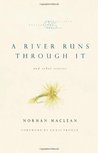
A River Runs Through It and Other StoriesA River Runs Through It and Other Stories by Norman Maclean
My rating: 5 of 5 stars

Norman Maclean's only novella to date, A River Runs Through It and Other Stories, consists of three semi-autobiographical short stories set in Western Montana.  In each story, we are introduced to a specific art and presented with a memorable portrait of a complex character. In the novella's titular story, A River Runs Through It, we learn about the art of fly-fishing and meet Norman's brother, Paul; in "Logging and Pimping and 'Your pal, Jim'", we read about the nature of logging as well as an enigmatic logging expert, Jim; finally, in "USFS 1919: The Ranger, the Cook, and a Hole in the Sky," our characters pass their time playing cribbage, eventually betting on the mysterious and dislikable cook - a cardshark - to win big in Hamilton, helping them "clean out town" at the end of the summer.

Bill, the ranger from "USFS 1919," calls the cook an artist; yet the true artist of the novella is in A River Runs Through It: Paul. Our narrator, Norman, speaks of Paul as an artisan multiple times throughout the story, even calling his fishing stick "a wand."
"At the end of this day, then, I remember him both as a distant abstraction in artistry and as a closeup in water and laughter"
As is the case with so many artists, however, Paul is reckless, troublesome and hard to understand. Everyone in Paul's family adores him and wants to help him - yet the difficulties of both articulating and accepting a help offering stand between them until the final, irreversible end.

The difficulty of extending a helping hand is already captured at the beginning of the story, where Norman humorously admits that giving advice on fly-fishing could pose a "strain on family relations" if not carefully expressed. It's one of those relatable sibling problems where giving tips and suggestions is considered offensive/inappropriately authoritative/nosy. And it is because of this, a problem equally noted in the first part of Paul's father's claim, that Paul is so tragically unhelp-able: "Help," he said "is giving part of yourself to somebody who comes to accept it willingly and needs it badly." The difficulty of mutual understanding is also captured through fly-fishing, particularly in the scene where both brothers are shouting at each other across a raging river, unable to fully interpret the other's words. "Finally, we understood each other," is the remark Norman makes about the end of that conversation - but sadly, it is not a truth he can declare at the end of the story.
“In the loneliness of the canyon I knew there were others like me who had brothers they did not understand but wanted to help. We are probably those referred to as "our brother's keepers," possessed of one of the oldest and possible one of the most futile and certainly one of the most haunting instincts. It will not let us go.”
Neal Burns, the brother of Norman's wife in the story, is another example of a brother who needs help but doesn't accept it. In stark contrast to Paul, Neal is much less likeable, less adventurous, more preened ("Jessie's brother Neal stepped off the train trying to remember what a Davis Cup tennis player looked like") and, to Paul's disgust, fishes with worms (instead of flies). Yet like Paul, he is the subject of worry for those around him; Jessie's family hopes that fishing with the Macleans, the "preacher's sons," will correct Neal's morals, while "Old Rawhide," a horsewoman-turned-whore, thinks that she can help Neal ("He's my man," she keeps insisting).

The frustration and sadness Norman feels about his inability to help is eloquently voiced by both himself and his father:
"Tell me, why is it that people who want help do better without it - at least, no worse. Actually, that's what it is, no worse. They take all the help they can get, and are just the same as they always have been."
"So it is that we can seldom help anybody. Either we don't know what part to give or maybe we don't like to give any part of ourselves. Then, more often than not, the part that is needed is not wanted. And even more often, we do not have the part that is needed. It is like the auto-supply shop over town where they always say, 'Sorry, we are just out of that part.'"
Yet the moving beauty of such a relationship is this:
"But we can still love them - we can love completely without complete understanding.”
“Do you think I could have helped him?” Norman's father asks. “Do you think I could have helped him?” answers Norman in response. As he accurately remarks, How can a question be answered that asks a lifetime of questions? 

But sometimes, as Norman says, "Help doesn't have to be anything that big."
He asked me, "Do you think your mother helps him by buttering his roll?" 
"She might," I told him. "In fact, yes, I think she does."
Does Norman help Paul by taking him fishing? Yes, I think he does.

In the novel, Maclean also portrays a magical quality of the river, and the way it shapes not only rocks and geology, but also our stories and our lives. The water has a certain power over its fishermen ("Eventually, the watched joined the river, and there was only one of us. I believe it was the river") as well as an inclusivity ("As the heat mirages on the river in front of me danced with and through each other, I could feel patterns from my own life joining with them.")

Maclean uses the metaphor of a story to write about "reading the water," and how "it is much easier to read the waters of tragedy." It is thus fitting that he says, "stories of life are often more like rivers than books." For the river that he writes about, Big Blackfoot, was the family river that ran throughout his life, the medium that connected both him and his brother, the landscape in which he witnessed an artist at work, the place where the "Dance of Death" of a fish would foreshadow his brother's, the one place where came closest to understanding and helping Paul.
“Eventually, all things merge into one, and a river runs through it. The river was cut by the world's great flood and runs over rocks from the basement of time. On some of the rocks are timeless raindrops. Under the rocks are the words, and some of the words are theirs. I am haunted by waters.”
If I eventually do become an English teacher/professor, A River Runs Through It is a story I want to teach. It is at once humorous (the hilarious shock of seeing not two "bears," but two "bare asses") and poignant. This may sound childish, but I feel so joyous to have a beautiful short story I can call my all-time favourite.
“One of life's quiet excitements is to stand somewhat apart from yourself and watch yourself softly becoming the author of something beautiful even if it is only a floating ash.”
“Many of us would probably be better fishermen if we did not spend so much time watching and waiting for the world to become perfect.”


View all my reviews

Saturday, July 18, 2015

Prejudice, a dirty word, and faith, a clean one, have something in common: they both begin where reason ends.

Go Set a WatchmanGo Set a Watchman by Harper Lee
My rating: 2.5 of 5 stars

Before I start anywhere with this review, let me just say: To Kill a Mockingbird is one of my favorite books ever. Of all time. It confirmed my love for bildungsromans, fuelled my interest in said genre, and warmed my heart in so many ways. When it was announced that Harper Lee - who has famously only published that ONE book - would be releasing a sequel, Go Set a Watchman, I knew at once that I would have to read it.

Whereas Mockingbird is perfect for a young audience, Watchman comes across as an adult-geared book. It deals with the same difficult themes through not the eyes of young "Scout," but rather the now 26-year old, cigarette-smoking, New Yorker Jean Louise Finch. Everything (and everyone) is different. The famous court case, around which which Mockingbird largely revolved, is only given a couple of paragraphs in Watchman. Dill is in Italy, Jem died of a heart stroke years ago, Henry Clinton wants Jean Louise's hand in marriage, and the almost prophet-like Uncle Jack is suddenly a principal character. And to many readers’ dismay, the legendary Atticus Finch is 72, has arthritis and - as nearly all online reviews boldly declare in their titles - is racist.

Atticus Finch, arguably the most respected father in American literature—a racist? In Watchman, Jean Louise returns from New York to discover that her father is suddenly on the board of directors on the Maycomb County Citizens’ Council, a union that holds KKK meetings and is viciously pro-segregation. Instead of echoing his “equal rights for all, special privileges for none” philosophy, Atticus instead asks his daughter, “do you want them in our world?” A priori, such a turn defies everything Mockingbird stood for and stamps out its very heart and soul. Such change is best captured by Jean Louise's own words:
“You who called me Scout are dead and in your grave.”
“I am their blood and bones, I have dug in this ground, this is my home. But I am not their blood, the ground doesn’t care who digs it, I am a stranger at a cocktail party.”

Yet Atticus’s racist views, framed by cold pragmatism and a harsh sort of “balance out the equities” approach, urges us to think about racism on a deeper level because this sort of prejudice differs from the more conspicuous and easier-to-criticize violence presented to us in Mockingbird. In Watchman, the racism we encounter is spoken by good people, explained in sophisticated ways and pronounced without raised voices. “The Negroes down here are still in their childhood as a people,” says Atticus. That is why it is so difficult to agree, as Jean Louise herself lashed out, that the Atticus we once knew is now a “coward as well as a snob and a tyrant.” Indeed, there are moments in the novel when Atticus is defended (the notion that his motive is to observe the racism, and hence understand how to combat it, is raised a couple of times). Regardless, one cannot depart from the novel with the same reception of Mockingbird’s Atticus.

Yet just as we are given deeper insight into Atticus’s beliefs, we are also enlightened as to Jean Louise's own shortcomings. Interestingly enough, she has a flaw that is and isn’t a flaw:
“You have never been prodded to look at people as a race, and now that race is the burning issue of the day, you're still unable to think racially.”
Lee seems to have taken the sweet innocence of Mockingbird and whammed it with a heavy dose of real-world bitterness.

More significantly, as Uncle Jack explains, Jean Louise's biggest problem is that she had always confused her father “with God:”
The most potent moral force in her life, was the love of her father. She never realized what made her dig in her feet and stand firm whenever she did was her father.
Which is why,
If a man says to you, “This is the truth,” and you believe him, and you discover what he says is not the truth, you are disappointed and you make sure you will not be caught out by him again.
But a man who has lived by truth — and you have believed in what he has lived — he does not leave you merely wary when he fails you, he leaves you with nothing.

So, whereas Mockingbird is a bildungsroman, a coming of age novel, Watchman is, to use Uncle Jack's words, a "coming into this world" novel. It is a story about having deep-rooted beliefs shattered, of struggling to reconcile with the people you love whose principles oppose yours completely. When Jean Louise screams at Atticus, therefore, she is—according to Uncle Jack—reducing her father “to the status of a human being.” Readers are forced to do that too, eroding the legendary status of one of literature’s most memorable heroes.

And it is in this complex father-daughter relationship that the significance of the title unravels itself:
For thus the Lord said to me: “Go, set a watchman; let him announce what he sees." 
“I need a watchman to lead me around and declare what he seeth every hour on the hour. I need a watchman to tell me this is what a man says but this is what he means, to draw a line down the middle and say here is this justice and there is that justice and make me understand the difference.”
To set a watchman is to follow your own moral compass despite the disillusionment you suffer; it is to be surrounded by a county of people who think differently from and but still be able to discern what is right by your own standards. The title "To Kill a Mockingbird" is hypothetical, suggesting a scenario, but"Go Set a Watchman" is a direct command. In all walks of life, we need to set our own watchman—to set us straight.

Watchman asks bigger questions than Mockingbird does. We read about a more complicated form of prejudice—not simply discrimination against a different race—but a fixed-mindset that brutally labels even the nicest of people. For example, Henry points out that Jean Louise is entitled to a certain wildness because she is a “Finch” and “all Finches” are “mad.” On the other hand, he is obliged to toe the line because any false step would  mean that it is the "red-necked" “trash” within him rearing its ugly face.

Towards the end of Watchman, when everything turns unwelcomingly dialogue-heavy, and Jean Louise keeps interrupting everything Atticus and Uncle Jack was saying, the conversations becomes overdramatized and excessively vicious (sadly, I think Jean calling Atticus a “son of a btch” is going to be permanently ingrained in my memory). Another thing I don't like about the novel is Uncle Jack's oracle-esque, all-knowing role. Yes, he has his charm, but his character’s wisdom and insight seemed purported and unconvincing at times. Overall, Watchman lacks the warmth and imaginative plot of its prequel.

Nonetheless, despite everything that is different in Watchman, Lee still includes a couple of "throwback" chapters in the novel that recount stories from Jean Louise's childhood and are written in the same young and humorous voice I loved so much in Mockingbird. Lines such as "Atticus was in bed reading" (215) do take on back. If you don't read the whole book, do read Chapter 11 - it is an absolute gem.

So, I appreciate Watchman for its depth and exploration. Yet thankfully, despite everything, Mockingbird will still have a special place in my heart forever.


(P.S. Every time I typed "Jean Louise" in this review, I was aching to type "Scout")


View all my reviews