Showing posts with label quotes. Show all posts

Thursday, October 23, 2014

Quotes from The Goldfinch

Fabulous graphic from the NYT:


I didn't want to post these quotes with my review (because we would then be looking at ~2,000 words), but here are my favourite passages from Donna's Tartt's The Goldfinch.


"To understand the world at all, sometimes you could only focus on a tiny bit of it, look very hard at what was close to hand and make it stand in for the whole; but ever since the painting had vanished from under me I'd felt drowned and extinguished by vastness -- not just the predictable vastness of time, and space, but the impassible distances between people even when they were within arm's reach of each other, and with a swell of vertigo I thought of all the places I'd been and all the places I hadn't, a world lost and vast and unknowable, dingy maze of cities and alleyways, far-drifting ash and hostile immensities, connections missed, things lost and never found, and my painting swept away on that powerful current and drifting out there somewhere: a tiny fragment of spirit, faint spark bobbing on a dark sea."
Weren't we, as sentient beings, put upon the earth to be happy, in the brief time allotted to us?
“For humans-trapped in biology-there was no mercy: we lived a while, we fussed around for a bit and died, we rotted in the ground like garbage. Time destroyed us all soon enough. But to destroy, or lose, a deathless thing-to break bonds stronger than the temporal-was a metaphysical uncoupling all its own, a startling new flavor of despair.”
“The world is much stranger than we know or can say. And I know how you think, or how you like to think, but maybe this is one instance where you can’t boil down to pure ‘good’ or pure ‘bad’ like you always want to do.”
“Because--isn't it drilled into us constantly, from childhood on, an unquestioned platitude in the culture--? From William Blake to Lady Gaga, from Rousseau to Rumi to Tosca to Mister Rogers, it's a curiously uniform message, accepted from high to low: when in doubt, what to do? How do we know what's right for us? Every shrink, every career counselor, every Disney princess knows the answer: "Be yourself." "Follow your heart."
Only here's what I really, really want someone to explain to me. What if one happens to be possessed of a heart that can't be trusted--? What if the heart, for its own unfathomable reasons, leads one willfully and in a cloud of unspeakable radiance away from health, domesticity, civic responsibility and strong social connections and all the blandly-held common virtues and instead straight toward a beautiful flare of ruin, self-immolation, disaster?...If your deepest self is singing and coaxing you straight toward the bonfire, is it better to turn away? Stop your ears with wax? Ignore all the perverse glory your heart is screaming at you? Set yourself on the course that will lead you dutifully towards the norm, reasonable hours and regular medical check-ups, stable relationships and steady career advancement the New York Times and brunch on Sunday, all with the promise of being somehow a better person? Or...is it better to throw yourself head first and laughing into the holy rage calling your name?
If a painting really works down in your heart and changes the way you see and think and feel, you don't think, 'oh I love this painting because it's universal' 'I love this painting because it speaks to mankind'. That's not the reason anyone loves a piece of art. It's a secret whisper from an alleyway. Psst, you. Hey kid. Yes, you. An individual heart shock. . . .A really great painting is fluid enought to work its way into the mind and heart through all different angles, in ways that are unique and very particular.

Sunday, February 9, 2014

Things can change in a day

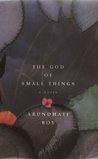
The God of Small ThingsThe God of Small Things by Arundhati Roy
My rating: 5 of 5 stars

"You must read this," I was told time and time again by two of my good friends (whose opinions I value). So I did, and I am grateful.

Arundhati Roy's The God of Small Things is powerfully compelling, at once revolving around the hard boundaries of the caste system but also throbbing with a childhood tenderness and delicacy.

It opens in the long, humid and rainy days of May in Ayemenem where we are at once thrown into a chapter (beautifully alliterated: Paradise Pickles and Preservers) brimming with description, with puddles and dampness and soft moss and a "wild, overgrown garden full of the whisper and scurry of small lives."
And such a notion of smallness - of small things changing a lifetime and of small gestures making small imprints on something as vast as love - recurs throughout the novel. 

On the back of my copy, John Updike is quoted for having said that "to discuss the plot [of this novel] would be to violate it." And I agree - but just to give you some context...

Rahel and Esthappen are two twins (Rahel - girl, esthappen - boy) who - at the curiosity-driven, innocuous years of childhood - find themselves tied down by an immense history of caste systems and political/social boundaries that weave themselves into their lives. These restraints impact not only them but also their mother, Ammu, and the 'Untouchable' Velutha, the carpenter who works at Paradise Pickles and Preserves.

The twins are fond of Velutha, who is in turn fond of them, and soon Ammu herself develops feelings for Velutha - dangerous feelings forbiden by the Love Laws, "the laws that lay down who should be loved, and how. And how much."

These laws lie at the heart of this novel and because of them the characters find themselves:
"... prisoners of war," Chacko said. "Our dreams have been doctored. We belong nowhere. We sail unanchored on troubled seas. We may never be allowed ashore. Our sorrows will never be sad enough. Our joys never happy enough. Our dreams never big enough. Our lives never important enough. To matter."

Even after finishing this novel I'm not sure if I can put a name to 'The God' of Small Things; I don't even think that is a question the novel asks. Rather what it stressed are the small things and the effects they have on history as a whole, on how Rahel and Estha's lives pan out, on how "things can change in a day" because of small things. Most importantly, about how "history negotiates its terms and collects its dues from those who breaks its laws."

What is most heartbreakin most about Roy's characterization of the twins is how they think of each other as "me," and how "emptiness in one twin was only a version of the quietness in the other"... how Estha grew "accustomed to the uneasy octopus that lived inside him and squirted its inky tranquilizer on his past. "

If you're planning to read the novel, the family tree below shall prove immensely helpful, too bad I only found out about it 5 minutes ago:


Lengthy and even arguably verbose, The God of Small Things does not unfold chronologically and thus its plot is not so easily grasped; however, Roy reiterates key sentences throughout the novel:
The God of loss.
The God of Small Things.

Love. Madness. Hope. Infinite joy.


- which, like color-coded lighthouses on a broad sea, point readers in the right direction. Technically, a large chunk of the whole novel is exposed in the first chapter but at that point one lacks too many of the precious details (Roy does details so well) to register much.

Roy's prose is poetic; she doesn't merely write - she paints, embellishes and illustrates using the most ordinary or exquisite of words. Such elegance, made visual by Roy's crafting, remains constant throughout the novel regardless of what she is describing, be it a beaten man or a yellow church.

Thus thought-provoking as the themes expressed in this novel are, it is ultimately the language - the intrinsic detail, the exquisite metaphors - that carry the plot and tie together all its magic and mystery.
Human beings were creatures of habit, and it was amazing the kind of things they could get used to.

It seemed so absurd. So futile. Like polishing firewood

It is curious how sometimes the memory of death lives on for so much longer than the memory of the life that it purloined..

And we, my dears, everything we are and ever will be are just a twinkle in her eye," Chacko said grandly, lying on his bed, staring at the ceiling.

Then Small God (cozy and contained, private and limited) came away cauterized, laughing numbly at his own temerity. Inured by the confirmation of his own inconsequence, he became resilient and truly indifferent. Nothing mattered much. Nothing much mattered. And the less it mattered, the less it mattered. It was never important enough. Because Worse Things had happened. In the country that she came from, poised forever between the terror of war and the horror of peace, Worse Things kept happening.

So Small God laughed a hollow laugh, and skipped away cheerfully. Like a rich boy in shorts. He whistled, kicked stones. The source of his brittle elation was the relative smallness of his misfortune. He climbed into people’s eyes and became an exasperating expression.”


View all my reviews

Tuesday, December 17, 2013

life will teach you reality and realism

The Sense of an EndingThe Sense of an Ending by Julian Barnes
My rating: 4 of 5 stars

Requisites upon finishing The Sense of an Ending:

1) Reread the closing paragraph
2) Revisit the equations
3) Reread the enumerations on page 1 and (this time) understand them

“We live in time - it holds us and molds us - but I never felt I understood it very well. And I'm not referring to theories about how it bends and doubles back, or may exist elsewhere in parallel versions. No, I mean ordinary, everyday time, which clocks and watches assure us passes regularly: tick-tock, click-clock. Is there anything more plausible than a second hand? And yet it takes only the smallest pleasure or pain to teach us time's malleability. Some emotions speed it up, others slow it down; occasionally, it seems to go missing - until the eventual point when it really does go missing, never to return.”

A significant individual in Anthony ('Tony') Webster's "book-hungry, sex-hungry, meritocratic, anarchistic" youth is Adrian, his 'philosophical' friend who always "grasped life-and truth and morality, and art- more clearly" than the rest of his peers. Even after Tony goes to university and gets his first girlfriend - Veronica, whose family (esp. her mother, the enigmatic Mrs. Ford) he later meets - it is "Camus-quoting" Adrian (in Cambridge) that matters to him the most.

But Veronica and Adrian end up together and Tony has a bad case of sour grapes that extends to after his marriage and (amicable) divorce, prompting him to write a bitter, recriminating letter to the new couple. One day, he receives news of Adrian's suicide and is later notified that the late Mrs. Ford has left him money and Adrian's diary in her will, none of which makes sense to Tony. So Tony spends the remainder of the novel trying to uncover the truth from Veronica and retracing his confabulated memories, all the while harbouring a borderline concocted conception of Adrian, glorifying his death and attributing it to the most 'highest' of reasons (e.g. intense intellectual stimulation).

Victim to the "imperfections of memory [...and] inadequacies of documentation," Tony only comes to term with the rather banal reality at the end of the novel, by which time he concludes also that he himself is but"average at life; average at truth; morally average." He wonders,

“Had my life increased, or merely added to itself? There had been addition and subtraction in my life, but how much multiplication?”

But he can neither change his past or mend his errors, neither can he take back the scathing words in the letter he wrote or reduce the responsibility and remorse he feels,

Whose chief characteristic is that nothing can be done about it: too much time has passed, too much damage has been done, for amends to be made.

The way we make sense of the novel's ending is almost mathematical. Barnes drops us fragments along the way and we scamper along, piecing together our own 'sense' of the ending according to Tony's own "imposed meaning on what might or might not have happened;" only at the end do we realize, like Veronica did throughout, that Tony just didn't "get it" because he would "adjust, embellish, make sly cuts" to his accounts. And as Adrian had said,

That’s one of the central problems of history, isn’t it, sir? The question of subjective versus objective interpretation, the fact that we need to know the history of the historian in order to understand the version that is being put in front of us.”

In which case Tony is the historian and the history in question not that of WW1 as discussed in the lessons of his youth, but his own "small, personal, largely undocumented piece" of time. At the end he learns that “History isn't the lies of the victors" but "the memories of the survivors, most of whom are neither victorious or defeated” - like him.

Barnes keeps us, like Tony, on the edge, impatient to make sense of the unfurling past. So we follow Tony as he blunders through self-deception, irks Veronica and relies on his imperfect memory to unearth a reality that eventually turns out not the way he had idealized or assumed.

The novel ends by pithily encapsulating the 163 pages of the novel in a sentence:

There is accumulation. There is responsibility. And beyond this there is great unrest.

Check, check and check.

<

View all my reviews
But time...how time first grounds us and then confounds us. We thought we were being mature when we were only being safe. We imagined we were being responsible but we were only being cowardly. What we called realism turned out to be a way of avoiding things rather than facing them. Time...give us enough time and our best-supported decisions will seem wobbly, our certainties whimsical.”
“It strikes me that this may be one of the differences between youth and age: when we are young, we invent different futures for ourselves; when we are old, we invent different pasts for others.”
“You get towards the end of life - no, not life itself, but of something else: the end of any likelihood of change in that life. You are allowed a long moment of pause, time enough to ask the question: what else have I done wrong?”
“When you're young - when I was young - you want your emotions to be like the ones you read about in books. You want them to overturn your life, create and define a new reality. Later, I think, you want them to do something milder, something more practical: you want them to support your life as it is and has become. You want them to tell you that things are OK. And is there anything wrong with that?”
“We live with such easy assumptions, don't we? For instance, that memory equals events plus time. But it's all much odder than this. Who was it said that memory is what we thought we'd forgotten? And it ought to be obvious to us that time doesn't act as a fixative, rather as a solvent. But it's not convenient--- it's not useful--- to believe this; it doesn't help us get on with our lives; so we ignore it.”
“I certainly believe we all suffer damage, one way or another. How could we not,except in a world of perfect parents, siblings, neighbours, companions? And then there is the question on which so much depends, of how we react to the damage: whether we admit it or repress it,and how this affects our dealings with others.Some admit the damage, and try to mitigate it;some spend their lives trying to help others who are damaged; and there are those whose main concern is to avoid further damage to themselves, at whatever cost. And those are the ones who are ruthless, and the ones to be careful of.”
“This was another of our fears: that Life wouldn't turn out to be like Literature.”
“I know this much: that there is objective time, but also subjective time, the kind you wear on the inside of your wrist, next to where the pulse lies. And this personal time, which is the true time, is measured in your relationship to memory.”
Here's a rather brilliant, eccentric metaphor:
“History is a raw onion sandwich, it just repeats, it burps. We've seen it again and again this year. Same old story, Same old oscillation between tyranny and rebellion, war and peace, prosperity and impoverishment”

Sunday, November 17, 2013

"Time," says Nora bitterly. "Will you come by ever again?"


The tiny share we have of time appalls me, though my father seems to regard it with tranquility. Even my father, who sometimes seems to me to have been at home in the world as long as it has lasted, has really lived on this earth only a little longer than I have, in terms of all the time there has been to live in. He has not known a time, any more than I, when automobiles and electric lights did not at least exist. He was not alive when this century started. I will be barely alive — old, old – when it ends. I do not like to think of it. I wish the Lake to be always just a lake, with the safe-swimming floats marking it, and the breakwater and the lights of Tuppertown.


I originally planned to read J. M. Coetzee's Waiting for the Barbarians but settled for the work of another Nobel laureate instead - Alice Munro's Selected Stories. I did this for two reasons - the first being that I won't be able to take my time with the former (school life is throwing assessments my way), and the second being I haven't read short stories in ages. Why not Munro, whose collections I've often glimpsed on bookshelves but never read?

I've just read the first story (twice), Walker Brothers Cowboy. A sense of leaving permeates the opening  lines as our narrator and her father (Ben) make their way down a "long, shabby sort of street" towards the Lake, leaving her mother and brother at home, one "sewing under the dining-room light" and one "in bed [...in a] little screened porch."  

They are in "Tuppertown, an old town on [...] an old grain port," where tramps hang around the docks bordering "ancient, rusty, wallowing" grain boats. Such decrepit, decaying imagery works with the feeling of 'letting go' to unfold the enigma of a crack-of-dawn sentiment, harking back to a bygone time. And the past indeed trails behind the characters throughout the story, even presenting itself in front of them when Ben takes his children - our narrator and her brother - to visit Nora (a woman of his past) and her blind mother, taking a detour from his regular salesman trip as the 'Walker Brothers Man.'

It is clear from Nora's cheerful yet aggressive tone that news of Ben's marriage and job as the Walker Brothers Man is a long leap from who he was in their shared past, and as Nora drinks whisky and urgest Ben to dance she attempts to rekindle their history. Nora "whirls [...our narrator] around in" a dance, dragging her too into that enigmatic past. 

Although our narrator initially regarded the trip with a childish "rising hope of adventure," she is offered a glimpse of her father's youth and at the end -unlike her innocuous brother- cannot shake off an acute awareness of the gone yet ever 'present' past.   

As Updike wrote in the NY Times Book Review - "Munro is an implacable destiny spinner, whose authorial voice breaks into her fiction like that of a God who can no longer bear to keep quiet." Indeed. I look forward to reading and rereading the next 27 stories in this anthology. 

I pretend to remember far less than I do, wary of being trapped into sympathy or any unwanted emotion.
So my father drives and my brother watches the road for rabbits and I feel my father’s life flowing back from our car in the last of the afternoon, darkening and turning strange, like a landscape that has an enchantment on it, making it kindly, ordinary and familiar while you are looking at it, but changing it, once your back is turned, into something you will never know, with all kinds of weathers, and distances you cannot imagine.

Monday, September 23, 2013

There wasn't really much else to do. Make something, and die.

AmsterdamAmsterdam by Ian McEwan
My rating: 4 of 5 stars

When Molly Lane, a flirtatious restaurant critic, dies from amnesia (inferred), her former lovers Clive Linely - a celebrated composer - and Vernon Halliday - editor for The Judge - reconvene at her funeral. Also at the funeral are George Lane, Molly's widowed (and detestable) husband, and Julian Garmony, who is running for prime minister and also once Molly's lover.

The memory of Molly trails Clive as as he works on his chef d'oeuvre, and accompanies Vernon as he struggles to save his declining newspaper. As the debut of Clive's symphony in Amsterdam inches closer, and while Garmony continues his campaign, Clive and Vernon encounter ethical dilemmas that force them to choose between what is 'morally right' - at the cost of their friendship - and what is 'best' for their personal objectives and careers.

Amsterdam is a thoroughly personal story; regardless of the scope of events its characters deal with, their each whim has its base on firmly grounded - and even depraved - personal desires. Both Clive, who struggles with writing his "Millennial Symphony", and Vernon, who attempts to save his newspaper, gladly dive into reprobate, degenerate waters to achieve their aims: the former does it to write the piece of a lifetime, and the latter does it for a return to glory.

Amsterdam is darkly humorous, well-structured and poetically written. Especially during McEwan's expressive, elegiac accounts of Clive's music do readers understand why The Times acknowledged him as one of "The 50 greatest British writers since 1945." It is a quick yet thought provoking and plot-chasing read that will leave readers thinking about its beginning (spoiler) at its end.

View all my reviews

“We knew so little about each other. We lay mostly submerged, like ice floes with our visible social selves projecting only cool and white. Here was a rare sight below the waves, of a man's privacy and turmoil, of his dignity upended by the overpowering necessity of pure fantasy, pure thought, by the irreducible human element - Mind. ”

Thursday, August 8, 2013

Whether they are part of a home or home is a part of them is not a question children are prepared to answer.

I put a colossal amount of effort into hunting down this book and it was worth the effort.

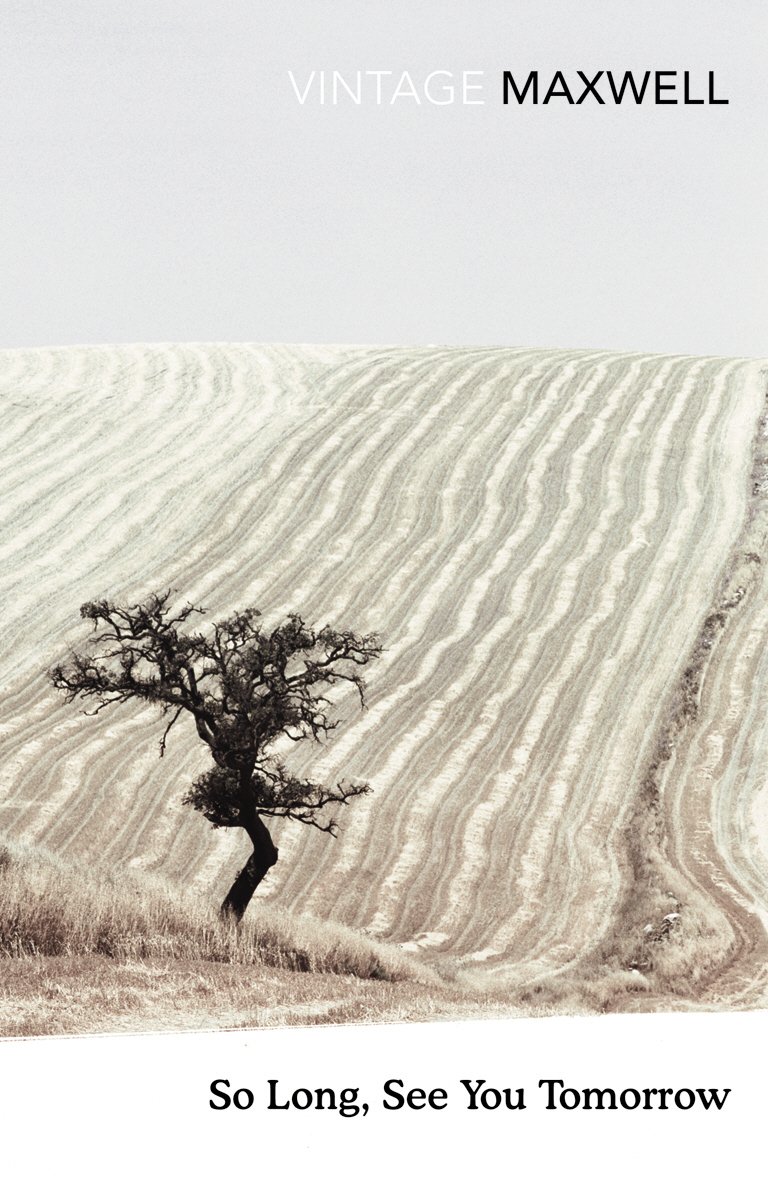
First published in The New Yorker, So Long, See You Tomorrow by Williams Maxwell is a 70% pulled together and 30% "hazy half-recollection".

Lloyd Wilson, a tenant farmer, is found dead with one of his ears missing (why the ear, we never find out); Clarence Smith, his friend and husband of his mistress, is the definite culprit. Cletus Smith, son of Clarence, takes to wandering somberly in the hallways of the MoMA, stumbles upon a painting - the Palace at 4am - and meets then befriends our narrator. Although both come from different social classes, they are equated by their age and circumstance. Cletus is trembling under his mother's treachery, his father's retreat and the inevitable fragmentation of his family; our narrator is dealing with the death of his mother, his father's remarriage and a new town. Both face the impossibility that comes with the passage of time of ever "getting around to the way things were."

Not long after, Cletus' father suicides, forcing Cletus "over the line into maturity." When the two young boys meet again, our narrator, perhaps due to his never-pitied "physical inadequacy, fear [and] humiliation," fails to reach out to Cletus and allows Cletus - his momentary companion - to slide out of his life.

Yet the past is a metaphysical friend (or foe) to whom we can say "so long, see you tomorrow." This is exactly what our narrator does, for the memory of his ignorance is to him a betrayal as deep as Lloyd Wilson's affair was to Clarence, and follows him his whole life.

Upon his attempt to reconstruct the past, Cletus' first step is to "invent a dog," and this dog trots throughout the recollected past, as Clarence's pet, an observant companion that runs parallel to the boys' lost childhood. In fact, when our narrator cedes his recollection, and when Cletus's childhood is decidedly terminated, the dog is the first to go, put to sleep by chloroform, vanishing into the obscure past like a tarnished memory.

Tenderly recounted in the perspective of an old man yet recollected in the voice of the innocuous child he once was, So Long, See You Tomorrow reveals the vilifying power of betrayal, heartbreaking naivety of a child, and most of all, how a neglected gesture can turn into a lifetime's regret.


“Innocence is defined in dictionaries as freedom from guilt or sin, especially from lack of knowledge; purity of heart; blamelessness; guilelessness; simplicity, etc.”
“What we, or at any rate what I, refer to confidently as memory--meaning a moment, a scene, a fact that has been subjected to a fixative and thereby rescued from oblivion--is really a form of storytelling that goes on continually in the mind and often changes with the telling. Too many conflicting emotional interests are involved for life ever to be wholly acceptable, and possibly it is the work of the storyteller to rearrange things so that they conform to this end. In any case, in talking about the past we lie with every breath we draw.”
“Who knows what oversensitive is, considering all there is to be sensitive to.”
Best chunk from the novel:
“Whether they are part of a home or home is a part of them is not a question children are prepared to answer. Having taken away the dog, take away the kitchen–the smell of something good in the oven for dinner. Also the smell of washing day, of wool drying in the wooden rack. Of ashes. Of soup simmering on the stove. Take away the patient old horse waiting by the pasture fence. Take away the chores that kept him busy from the time he got home from school until they sat down to supper. Take away the early-morning mist, the sound of crows quarreling in the treetops. His work clothes are still hanging on a nail beside the door of his room, but nobody puts them on or takes them off. Nobody sleeps in his bed. Or reads the broken-back copy of Tom Swift and His Flying Machine. Take that away too, while you are at it. Take away the pitcher and bowl, both of them dry and dusty. Take away the cow barn where the cats, sitting all in a row, wait with their mouths wide open for somebody to squirt milk down their throats. Take away the horse barn too–the smell of hay and dust and horse piss and old sweat-stained leather, and the rain beating down on the plowed field beyond the door. Take all this away and what have you done to him? In the face of a deprivation so great, what is the use of asking him to go on being the boy he was. He might as well start life over again as some other boy instead.”
Atticus-esque:
“A gentleman doesn't have one set of manners for the house of a poor man and another for the house of someone with an income incomparable to his own.”
“Love, even of the most ardent and soul-destroying kind, is never caught by the lens of the camera.”

Wednesday, August 7, 2013

The half-life of love is forever

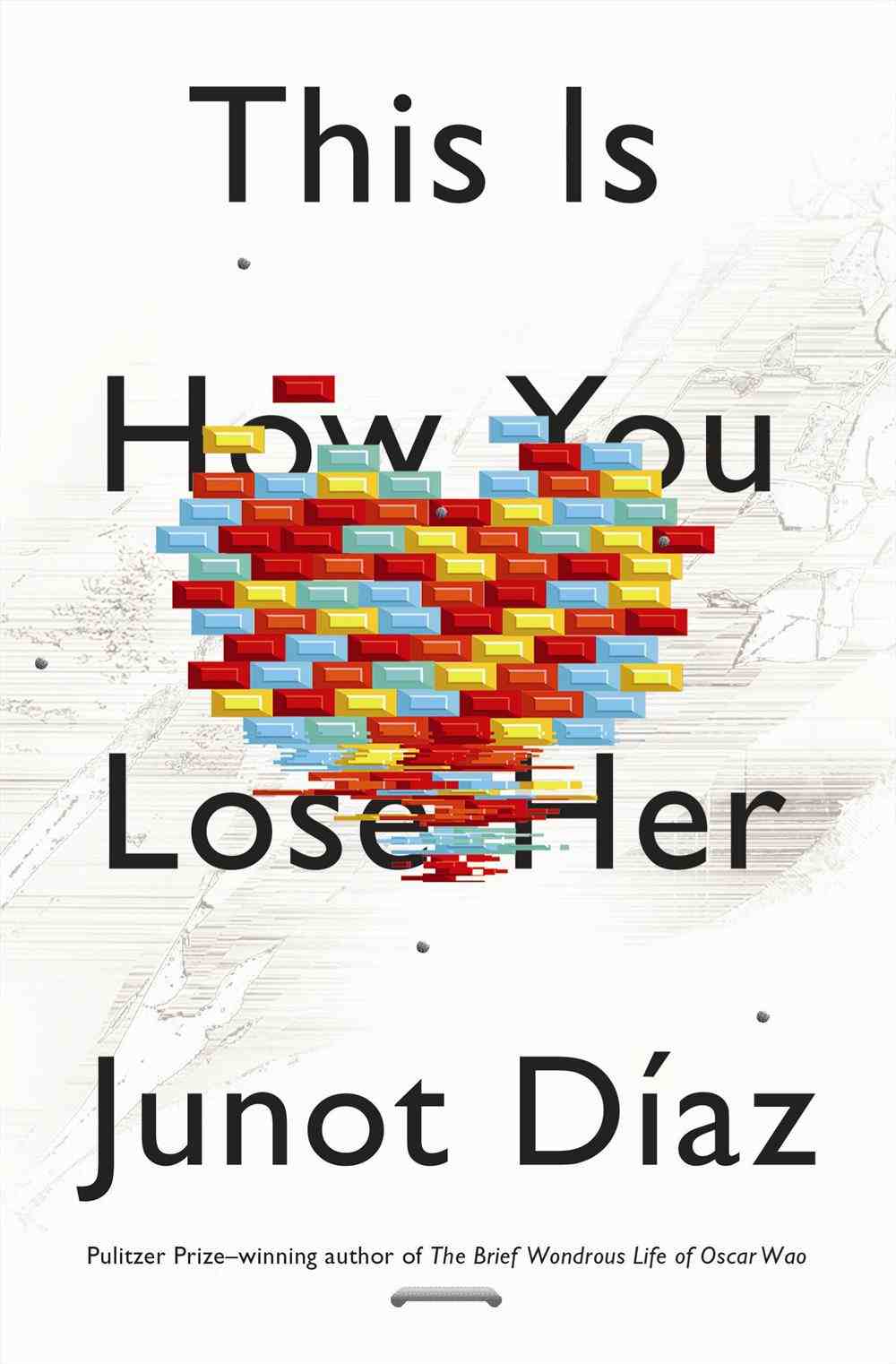
After dragging myself through All the Names and July's People, I decided to read something more contemporary with a fair bit of cussing (joking about the latter). I first spotted This Is How You Lose Her in an airport bookstore, read the line "the half life of love is forever" in the blurb (mind you, I was studying radioactive decay then) and have hungered to read it since.

It took me a while to realize that I was reading a collection of short stories, not a novel - Diaz's narrative tone is so autobiographical throughout and his characters recurrent that the stories, like Hemingway's Nick Adams stories, string together effortlessly.

This Is How You Lose Her revolves around, Yunior, a reckless yet innately sensitive womanizer who goes around breaking hearts but always eventually gets his fair share of karma and learns that he's become prone to "losing 'her,'" whoever 'she' may be - his high school teacher, his fiancee, or maybe even just some 'sucia' he met at a club.

From being subconsciously aware of his father's dishonesty (I may be wrong but it was heavily insinuated) to watching his brother recycle helplessly stricken girls, Yunior finally becomes the fickle, mercurial "Dominican man" most girls in the stories come to stereotype and avoid; he is left in adulthood, suffering from stenosis and sour.

The best in this collection are: The Pura Principle (the funniest), Invierno (the tenderest) and The Cheater's Guide to Love (the most confessional and heartfelt one of all).

Sadly, one story - Otravida, Otravez - fits uncomfortably into the collection because it is written in the perspective of a woman and trammels the otherwise continuous flow of Diaz's narrative; nonetheless, This Is How You Lose Her is a quick and hilarious read.

I'll definitely read Drown and The Brief Wondrous Life of Oscar Wao; from what I've heard, they embody the same, if not more, explosive literary energy Diaz pours into This Is How You Lose Her.


“A father is a hard thing to compass.”
“In the months that follow you bend to the work, because it feels like hope, like grace--and because you know in your lying cheater's heart that sometimes a start is all we ever get.”
“Ana Iris once asked me if I loved him and I told her about the lights in my old home in the capital, how they flickered and you never knew if they would go out or not. You put down your things and you waited and couldn't do anything really until the lights decided. This, I told her, is how I feel.”

July's People

I unfortunately didn't cling on to this novel as much as I was hoping to - I'll revisit certain pages and remember particular phrases but eventually think: 

What I did manage to grasp, with aid of the blurb: July's People is set in the late 1980s. July, a servant, helps the white family he serves - the Smales family - escape the violence of the African Americans' violent retaliation to apartheid. The way Gordimer sews the human relationships together in this novel is tender and masterful (I'm definitely rereading this novel).

I bolted down 100 pages of this book at 2am last night (bad idea) but thankfully pulled myself together for the ending, which is gorgeously written. This novel is a delicate clash between love and angst. Although its plot line is tough to follow (due to the prose), this novel has at least told me one thing: continue reading Nadine Gordimer!!
The humane creed [...] depended on validities staked on a belief in the absolute nature of intimate relationships between human beings. If people don't all experience emotional satisfaction and deprivation in the same way, what claim can there be for equality of need?

Saturday, July 20, 2013

“It is a far, far better thing that I do, than I have ever done; it is a far, far better rest that I go to than I have ever known.”

A Tale of Two Cities is similar to Great Expectations. In both novels, readers meet a cruel, domineering woman, and - true to Dickens - elements of gothic fiction. Whether they spill from the 'sharp female called La Guillotine' or are found at the bottom of the graves Cruncher digs, blood and death are prevalent during the French Revolution, the turmoiled time in which the characters of this novel live.


Charles_Dickens-_A_Tale_of_Two_Cities-With_Illustrations_by_H_K_Browne,_1859.jpg


A Tale of Two Cities is a story of tyranny, self-sacrifice, and of course, love. It tells the story of two men, strikingly similar in appearance yet distinct in character: Charles Darnay, a French aristocrat, and Sydney Carton, an English lawyer. Darnay is wrongfully convicted for a crime he did not commit, but saved from a sure death by Carton (spoiler alerts: clever foreshadowing on Dickens's part) Both men fall in love with the Lucie Manette, the daughter of a French doctor, and although Darnay ultimately weds Lucie, the fates of both men, in the "shadow of the guillotine" (as the blurb on my copy eloquently puts  it) are inevitably intertwined.

Although many 'flat' (quote E.M. Forster) characters in A Tale of Two Cities simply do not undergo as much character development as Pip does in Great Expectations, the ingenuity of this novel's plot line and the eloquence of Dickens's narrative make up for all the minor foibles in this triumphant work. Just as how Cosette's plain nature does not impinge on the tremendousness of Les Mis, Lucie's one-sided disposition does not affect the ultimate achievement of A Tale of Two Cities either.

This novel was both difficult and lovely to read, the former due to Dickens's oft-archaic prose (not to mention the weight of the volume) and the latter due to the novel's perfect pace and mind-blowing revelations. All the motifs and imagery in the novel - such as the jackal, game of cards and knitting (perhaps I'll write separate posts discussing these motifs) are masterfully used to portend and symbolize the happenings in the novel. It is a truly rewarding - yet heartbreaking - 5-star classic.
I see a beautiful city and a brilliant people rising from this abyss, and, in their struggles to be truly free, in their triumphs and defeats, through long years to come, I see the evil of this time and of the previous time of which this is the natural birth, gradually making expiation for itself and wearing out...
A solemn consideration, when I enter a great city by night, that every one of those darkly clustered houses encloses its own secret; that every room in every one of them encloses its own secret; that every beating heart in the hundreds of thousands of breasts there, is, in some of its imaginings, a secret to the heart nearest it!

Tuesday, July 16, 2013

A Tale of Two Cities


It was the best of times, it was the worst of times, it was the age of wisdom, it was the age of foolishness, it was the epoch of belief, it was the epoch of incredulity, it was the season of Light, it was the season of Darkness, it was the spring of hope, it was the winter of despair, we had everything before us, we had nothing before us, we were all going direct to heaven, we were all going direct the other way - in short, the period was so far like the present period, that some of its noisiest authorities insisted on its being received, for good or for evil, in the superlative degree of comparison only.
Next to Virginia Woolf's The Years, Charles Dickens' A Tale of Two Cities presents one the best opening chapters I've ever read. The introductory paragraph not only introduces the theme of duplicity that continues to emerge throughout the novel (e.g. Darnay and Carton) but also fleshes out the setting of the novel and the condition of the incoming revolution.

Ah, reading Dickens once more and being entertained by Dickensian humor is the best way to spent a train ride from Tainan to Keelung.

Quotes so far:
A wonderful fact to reflect upon, that every human creature is constituted to be that profound secret and mystery to every other. A solemn consideration, when I enter a great city by night, that every one of those darkly clustered houses encloses its own secret; that every room in every one of them encloses its own secret; that every beating heart in the hundreds of thousands of breasts there, is, in some of its imaginings, a secret to the heart nearest it!
So does a whole world, with all its greatnesses and littlenesses, lie in a twinkling star. And as mere human knowledge can split a ray of light and analyse the manner of its composition, so, sublimer intelligences may read in the feeble shining of this earth of ours, every thought and act, every vice and virtue, of every responsible creature on it.

Perhaps we all reappear, perhaps all our lives are impositions one on another.

I am a sucker for experimental books, esoteric as they may be -


From reading Loon Lake, E.L Doctorow reminds me fondly of Cormac McCarthy - both writers glorify violence with graceful (albeit recondite) prose that is - personally, at least - refreshing to read.

Set in America during the Great Depression, Loon Lake follows the story of Joe Paterson, a wandering 'hobo' who initially finds solace working for a circus before he, the "wiseass street kid," is ultimately "gone in love, gone in aspiration, gone in the dazzlement of the whole man, the polished being."

Loon Lake adopts a convoluted structure that bedazzles and frustrates readers. Only until the last two pages did I truly appreciate the effectiveness of the structure; the story is told with poetry, eulogies and an overall remission of chronological sequence. Although it is initially difficult to delve into, Loon Lake is ultimately a grueling and rough story of ambition, truth and one's ability to adapt.

Standout quotes from the novel:
The poem is a cry of the unborn heart. Yes, because the poem perfectly embodies the world, there is no world without poem.
I cite too the ordinary fears of mortality the inspection of a fast-growing mole on the side of the nose blood in the stool a painful injury or the mournful witness of the slow death of a parent all this is given to all men as well as the starting awake in the nether hours of the night from such glutinous nightmare that on'e self name relationships nationality place in life all data of specificity wipe out amnesiatically asiatically you don't even know the idea human it is such a low hour of the night and he shares it with all of us.
He wondered seriously if love wasn't a feeling at all but a simple characterless state of shared isolation. If you were alone with a woman your feelings might change from moment to moment but the circumstance of your shared fate did not change. Maybe that's where the love was, in the combined circumstance. [...] They knew it could incorporate passion or prim distaste, it might be joyous or full of rage, it might carry extreme concern of any kind, or unconcern, but it was presumed to survive challenge. All it was, was a kind of neutral constancy. [... It was] nothing grand, nothing monumental, and not a prison either, but a sort of sturdy structure of outlook, one that wouldn't break under the weight of ideas and longing feelings terrors visions and the world's awful mordant surprises.


Wednesday, July 3, 2013

Poor People


In an attempt to understand the "characteristics of poverty," journalist and National Book Award winner William T. Vollmann asks victims of poverty worldwide, "why are you poor?"

Some believe it is their destiny and some accept it as the corollary of an imbalanced society; regardless, it results in an inevitable "mutual class invisibility called segregation."

Although Vollmann's tone may at times seem egregiously pretentious and his writing repetitive, Poor People is an introspective, thought-provoking book enriched (ironically) by his distinct, poetic narrative.
“Life is an extended camping trip. With a leaky, inferior tent one runs no more risk of rain than anyone else; but if it does rain, the person in the cheap tent chances soaking in his sleeping bag, and possibly dying of hypothermia.”

Other books by William T. Vollmann: Europe Central, Rising Up and Rising Down

Sunday, April 14, 2013

Darkness is stronger and swallows them like minnows


I finished reading Beloved, and... *shudders.* It's not that it's badly written (it ain't), it's just very unlovable; and why wouldn't it be when it so aptly illustrates the horrors/consequences of slavery?

The inhabits of 124 (Sethe and her daughter Denver) are ever-accompanied by the ominous presence of Sethe's dead baby's (whose tombstone bears one word: Beloved) ghost until Paul D., an ex-slave who worked on the same plantation as Sethe, arrives, drives the ghost out, and settles down with Sethe. Everything is ominously okay until a black woman... named BELOVED.... mysteriously shows up on their doorstep one day. The moment she enters the home, she herself and her presence are as irremovable as a mile-deep root in soil. We eventually learn that Sethe tried to MURDER her children (succeeded in murdering 1) to free them from the horrors of slavery, and that Beloved is the ghost of this murdered child, the same ghost that haunted 124 before Paul D., the emblem of reality and anti-supernatural-elements in this novel, rid the house of it. Denver initially loves Beloved, partly because Beloved is the sister she never had; however, before dissipating (to Lord knows where?), Beloved almost kills Sethe, has sex with Paul D., and by the end, I'm sure, has pretty much freaked the shat out of/severed her arguably-never-was-existent bond with Denver, who evolves into a working woman, not the lonely child she was at the beginning of the book.

Toni Morrison whips this all out in a 324-page novel with fluid and masterful prose; Denver's character development is relieving to witness in the midst of all cray plot turns, Sethe's dedication to Beloved (compensation for killing her... *shudders again*) is haunting, and Beloved's silent eeriness is... terrifying.
Below are 2 quotes from this CHILLING story.
“Love is or it ain't. Thin love ain't love at all.”
“There is a loneliness that can be rocked. Arms crossed, knees drawn up, holding, holding on, this motion, unlike a ship's, smooths and contains the rocker. It's an inside kind--wrapped tight like skin. Then there is the loneliness that roams. No rocking can hold it down. It is alive. On its own. A dry and spreading thing that makes the sound of one's own feet going seem to come from a far-off place.”

Thursday, April 4, 2013

Love in the Time of Cholera

WARNING: THIS REVIEW CONTAINS SPOILERS

...Yes. I have returned from a 11-day absence to announce that I have finally finished reading Love in the Time of Cholera and that the predilections I established the last time I posted about this book turned out to be... inaccurate/irrelevant.

"How does the love between Jeremiah and his lover differ? We will find out," I wrote.

We don't find out. We do not. Jeremiah and the parrot essentially vanish for the remainder of the book (?!??). I'm currently part of a Goodreads forum that tackles this exact issue; hopefully any wisdom-nuggets I glean from that will ameliorate my confusion.

Jeremiah's fleeting appearance, however, gives us mini-glimpses of grand themes to come: age (life-death) and love. His death also indirectly causes Urbino's death, which causes the arrival of a certain individual (who later develops into an extremely unlikable protagonist) - Florentina Ariza - who avows his apparent unfaltering love for Ferminana Daza (yes, Urbino's widow; what?). To complete the compendium: the rest of the novel revolves around the relationship (not using the word love here, you'll see why in a moment) between Florentina Ariza and Fermina Daza.


LOVE = CHIMERIC

In a way, Ariza is akin to a Spanish Romeo, more concerned with the effects of apocryphal love on him than the reality of the women he is infatuated with. Initially, a myriad of clandestinely delivered letters between the two (and the occasional camellia) is all that encompasses their love... the two are maddeningly wedged within the abyss of enchantment. Young, betrothed, ready-to-wed, it is only when Daza sees Ariza in the square, that she thinks to herself (incredible line):
“Today, when I saw you, I realized that what is between us is nothing more than an illusion.”
... Naturally, her rejection renders Ariza abject. She maintains an equanimity throughout the foundering of their 'love' while Ariza is still endorsed under the spell of his "self-absorbed love,"even after Daza eventually weds Urbino.
“She knew that he loved her above all else, more than anything in the world, but only for his own sake.”
“He asked himself, with his infinite capacity for illusion, if such pitiless indifference might not be a subterfuge for hiding the torments of love.”
Ariza has an "insatiable need for love" and is therefore actuated by all things amorous. His constant infatuation/obsession can honestly tire readers out; I constantly fluctuated between "stop being a creep" and "forget about her and find someone new."

Technically, throughout the book he has occasional flings with widows (ironic as later Daza becomes a widow anyway), and even a young girl (who commits suicide after Ariza, the prick, runs off to woo Daza after Urbino's death), but in the end, Daza has always been his target.

He 'deserves' empathy, but piteously so. Nonetheless, don't bash on him too much. As Daza's aunt said: “he is ugly and sad... but he is all love.”

LOVE = CHOLERA

So what are effects of this illusory love?

All that was needed was shrewd questioning, first of the patient and then of his mother to conclude once again that the symptoms of love were the same as those of Cholera. The doctor prescribed infusion of linden blossoms to calm the nerves and suggested a change of air so he could find consolation in distance but the man longed for just the opposite, to enjoy his martyrdom.

Throughout the novel, connections are constantly being drawn between love and cholera
This, for me, was the most fascinating parallel this book offered; love as a disease. Heartbreak as a sickness. To be consumed by love and driven to death's doorstep by it. To be incurable. The pitfalls of love and the effects of cholera are not so different when looked at in this perspective. Considering the feverish and insatiable state Ariza is in for the entire book, this makes a lot of logical sense. Urbino, a doctor, cured many cholera cases. It is ironic to think that the man who was the most overwhelmed with 'cholera' was infatuated with his own wife.

Cholera makes a symbolic reappearance at the end, too, when Daza and Ariza are on the boat.

OLD AGE

The latter part of the novel progresses chronologically, and ends with Daza and Ariza both old and withered. Ariza has pursued Daza to the age where, already old and feeble, she can no longer throw huge tantrums to dismiss him. It is also the age where neither can get too physically involved (http://i3.kym-cdn.com/photos/images/original/000/430/609/3d9.png); perhaps the bodily attrition of both renders them capable of sustaining a companion-based relationship. Their young past is behind them. This is best illustrated in the quote below:

“It was the first time in a half century that they had been so close and had enough time to look at each other with some serenity and they had seen each other for what they were: two old people, ambushed by death, who had nothing in common except the mercy of an ephemeral past that was no longer theirs but belonged to two young people who had vanished and who could have been their grandchildren.”


Growing old is a theme Marquez throws at us in the first chapter (arguably the first page). Jeremiah avoided it by setting a death-date, Urbino avoided it like the plague by being a health guru, but neither Daza nor Ariza really considered the reality of the "humiliation, suffering and frightful loneliness" of old age until they were smack in the middle of it.

“It was as if they had leapt over the arduous cavalry of conjugal life and gone straight to the heart of love. They were together in silence like an old married couple wary of life, beyond the pitfalls of passion, beyond the brutal mockery of hope and the phantoms of disillusion: beyond love. For they had lived together long enough to know that love was always love, anytime and anyplace, but it was more solid the closer it came to death.”


^Chilling, isn't it? What's even more chilling is the last page of the book; the captain of the boat inquires, "how long do you think we can keep up this goddamn coming and going?" Ariza replies, "'Forever.'"

DOES that sound like an acceptance of old age/death to you?? ... I don't think so (lord, Ariza is so detestable). At the end, Ariza succumbs to his illusions/love/'cholera.'


In conclusion... this novel is just teetering with symbolic significance and powerful themes that throw romance in a plague-like perspective, and its antipathy-attracting protagonist fits right into the core of it all. The novel is impressively constructed (and the version I read: Kudos to Edith Grossman for a fluid translation). It's just a shame us readers weren't exposed to Jeremiah's storyline!!

 One final quote:
The years of immobilized waiting, of hoping for good luck, were behind him, but on the horizon he could see nothing more than the unfathomable sea of imaginary illnesses, the drop-by-drop urinations of sleepless nights, the daily death at twilight. He thought that all the moments in the day, which had once been his allies and sworn accomplices, were beginning to conspire against him.

Wednesday, March 20, 2013

At nightfall, at the oppressive moment of transition, a tender breath of human sht, warm and sad, stirred the certainty of death in the depths of one's soul


I've had a wreck of a week, but my test-streak just ended so I'm about to go on a serious reading rampage. I'm currently reading Love in the Time of Cholera by Gabriel Garcia Marquez; this is a book I considered picking up a while ago but could not stand. Now, I'm hooked.

It was inevitable: the scent of bitter almonds always reminded him of the fate of unrequited love.


How poignant, right??
[note from the future: I've just finished the book and Daza and Ariza meet under an almond tree... almonds everywhere...so this brilliant first sentence did have foreshadowing intentions]
So far so good - Urbino is a fascinating (but not very likable) character. He is a self-deemed devoted catholic, he hates animals (yet tolerates a parrot? Further expatiation on the parrot's significance will come later), and he seems to live off his reputation (background information: he was a doctor and is now incredibly wealthy). He is also a health-nut and at 81 years of age, is obsessed with longevity (and due to this he has sketchy medicinal routines) which is interesting because the book opens with the suicide of one of Urbino's close friends, Jeremiah Saint-Amour, who was determined to die at age 60; I'll delve into this as the book progresses.

The setting of this novel is relevant; it's a colonial city ("illusion of memory") and although Urbino (who lives in more of a high-profile residential area) is detached from it, after reading Jeremiah's note he is obliged to plunge into "the city drowned in memories." So, there is a sense of readers being taken back in time, back into the time of cholera...

Urbino despises animals yet diligently trains a parrot who is afforded "privileges that no one else in the family ever had." Many would visit Urbino to hear his talented parrot sing. Even after the parrot refused to sing for the president (why?), it still maintains its privileges. Why, why why? We'll find out.

LOVE is going to be a theme astoundingly expressed in this novel, I can foresee it... readers are already exposed to the relationship between Urbino and his wife which seems to be a "mutual dependence [... more based] on convenience" that with the decline of age, has also declined "beyond the reach of pity." Their gravest argument was over soap - Urbino's wife will not back down. Their love is "mythical and perverse" (the word 'darkness' is stressed many times in the passage that explores their relationship); how does the love between Jeremiah and his lover differ? We will find out.

OK enough vague rambling, off to read now...

Sunday, March 3, 2013

Metaphors are dangerous. Love begins with a metaphor.

I finished reading The Unbearable Lightness of Being! There were moments when I found it unbearable (ha...ha ha) and also times when I was blown away by it.

Something you should know about this book - Deep, deep, deep.
This is the recurring question throughout:

The heaviest of burdens is therefore simultaneously an image of life's most intense fulfillment. The heavier the burden, the closer our lives come to the earth, the more real and truthful they become. Conversely, the absolute absence of burden causes man to be lighter than air, to soar into heights, take leave of the earth and his earthly being, and become only half real, his movements as free as they are insignificant. What then shall we choose? Weight or lightness?”
All the characters are either light/heavy or torn between both. It's interesting.

So be prepared to come across the words 'unbearable,' 'weight,' and 'lightness,' MANY times.

Overall, I didn't really 'get' this book - I didn't love it, did not have the spirit to delve into it, but it definitely DOES express very profound ideas (perhaps if I reread in a couple year times I'll see it in another light). The conciseness with which Kundera expresses these ideas through his book is one of its most noticeable traits; personally, I prefer it when writers churn out/explore ideas a tad more clearly in their books.

Nonetheless, there was this SWELL CHAPTER on kitsch -

"kitsch is the absolute denial of shit both in the literal and figurative senses of the word; kitsch excludes everything from its purview which is essentially unacceptable in human existence."


I generally have issues with profanity in literature (it's a besmirching of the English language; see quote 3 paragraphs below that rejects this, though) but then again there have been time when it is used so appropriately/perfectly (e.g. Of Mice and Men, Fraction of the Whole, etc.) so when shit popped up I thought I'd read on... and it was absolutely worth it!

 Kitsch (I understand that there are more connotations now, though) is the act of not accepting that life sucks... Sabina lives with the old couple, listens to beautiful music, and in that moment, is undergoing Kitsch, but as Kundera explains, this is inevitable as kitsch is an "integral part of the human condition."

Then, he started talking about TOTALITARIAN KITSCH which is a lot more complicated but basically the communist sense of it - individualism, doubt and irony banished.

You can't claim that shit is immoral, after all! The objection to shit is a metaphysical one. The daily defecation session is daily proof of the unacceptability of Creation. Either/or: either shit is acceptable (in which case don't lock yourself in the bathroom!) or we are created in an unacceptable manner.

In conclusion: Didn't particularly connect with this novel but it is written fluidly and has a brilliant chapter on Kitsch.


Currently: Listening to the Return of the King soundtrack (I'VE MISSED IT) and re-reading Sylvia Plath (despite my 3 month no-intense-Plath rule, because her depression is a tad contagious). This is the 2nd time this anthology has sat in my home but I'm reading it in a different light... I'm noticing new rhyme schemes (and being mind-blown, yes)... so many soft constants and "liquid vowels" as Ted Hughes eloquently put it.

Rediscovering my old favorites, like Daddy and Lady Lazarus (more recent, yes), but
http://allpoetry.com/poem/8498383-Trio_Of_Love_Songs-by-Sylvia_Plath
IS INCREDIBLE; I DIDN'T LOVE IT THIS MUCH BEFORE! Perfect puns everywhere, so delicate (yet strong, esp. the 1st one); love it.
Hearing a white saint rave
About a quintessential beauty
Visible only to the pargon heart,
I tried my sight on an apple-tree
That for eccentric knob and wart
Had all my love.

Friday, February 15, 2013

All great and precious things are lonely

ALERT: THIS POST CONTAINS LEGIT SPOILERS 


IIIIIIIIIII FINISHED EAST OF EDEN (now will Goodreads stop reminding me I'm 2 books behind on my 2013 Reading Challenge?).

I would not say that I absolutely adored and treasured this book, or that it was full of love and goodness - because it wasn't (and that was sort of the point of it) - but Steinbeck, with his fluid style and clearly drawn parallels, certainly had me hooked throughout. Of Mice and Men, due to its brevity (and killer [no pun intended] ending), perhaps remains most memorable for me, yet East of Eden was definitely (due to its length), the more developed and fledged story.

One of the most expatiated themes in the novel = the idea of one's capability to CHOOSE between greatness and evil, expressed via the word: TIMSHEL

This word bore massive significance in the novel (I mean, it was even the last spoken word). Here are its connotations/ramifications explained, as told by Lee (Lee is perhaps the most interesting character in the entire novel; more on that later):
‘Thou shalt,’ meaning that men will surely triumph over sin. But the Hebrew word, the word timshel —‘Thou mayest’—that gives a choice. It might be the most important word in the world. That says the way is open. That throws it right back on a man. For if ‘Thou mayest’—it is also true that ‘Thou mayest not.’ Don’t you see? [...] 'I said that word carried a man's greatness if he wanted to take advantage of it.'
I feel that a man is a very important thing—maybe more important than a star. This is not theology. I have no bent toward gods. But I have a new love for that glittering instrument, the human soul. It is a lovely and unique thing in the universe. It is always attacked and never destroyed—because ‘Thou mayest.’
'I believe when you come to that responsibility the hugeness and you are alone to make your choice. On one side you have warmth and companionship and sweet understanding, and on the other—cold, lonely greatness. [...] it’s nice for a mediocre man to know that greatness must be the loneliest state in the world.'
"Greatness must be the loneliest state in the world." This state is realized by Lee when he leaves (shortly) to attempt his long-buried/half-imagined dream of starting a bookstore. Honestly, by this time in the book:
  1. Every single potential dream of all the other characters have NOT turned out well 
  2. This is just Steinbeck's classic theme, reflective of the great depression/American dream; people make great pilgrimages/go to war in hopes of finding God/going to heaven but does that pan out?
Nearly everything Lee says in the book is accepted as legit. Adam runs to him for counsel; he brings up Cal and Abel; Abra looks to him as a father; he knows everything and has seen everything. So, of all characters, perhaps he has the greatest chance of fulfilling his dream - and does he? The fact that he returns, beaten, 150% certain of the loneliness of greatness, further embellishes the theme of a unreachable Eden that Steinbeck explores in this novel.

Reason for Lee's lapse in judgment?
“I’d rather you saw for yourself and thought for yourself,” Lee said. “You know whena man lives alone as much as I do, his mind can go off on an irrational tangent just because his social world is out of kilter.”
Anyhow - back to Timshel and greatness - 
FACTOID: I know for a fact that Marcus Mumford's favorite authour is JOHN STEINBECK and guess which band has a song titled timshel...?

Throughout the entire novel nearly all characters are torn between self-conflicts evil and goodness, and at the end, when Adam says 'Timshel' to Cal, that is his way of enunciating that Cal is free to make a choice, to choose greatness, and forget his sins (that Cal believes he inherited from his mother) - his indirect causing of his brother's (and mother's) death (another biblical reference), for example. It is also Adam's acceptance of Cal (an acceptance of love that Lee recognizes that Cal NEEDS to be able to go on).

The importance of sins, though:
“The ways of sin are curious,” Samuel observed. “I guess if a man had to shuck off everything he had, inside and out, he’d manage to hide a few little sins somewhere for hisown discomfort. They’re the last things we’ll give up.”“Maybe that’s a good thing to keep us humble. The fear of God in us.”
Adam was the one his father preferred, and out of his two sons, he would go on to prefer Aron... There is a uber handy table from Wikipedia that shows all major biblical references.

Another huge theme in the novel is LOVE:
Cyrus's love for Adam, Charles's love for Cyrus (and also Charles's lack of receiving love that makes him violent)
Adam's love for Aron, Cal's love for Aron (and also Cal's lack of receiving love that ALSO makes him violent).
Adam's mad, (almost) self-dreamed love for Cathy, her lack of love for anyone in general (except possibly Aron)
Lee's love for Abra (IN THE FATHERLY WAY), her love for him
Aron's mad (almost) self-dreamed love (aha) for Abra, her gradual transitioning love for Cal (due to Aron's intenseness...)
All this love (or lack thereof) is extremely pertinent to how the characters grow, how they dream, and how they eventually die.


 Other interesting mini-themes in the book that I won't delve into but want to mention:
1) The significance of 'Joes' and their correlation to modern outputs like the automobile.
2) The representation of Alice (in Wonderland) as Cathy's childhood spark.

Final lovely quote:

When you’re a child you’re the center of everything. Everything happens for you.Other people? They’re only ghosts furnished for you to talk to. But when you grow up you take your place and you’re your own size and shape. Things go out of you to others and come in from other people. It’s worse, but it’s much better too.


I'll give it a year, maybe, and then take on THE GRAPES OF WRATH.

Thursday, February 7, 2013

He covered his life with a veil of vagueness, while behind his quiet eyes a rich full life went on.

When I finished Of Mice and Men, I knew it would not be the end of my Steinbeck-journey. After ploughing through Plath, I also knew that I had to make a smart choice about my next book to read (I don't particularly want to be trapped neck-deep in a 500-page volume of self-loathing/mother-loathing rambling - albeit tenderly poetic - again). I veeeery much wanted to delve into a bildungsroman, or Fitzgerald, but I'm reading Great Expectations for English class already and reading TWO heavy bildungsromans and 19th century novels will topple me.
East of Eden is huge. I am taking the risk of being uncomfortably squished in the middle of this book (but the show must go on), so I'm reading like mad right now.
Besides, I have a friend who'll disown me if I don't read The Unbearable Lightness of Being asap, so that gives me more incentive to finish off East of Eden.
... SO FAR SO GOOD, truly! It's like the expatiated, multi-character version of Of Mice and Men.


I originally had way more quotes but I'm tired so I've cut some out.
The intense beliefs of Cyrus on an army and being a soldier -

The whole machine devotes itself coldly to the destruction of his difference. They'll beat your spirit and your nerves, your body and your mind, with iron rods until the dangerous difference goes out for you. ... It's better to fall in with them. They only do it to protect themselves. A thing so triumphantly illogical, so beautifully senseless as an army can't allow a question to weaken it. Within itself, if you do not hold it up to other things for comparison and derision, you'll find slowly, surely, a reason and a logic and a kind of dreadful beauty. A man who can accept it is not a worse man always, and sometimes is a much better man.
...A soldier gives up so much to get something back. From the day of a child’s birth he is taught by every circumstance, by every law and rule and right, to protect his own life. He starts with that great instinct, and everything confirms it. And then he is a soldier and he must learn to violate all of this— he must learn coldly to put himself in the way of losing his own life without going mad. 
^These are the type of proclamation that would give capitalists a heart attack.
If you can go down so low, you will be able to rise higher than you can conceive, and you will know a holy joy, a companionship almost like that of a heavenly company of angels.
^This is almost Maoist (It's got continuous revolution, only-through-social-disorder-will-we-succeed vibes)
Nearly all men are afraid, and they don’t even know what causes their fear—shadows, perplexities, dangers without names or numbers, fear of a faceless death. But if you can bring yourself to face not shadows but real death, described and recognizable, by bullet or saber, arrow or lance, then you need never be afraid again, at least not the same way you were before. Then you will be a man set apart from other men, safe where other men may cry in terror. This is the great reward. Maybe this is the only reward. Maybe this is the final purity all ringed with filth.
Intense. 

-

Things to think about as I read on (BEWARE OF SPOILERS)
Why did Edward want to kill Cathy? Out of fear? Out of self-reassurance? How is it different from how Lennie killed Curly's wife? And WHAT IS WITH John Steinbeck's portrayal of women?!

Cathy is a MONSTER, and absolutely terrifying throughout the book. She is described as so:
I believe there are monsters born in the world to human parents. [...] Just as there are physical monsters, can there not be mental or psychic monsters born? The face and body may be perfect, but if a twisted gene or a malformed egg can produce physical monsters, may not the same process produce a malformed soul?Monsters are variations from the accepted normal to a greater or a less degree. As a child may be born without an arm, so one may be born without kindness or the potentialof conscience. A man who loses his arms in an accident has a great struggle to adjust himself to the lack, but one born without arms suffers only from people who find him strange. Having never had arms, he cannot miss them. Sometimes when we are little we imagine how it would be to have wings, but there is no reason to suppose it is the same feeling birds have. No, to a monster the norm must seem monstrous, since everyone is normal to himself. To the inner monster it must be even more obscure, since he has novisible thing to compare with others. To a man born without conscience, a soul-stricken man must seem ridiculous. To a criminal, honesty is foolish. You must not forget that amonster is only a variation, and that to a monster the norm is monstrous.
Diverging a tad -

The motif of cats has popped up WAY too many times in the book - originally, I thought it was a coincidence, then it JUMPED OUT AT ME WHAM and at times Adam/Charles/Cathy are even compared to cats - I don't understand -
- Also, a weak dog has been shot - of Mice and Men - esque again;
- This post is SO, so, ramble-y; it wasn't meant to turn out this way, my apologies.


Monday, January 28, 2013

Embellished by the chameleon mind

I finally finished (albeit power-skimming last 150 pages) The Unabridged Journals of Sylvia Plath, and I definitely think I would have been content with the heavily abridged version...
Nonetheless, when is it not enlightening to be exposed to the ramblings of a poet, especially Plath, with her bipolar disorder and sensitivity to the world?

It was greatly gratifying to be able to draw huge correlations between her journal entries and her famous poems (ESPECIALLY DADDY - it makes a ton more sense now; incredible how she was led to believe she killed him, due to a dream she had and the influence of her mother, whom she despised...).

For example, she wrote briefly on the death of the Rosenbergs, and the first line of The Bell Jar is "It was a queer, sultry summer, the summer they electrocuted the Rosenbergs, and I didn't know what I was doing in New York."

Quotes are below.
 Tumblr_mekgd4kycc1ruyb38o1_500_large
Writing is a religious act: it is an ordering, a reforming, a relearning and reloving of people and the world as they are and as they might be. A shaping which does not pass away like a day of typing or a day of teaching. The writing lasts: it goes about on its own in the world. People read it: react to it as to a person, a philosophy, a religion, a flower: they like it, or do not. It helps them, or it does not. It feels to intensify living: you give more, probe, ask, look, learn, and shape this: you get more: monsters, answers, color and form, knowledge. You do it for itself first. If it brings in money, how nice. You do not do it first for money. Money isn’t why you sit down at the typewriter. Not that you don’t want it. It is only too lovely when a profession pays for your bread and butter. With writing, it is maybe, maybe-not. How to live with such insecurity? With what is worst, the occasional lack or loss of faith in the writing itself? How to live with these things? The worst thing, worse than all of them, would be to live with not writing.
“I want to write because I have the urge to excel in one medium of translation and expression of life. I can't be satisfied with the colossal job of merely living. Oh, no, I must order life in sonnets and sestinas and provide a verbal reflector for my 60-watt lighted head.”

Ah, the two consider-taping-on-wall quotes for writers (feminist or not)...
“I hated men because they didn’t stay around and love me like a father: I could prick holes in them & show they were no father-material. I made them propose and then showed them they hadn’t a chance. I hated men because they didn’t have to suffer like a woman did. They could die or go to Spain. They could have fun while a woman had birth pangs. They could gamble while a woman skimped on the butter on the bread. Men, nasty lousy men.”
All girls feel like this at least one point in their lives, maybe.
“I can never read all the books I want; I can never be all the people I want and live all the lives I want. I can never train myself in all the skills I want. And why do I want? I want to live and feel all the shades, tones and variations of mental and physical experience possible in life. And I am horribly limited.”

“I like people too much or not at all. I've got to go down deep, to fall into people, to really know them.”
“I love people. Everybody. I love them, I think, as a stamp collector loves his collection. Every story, every incident, every bit of conversation is raw material for me. My love's not impersonal yet not wholly subjective either. I would like to be everyone, a cripple, a dying man, a whore, and then come back to write about my thoughts, my emotions, as that person. But I am not omniscient. I have to live my life, and it is the only one I'll ever have. And you cannot regard your own life with objective curiosity all the time...”
 Classic Plath quotes about being "horribly limited."

“With me, the present is forever, and forever is always shifting, flowing, melting. This second is life. And when it is gone it is dead. But you can't start over with each new second. You have to judge by what is dead. It's like quicksand... hopeless from the start. ”
Love the 3 below.
“Perhaps some day I'll crawl back home, beaten, defeated. But not as long as I can make stories out of my heartbreak, beauty out of sorrow.”
“Yes, I was infatuated with you: I am still. No one has ever heightened such a keen capacity of physical sensation in me. I cut you out because I couldn't stand being a passing fancy. Before I give my body, I must give my thoughts, my mind, my dreams. And you weren't having any of those."
“Life has been some combination of fairy-tale coincidence and joie de vivre and shocks of beauty together with some hurtful self-questioning.”
SO - this is definitely a recommended read, although bear in mind that the most worthwhile sections to read are: the beginning (to get hooked on her fluid style), the bits with Ted (fascinating), and her rambles on her mother/father. The rest - inclusive of her botany-ranting, and extremely recurrent tales of two-timing - are informative, but not as meaningful to delve int (unless you're a Plath scholar, then that's a different story).

5 pages in and she will grow on you, I promise (warning: don't read if depressed, it won't alleviate the situation).

Monday, December 31, 2012

Fate of whole galaxies against their imminent ruin

I finished The Orchard Keeper! I should have posted more quotes, but, um, I lost the sheet of paper that had all the important page numbers on it (which is totally the first time this has happened), so there's only one below. Anyway, this could be good, I don't want to be giving too much away anyway. There isn't much to give away, though. It may even help to know 50% of the plot before delving in (READ THAT BLURB), it will make your understanding miles easier. Plot isn't the big thing in this novel, but language and style is strongly established. Heaps of arcane words, fluid prose stuffed with complex vernacular, italics - McCarthy trademarks!
Tumblr_m6z59v7ui91r8kwlqo1_500_large
So, enjoy it for that!
The old man, clutching his cane, holding the dirty little sack between his knees, looked back at the dog still standing there like some atavistic symbol or brute herald of all questions ever pressed upon humanity and beyond understanding, until the dog raised his head to clear the folds above his milky eyes and set out behind them at a staggering trot.