Showing posts with label May Huang. Show all posts

Friday, April 3, 2015

All the sleeping women / Are now awake and moving

The Essential Feminist ReaderThe Essential Feminist Reader by Estelle B. Freedman
My rating: 5 of 5 stars

The Essential Feminist Reader is a collection of feminist essays edited and compiled by Estelle B. Freedman, a U.S. historian specializing in women's history at Stanford University.

The essays in the book span time and geography. We begin with an essay published in France in 1405 by Christine de Pizan, who lamented, "in my folly I considered myself most unfortunate because God has made me inhabit a female body;" we conclude with a statement issued in 2004 by a women's group from Afghanistan, celebrating International Women's Day and looking towards "the road to democracy and prosperity." How far we have come! Containing essays written by Alva Myrdal, a member of the Swedish Government in the 1940s, as well as Ding Ling, the director of the Chinese Literature and Arts Association in Yan'an during Mao's time, The Essential Feminist Reader powerfully attests to the extended and universal fight for women's rights.

Kishida Toshiko uses a sublime extended metaphor in her essay to describe how women are confined inside a "box." Like Toshiko,  Simon de Beauvoir argues that the "physiological, psychological, or economic forces" of women decide their destiny and deny them "full membership in the human race." On the subject of women's victimization, Susan Brownmiller presents one of the strongest arguments in the whole book by saying that "to talk about rape, even with nervous laughter, is to acknowledge a woman's special victim status."On a similar plane, The Committee on the Status of Women in India argues that "prostitution is the worst form of women's exploitation and inequality" because it forces a woman to be "viewed solely as a sex object and as an outlet for man's baser instincts." These are just some examples of the problems facing women that are illustrated in the book. 

It is fascinating to see how the arguments for feminism have evolved over time. Mary Astell, like many  early feminists writers, framed her argument in religious terms in order to appeal to a secular audience. Many also stress the advantages that gender equality brings to men: Flora Tristan argues that a female workforce would double productivity levels in industries, and that better-educated women would raise better-educated sons. Despite the pragmatic truth in such arguments, however, the best essays are those that vouch for feminism with less of an accent on how feminism is important because it benefits men. For example, François Poullaine de la Barre points out the absurdity of laying so much emphasis "on the constitution of the body to justify the difference between the sexes." One of the most memorable lines in the whole anthology is her argument that "the mind has no sex."

The writers in the anthology also present solutions for the problem of gender inequality. Many essays emphasize the importance of education and being well-informed; in particular, the Boston Women's Health Book Collective puts forward the argument that learning about women's health can help women understand their own image "on a firmer base," becoming "better friends and better lovers, better people, more self-confident, more autonomous, stronger, and more whole." Margaret Sanger argues for birth control as a way of giving women more agency over their bodies. Susan B. Anthony also claims that it is important for marriage to "be a luxury, not a necessity" and that only working women can see it as so because "whoever controls work and wages, controls morals." John Stuart Mill shares the same philosophy, saying that the "power of earning is essential to the dignity of the woman." Most memorably of all, Virginia Woolf presents an elegant solution in Three Guineas, arguing that financial support in preventing war, promoting women's education and providing for professional women would help women have a more significant presence in the public sphere. 

The road to gender equality, however, is no easy path. Qasim Amin, writing from Egypt, considers the status of women "inseparably tied to the status of a nation. She rejects the traditional veil and instead advocates for "a type of upbringing that will itself become an impenetrable veil and fortress protecting a woman from all forms of corruption at each stage of her liberation.” Mary Wollesetencraft blames upper-class women who are "so intoxicated by the admiration" they receive that they neglect to assert their own rights as individuals. (In other words, she is saying, "wake up," to these women.)  

The problems of "intersectional feminism" is also tackled in some essays. In "Two Speeches," Sojourner Truth points out the problem of racial discrimination overlaps with gender inequality, stressing that black women do not share the same rights as white women despite their common dream for feminism. Palesa Beverly Ditsie from South Africa urges the members of the Fourth World Conference on Women to "remove the brackets from sexual orientation," saying that some women are victims of not only gender, but also sexual, discrimination. Only through transcending such obstacles can, as Anna Julia Cooper says, "the cause for freedom" become "not the cause of a race or a sect, a party or a class," but "the cause of human kind." And of course, as Pat Mainardi humorously pointed out in The Politics of Housework, the gender stereotypes of men are bulwarks to the advancement of gender equality. 

Right before we get to the contents page, we see that the book is dedicated "to John."
Indeed, The Essential Feminist Reader is an important read not only for women, but also for men. As Jonah Gokova from Zimbabwe reminds us, "the term 'gender' is not synonymous for 'women.'" Rather, the Federation of South African Women defines it as the search for "permanent peace throughout the world." The anthology is a testament to how the power of the written word, be it in fiction or essays, is harnessed in fighting for equal rights and, as Betty Friedan wrote, in helping women become "complete." 

To quote Sarah M. Grimké: "Thine in the bonds of womanhood,"

May


View all my reviews

Sunday, March 22, 2015

Brutaliser une femme, il n'y a pas de quoi être fier

Les belles imagesLes belles images by Simone de Beauvoir
My rating: 3 of 5 stars

Simone de Beauvoir's Les Belles Images is about the role of women in a modernizing French society during the 1960s. As a femme au foyer (a housewife), Laurence - the novel's narrator - supposedly enjoys "le privilège" of having "tout [sa] temps" (all her time). However, trapped in the social 'image' of what a 'proper' woman should be and suffocated by the confines of a patriarchal household, she eventually descends into anxiety and anorexia.

Although the novel is set in an era where machines are so omniprescent that "les hommes deviendront inutiles," the lack of awareness of women's rights juxtapose such progress and instead reveal the backwardness of society. Indeed, the crushing reality of a woman's dependance on her husband is highlighted throughout the novel. In the first chapter, the people around Laurence assume that she only has her job because of her husband's connections. Similarly, Dominique, although an independent woman who enjoys "le solitude," admits that "même avec un nom une femme sans homme, c'est une demi-ratée, une espèce d'épave." It is in a society where"une femme n’est rien sans homme" (a women is nothing without a man) that the novel takes root.

"Les belles images," pretty pictures, are powerful symbols of deception in the novel. They are all that we see ("on n'aperçoit que des images, proprement encadrées sur le petit écran) but lack the "weight of reality" (leur poids de réalité). For example, the fact that "les objets gardent encore l'aura qui les nimbait sur l'image en papier glacé" suggests how the 'images' inside the window seem glossy and flawless on the surface, even though Laurence recognizes that they are "inerte et froid" underneath their sheen.

The idea of a woman as a "belle image" further emphasizes the objectification of women in the novel. Dominique, for instance, is one 'belle image' but is a broken woman under her mask of independence ("sous les masques, il y a une femme de chair et de sang, avec un cœur, qui se sent vieillir et que la solitude épouvante"). The tragedy is that people "exhorteraient leurs amis à aller voir Athènes et la chaîne de mensonges se perpétuerait, les belles images demeurant intactes en dépit de toutes les désillusions" (people perpetuate the chain of lies, allowing the pretty images to remain intact despite their illusory nature).

Thus, most captivating of all is the fate of Catherine, Laurence's eldest daughter, for she is the only one in the novel to question the meaning of existence (ah, the French and existentialism) and show how the world is not a "belle image". She represents the voice of a young generation that is beginning to consider increasingly independent ideas. When she is sent to psychologist, however, Catherine seems about to suffer the same fate as her mother. Indeed, Laurence thinks of Catherine, she thinks of someone"qu'on était en train d'assassiner" (who one was about to assassinate).

Saying that she wanted to give her daughter "la sécurité, la gaieté, le plaisir d'être au monde," to "lui ouvrir les yeux tout de suite et peut-etre un rayon de lumiere filtrera," Laurence thus reveals her wish to give Catherine the rights she was denied - security, happiness and the light of life. After all, "élever un enfant, ce n’est pas en faire une belle image:" raising a child is not to delude her into believing that the world is a "pretty picture." Only through grasping the truth can Catherine - and the women of her generation - "s'en sortira ... De quoi? De cette nuit" - the darkness of oppression. 

In the novel, Laurence is a victim of her time:"Qu’a-t-on fait de moi ? Cette femme qui n’aime personne, insensible aux beautés du monde, incapable même de pleurer, cette femme que je vomis." According to Laurence's husband, Jean-Charles, the 'solution' to this malaise is "le docteur," an approach reminiscent of the remedies presented to Jane in The Yellow Wallpaper and Emma in Madame Bovary.

Laurence, however, understands what she must do to save herself. Saying that she must "se débarrasser de Lucien" (remove herself from her lover, Lucien), she echoes the importance of "le solitude" in finding independence. Stronger still, the shouting match between her and her husband at the end of the novel captures the boldness of a woman bravely fighting to help her daughter see a better future.

The novel is an engaging critique on the social stereotypes in 19th century France, as well as a cry for the liberation of women. "Quelle chance," what chance, will "les enfants," the children, have? Laurence asks herself this question at the end of the novel. "Elle ne le sait" - she did not know - yet in today's France, where local elections have introduced a voting system that ensures each ballot will have a male and female candidate, the chance is slowly, but surely, approaching.


  • View all my reviews

    Sunday, March 15, 2015

    The world is. It just is.

    The Narrow Road to the Deep NorthThe Narrow Road to the Deep North by Richard Flanagan
    My rating: 3 of 5 stars

    Despite having spent the good part of the last two weeks studying the two world wars for my history mock exams, I decided to dive back into Richard Flanagan's Pulitzer Prize-winning The Narrow Road to the Deep North the day exams ended. 

    Dorrigo Evans, who worked as a surgeon during the construction of the Burma-Thailand railway between 1942 and 1943, is celebrated as a war hero during the post-war years. As a novel about the war, The Narrow Road to the Deep North tells the story of Dorrigo's work as a surgeon, the experiences of the many Australians who were "the slaves of the yellow man," as well as their lives after the war. Since the novel is also a love story, however, another undercurrent runs through it: Dorry's love affair with his uncle's wife, Amy, during the war years.

    While the novel does not progress chronologically, the overtones of war are established from the beginning. We start with a moment from Dorry's childhood, when a simple wound foreshadows the blood to be shed later on, just as the brief expletive - "F*ck!" - on page 9 is a mere harbinger of the many more foul words to come as the Australians are dragged into a war that is not theirs. 

    I found the most striking element of the novel to be its depiction of war."The Line," evoking an image of ironic simplicity and brutal straightforwardness, is the Japanese railway that millions of prisoners of war were enlisted to help build. To do so,
    They went on trudging and falling, they went on stumbling and slipping and swearing as they thought of food, or as they thought of nothing, they went on crawling and shitting and hoping, on and on in a day that had not yet even begun.
    Life is reduced to a bare minimum when it becomes "only about getting the next footstep right:" an aim that is at once deceptively simple and infinitely cruel.

    The harshness of war is further emphasized through the bestial imagery in the novel. When all vestiges of civilization are stripped away, Choi Sang-min, a Korean guard, "lived like an animal." He "behaved as an animal, he understood as an animal, he thought as an animal. And he understood that such an animal was the only human thing he had ever been allowed to be." Saying that the war turned the prisoners into "a strange animal, a single organism," Flanagan also stresses the sense of solidarity - for survival - that comes with war. 

    Another comparison between the POWs and animals is drawn in the novel, but to more tragic effect: like the fish in Mr. Nikitaris's fish shop in Hobart, the POWs are imprisoned in the "tank of war". It is fitting, then, that they - although in a drunk frenzy - smash the shop after the war, freeing the fish into the sea.

    Through the way Flanagan has narrated the novel, we are also invited to consider the perspectives of  different characters and, henceforth, different cultures in the novel. Unlike the Australian POWs, who sing when working, the Japanese approach the project of the railway with a strong, cold sense of nationalism that excludes responsibility and emphasizes duty:
    War "is human beings . . . Railway might kill human beings, but I do not make human beings. I make railway. Progress does not demand freedom. Progress has no need of freedom. You, doctor, call it non-freedom. We call it spirit, nation, Emperor."
    In a similarly cruelly pragmatic fashion, Major Nakaruma believes in the necessity of punishment by force. He is the one who encourages the beating of Darky Gardiner, a young sergeant who eventually drowns in his own excrement.

    At one point in the novel, Evans says that he wants to curse God for "for our lives," for "not being here and for not saving the men burning on the f*cking bamboo.” In the novel, war is rightly portrayed as "a terrifying world in which one could not escape horror, in which violence was eternal, the great and only verity, greater than the civilizations it created, greater than any god man worshipped." 

    And after the war?

    We are told that some veterans turn to drink, some become fathers who can never hit their children and others "died off quickly, strangely, in car crashes and suicides and creeping diseases." Choi San- min tries to develop his "own idea," one divorced from his nationalistic learnings, but is unable to do so. His only consolation is killing anything, a cockroach, before he himself is hanged. What has the war done to him? As for our narrator, Dorrigo's shock when his wife calls him "Alwyn," reinforces the way he - having lost his identity in the war - returns to a former life that will never be the same for him. Indeed,
    “He felt the withering of something, the way risk was increasingly evaluated and, as much possible, eliminated, replaced with a bland new world where the viewing of food preparation would be felt to be more moving than the reading of poetry; where excitement would come from paying for a soup made out of foraged grass. He had eaten soup made out of foraged grass in the camps; he preferred food. The Australia that took refuge in his head was mapped with the stories of the dead; the Australia of the living he found an ever stranger country."
    So, the war clearly has a long-lasting effect on all who were embroiled in it. "The war pressed, the war deranged, the war undid, the war excused." But what do we remember of the war itself, and how? The structure of the novel is fittingly disjointed, as is memory.
    Memory’s only like justice because it’s another wrong idea that makes people feel right.
    He would live to see people praised for things that were not worthy of praise, simply because truth was seen to be bad for their feelings.
    The aftermath of war brings the conflict between truth and memory. As Choi Sang-min reveals before his execution, some men were hanged even if they did not punish a single POW during the war.

    As we are further invited to consider,
    Nothing endures. Not empires, not memories. We remember nothing. Maybe for a year or two. Maybe most of a life, if we live. Maybe. But then we will die, and who will ever understand any of this?
    We are told that “the Line was broken, as all lines finally are; and it was all for nothing, and of it nothing remained." Yet to replace the line is its "antithesis:" the death poem written by the Japanese poet Shisui, whose poem appears at the beginning of the novel and recurs at the end. It is "the circle," a "contained void, an endless mystery, lengthless breadth, the great wheel, eternal return."

    The war is over, but it returns with unrelenting savagery. It returns to haunt Dorrigo, for example, when he finds out that - in the cleverest twist in the novel - Darky Gardiner was actually his nephew.

    The importance of the circle is further reinforced by the novel's circular plot. In the first couple of pages, Dorry wonders what his aunt's real name is - in the final pages, he has his answer, "Ruth". In both the beginning and the end, he reminds us that "one man’s feeling is not always equal to all life is. Sometimes it’s not equal to anything much at all. He just stared into the flames."

    Yet the one point on the circle that Flanagan keeps drawing us back to is Amy - "Amy, amante, amour." The first sentence of  the novel informs us that there is always light "at the beginning of things." Dorrigo's first encounter with Amy, whom he notices because of the light shone on her inside a bookstore, is thus imbued with significance.

    Why involve a love story in a book about the war? I kept asking myself that question as I read on. Undoubtedly, both love and war bring out the "demon of desire" in men, although for different reasons. The separation of Amy and Dorrigo as a consequence of the war also reinforces all that the war has forced those involved in it to lose. Yet the balance between romance and death also sustains a sense of poetic beauty throughout the novel that, like the beautiful haikus scattered throughout and even recited before an execution, contrast sharply with the darkness of war and death.

    The Narrow Road to the Deep North is a book that truly made me feel something. I was so tense during the amputation of Jack Rainbow's leg because something in Flanagan's tone suggested that Rainbow was not going to make it; when was a last time a book had me biting my nails in suspense? I had to read the description of beheadings through squinted eyes. When Dorrigo drives into a fire to save his family, at which point his children see a rare moment of tenderness pass between his parents, I wanted to cry.

    "Of imperial dreams and dead men, all that remained was long grass." Yet The Narrow Road to the Deep Road is stunning in its attempt to tell this history poetically, faithfully and capture "the suffering, the deaths, the sorrow, the abject, pathetic pointlessness of such immense suffering by so many." As Flanagan points out, "maybe it all exists only within these pages and the pages of a few other books." But in life, "Horror just is," the same way we are infallibly reminded that the world "just is."


    A happy man has no past, while an unhappy man has nothing else.

    It’s only our faith in illusion that makes life possible. It’s believing in reality that does us in every time”

    Humans are only one of many things and all these things long to live, and the highest form of living is freedom: a man to be a man, a cloud to be a cloud, bamboo to be bamboo.


    View all my reviews

    Saturday, March 7, 2015

    There are no two words in the English language more harmful than 'good job'

    Whiplash is a film that seizes you from its opening notes and does not let go until the end. Like Birdman, it was nominated for Best Picture at this year's Oscars, involves a lot of drumming and is about a journey to become great - in this case, "one of The Greats."


    A sense of growing intensity is established right at the beginning by the crescendoing sound of drums in the dark, followed by stellar dialogue between the film's two protagonists: Andrew Neiman (played by a focused, convincing Miles Teller) and Terence Fletcher (an astounding J.K. Simmons), whose enigmatic entrance from the shadows befits his near-Satanic personality. Of course, there are moments in the film when we see the tender side of him - when he high-fives a little girl and when he tears up at the thought of one of his old students. Yet as Damien Chazelle himself said to Simmons, "I want to see a monster, a gargoyle, an animal." This is what Simmons brings to the big screen.

    Neiman is a first-year jazz student at the Shaffer Conservatory, where he is initially an unconfident alternate for the core drummer of a practice band. However, his dreams are big and music is everywhere. The jazz score in the opening scenes brings the promise of possibility, despite the eerie green lighting and a road sign that appears for a brief second, bearing the following warning: "watch your step on the road ahead."

    As Fletcher tells Neiman amiably before he plays for the first time, Charlie Parker only became 'Bird' because Jo Jones threw a cymbal at his head. We are meant to bear this analogy in mind throughout the film as Fletcher hurls a chair at Neiman, screams profanity-laced insults at him and even slaps him to make a point about tempo (the famous rushing/dragging scene). Finally, traumatized and driven in a demoniac way, Neiman becomes so drawn into drumming that nothing - not even near, literal "whiplash" from a car accident - can diminish his desire to play his part and impress. Indeed, the myriad close-up shots of sweat, ears and eyes in the film only further reinforce the intense, intimate and sensual nature of drumming. It is electric and all-consuming.

    Thus, the philosophy of Whiplash is one that has, no doubt, raised eyebrows. It defines the price of success as sacrifice, maddening commitment and sweat and blood (literally) to an inhumane extent. Those who can reach that peak are immune from humiliation or discouragement. In the film, Neiman approaches such a dimension by wrapping bandaid after bandaid on his bleeding hand, drumming at breakneck speed for five hours straight to "earn" a part, and by finally going back on stage to challenge his conductor in an exhilarating finale that leaves your ears ringing. The fearful face of Neiman's father through the door crack is striking as he watches his son play - it is as if he knows his son is transcending the mortal, going beyond "what's expected" and approaching a terrifying territory of greatness that he cannot touch.

    So, watch Whiplash - be it for its message, Fletcher's astonishing insults, or ~108 minutes worth of great jazz and drumming!


    Sunday, February 15, 2015

    Hiatus


    My mock exams are upon me, so I may not be blogging at all over the next three weeks! Please accept the two blossom photos offered above in apology ^

    Sunday, February 8, 2015

    Sometimes it is the very people who no one imagines anything of who do the things that no one can imagine.

    Morten Tyldum's The Imitation Game is a beautifully shot, sequenced and acted film about Alan Turing, the unsung British hero who saved 14 million lives by breaking the German Enigma machine during the Second World War.

    The word "game" fittingly belongs in the title; at once, it suggests both the eagerness with which the geniuses approach their task as they say, "let's play," and the complexity of a puzzle that master linguists have deemed impossible to crack. War itself is also a game, but no one wins. Turing, who finally succeeds in building his incredible machine - what does he win in the end?


    Turing (Benedict Cumberbatch at his best) is a character who is "out of the ordinary." At a professional level, he thinks differently from his colleagues by insisting on designing a machine to decrypt German codes: by using "a machine" to "defeat another machine."

    Although it is his success in building "Christopher" that turns him into a hero, Turing has, in many ways, been a hero all his life. Knowing that one sometimes "can’t do what feels good" but instead "what’s logical," Turing lets the first British ship that they discover is in danger sink, tells Joan he doesn't care about her in an attempt to protect her, and even as a child refused to cry in front of his principal in a fierce attempt to hide his feelings for Christopher, his childhood love.

    Yet such heroism is not immediately perceptible by those around him, for in taking on the endeavour of building "Christopher," Turing isolates himself, is perceived as narcissistic by his colleagues and also considered a great mystery. Thus, it makes sense that Graham Moore has not structured the film in a linear way, but instead reveals the puzzle pieces of Turing's life through moments from his childhood as the film progresses: the threads of his life are being sewn together because the man, like the codes he cracks, is an enigma. He even seems to understand "electrical brains" better than the subtleties human speech. "I can't judge you," Detective Nock says with a air of stupefaction after he interrogates Turing. "You’re holding on to more secrets than the best of [spies]," Stewart Menzies, the head of MI6, tells him.

    Indeed, Turing is considered "different" for another reason in the film: his homosexuality, which is well-foreshadowed through the scenes we see of him as a child with Christopher. The film indeed takes a dark turn at the end by addressing this secret, showing how Turing - a man who had helped end the war early and swore to keep that a secret - cannot even properly use his hands to write out the answers to a crossword puzzle. It is heartbreaking to see how he is being forced to reject what made him capable of such success in the first place: his differences.

    The highest commendations must be paid to the actors in the film. Notably, Cumberbatch is extraordinary. He is well-suited for playing sophisticated and calculating British geniuses (Holmes and Turing), and all of his emotional scenes are heartrending. Alex Lawther, the young man who plays young Alan Turing, is also astounding.  Keira Knightley delivers a sharp performance as Joan Clarke, although I sometimes did not buy into her role, just as Turning's running scenes seemed oddly out of character. Yet I think this film takes a bold (and just) stance on women's rights: who says a lady cannot outwit a room of men?

    The screenplay maintains a sublime balance of suspense and humor; there is never a dull moment. Both elements are even mixed when Turing has his epiphany about cracking the code, for in doing so, he inadvertently spoils Hugh's date.  "Love just lost the Germans the whole bloody war!"

    Similarly, the cinematography of the film is stunning. A particular striking scene is when the rotating wheels of the Enigma machine translate into the wheels of British tanks on the warfront as both rotate in time to a crescendoing ticking clock. Through interspersing clips from the warfront into the film, Tyldum ensures that the audience knows - just as Peter, the youngest codebreaker, does - that "there are actual soldiers  out  there  trying  to win an actual war."

    But The Imitation Game is more than just a "war movie" or a "British biopic." It is an important film about remembering, as we are so often reminded in the movie, that it is sometimes "the very people who no one imagines anything of who do the things that no one can imagine." Such a line is true for Turing, true for Joan Clarke and the results that follow when one heeds it are extraordinary.


    Sunday, February 1, 2015

    There's a whole world out there where people fight to be relevant every day

    As the opening lines from Raymond Carver's Late Fragment suggest, Alejandro González Iñárritu's Birdman is about characters who want to feel "beloved on the earth" and will go to extreme lengths achieve a sense of self-worth.


    60-year old Riggan Thomson (Michael Keaton), once famous for having played the "Birdman" in a Hollywood blockbuster, is now adapting and acting in Raymond Carver's What We Talk About When We Talk About Love for Broadway. Right from the beginning of the movie, we know that life is not going well for Riggan; his daughter, Sam (Emma Stone), was not able to get him the lilac flowers he wanted, he is struggling with anger management issues and the deep, taunting voice of Birdman continues to haunt him by reminding him of what he is "capable of" but not achieving. Indeed, Riggan is years beyond his prime. The contemporary allusions drawn throughout the film, such as the mentions of Fassbender, Renner, Twitter and Facebook, plant the film in a modern-day context to further emphasize the fact that the world is moving on without him. All of a sudden, there is so much fuss over "trending topics" and "action" movies that no one, as Riggan's hallucination of Birdman sneers in his face, cares about "talky, depressing, philosophical bullsh*t" anymore. In this way, the film is a powerful commentary on the modern-day film industry and its audience.

    But the biggest question in the film, reiterated so often by Riggan as he plays "Eddie" in Carver's play, is this: What is love? What does it mean to feel "beloved?" It seems that all characters in Birdman share the desire to feel loved. Lesley (Naomi Watts), for instance, wonders why she does not have any "self-respect;" Riggan's compliment makes her feel better but Laura (Andrea Riseborough), overhearing it, laments that Riggan has never said anything like that to her in the two years during which they have been together. No degree of professional acting can mask the pain she feels when Riggan very obviously seems less-than-enthusiastic at the prospect of having her child. When Laura and Lesley kiss, they seem to be searching for the answer to Carver's question; finding some way to feel loved when the men around them disrespect them. Even Mike Shining (Edward Norton), who smoothly lies to the media and seems to have a self-inflated ego on the surface, struggles with his self-worth because of his inability to "get it up."

    Yet the character that struggles most with love is, of course, Riggan. As his ex-wife reminds him, he even struggles with the definition itself by confusing "love for admiration;" this is why he incorrectly assumed that constantly telling his daughter that she was "special" would substitute for his lack of parental presence. Thus, as Sam yells at him in her speech, he is not producing Carver's play "for the sake of art." He is doing it to "feel relevant again" and thus represents the "entitled, selfish, spoiled children" that the critic Tabitha lambastes. When striding naked through the streets of New York City to get back on stage, Riggan only seems to confirm the media's opinion that he is nothing but an attention-seeking, ego-inflating "celebrity" trying to make a comeback as an "actor." As Sam's therapeutic drawing technique teaches her, the brief time that humans have spent on the earth serves to "remind us that that's all our ego and self-obsession are worth.”

    Yet what the public eye and Tabitha don't see is that Riggan, despite his ego, is risking everything for the play - putting his self-worth on the line to once again become a "superhero". "Why do I have to end up begging people to love me?" he asks. "I spend every f*cking minute praying to be someone else." This line echoes Sam's question to Mike about how he can "go out there and pretend to be someone else in front of all those people" as an actor on a daily basis. Yet Mike - who drinks real gin on set and even wants to do "it" for real with Lesley in their motel scene - claims that he is not pretending when on stage.

    The blurred lines between performance and life are quite telling in the film and are made even more realistic by the visually astonishing and extraordinarily captivating one-take (well, almost) shot. What We Talk About When We Talk About Love indeed directly reflects the characters' lives, especially when Laura recites her monologue about pregnancy and when the characters sit around the table talking about love. It is fitting, therefore, that Lesley (in character as Terri) says that Eddie "shot himself in the mouth" and "screwed that up, too." All this foreshadowing culminates as Riggan, after eerily walking down the hallway with his loaded gun and passing an extra dressed like the Grim Reaper, attempts suicide by shooting himself. Iñárritu also foreshadows this by mentioning "Icarus," the Son of Daedulus from Greek mythology, twice in the film (in one scene, Mike is even reading Labyrinth, the maze in which Icarus was trapped). Icarus, driven by his own hubris, flew too close to the sun and perished.

    In the end, however, Riggan survives - with a distorted nose that makes him actually look like a birdman. In the final moments of the film, Riggan seems to have everything he originally wanted - Sam was finally able to buy his lilacs, he is front-page of the Times and Tabitha has given his adaptation a stellar review. But there is no sense of ego here and the voice of the Birdman has indeed vanished. As Tabitha remarks, Riggan has finally demonstrated the "unexpected virtue of ignorance." Like how Icarus, ignorant of his weak feathers, flew up to the sun to achieve greatness, Riggan risked everything and spent all his energy for his play, "willfully" ignoring "a place" that had already forgotten" him." In the end - he flies.

    Sunday, January 18, 2015

    Our lives are not fully lived if we are not willing to die for those we love and for what we believe

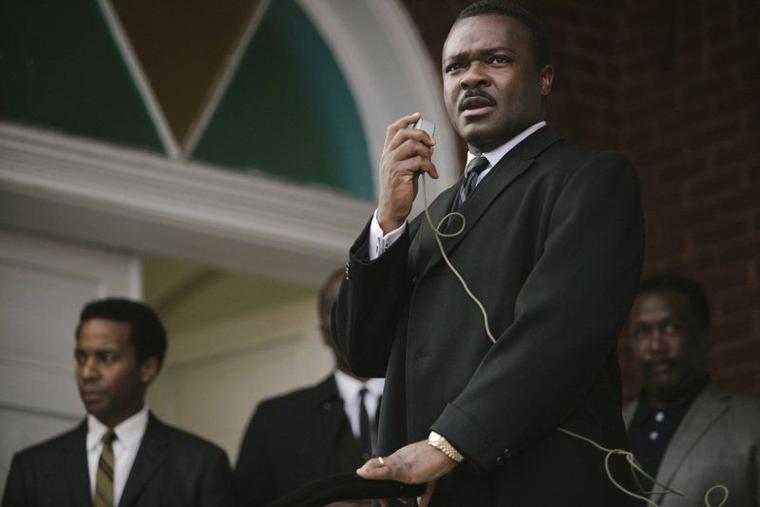
    Selma, one of this year's Best Picture contenders at the Oscars, is sublimely directed and driven by its actors' powerful performances. It traces Martin Luther King's campaign for equal voting rights - starting from the day he wins his Nobel Prize to the moment his dream is realized.


    As a Martin Luther King biopic, the film does his character justice. We immediately get a sense of Dr. King's elocutionary prowess at the beginning of the film as he rehearses the opening lines of his Nobel acceptance speech. Even before we see him, we hear his voice speaking light into darkness the way it did for so many African Americans during the civil rights movement. His humility does not escape us either, as he laments that it is "not right" how he looks like he's "living high on the hog dressed like this" while "folks back home" are suffering. In sharp contrast to President Johnson, who insisted that "this voting thing's just gonna have to wait," Dr. King persists in his determination to "build the path
    rock by rock" through civil disobedience. There is palpable hope among his allies for such an endeavour. For example, when Coretta King worries that she didn't have enough time to "prepare" prior to meeting Malcolm X, Amelia Boynton (leader of the American Civil Rights Movement in Selma), says to her: "We are the descendants of a mighty people [...] They've prepared you. You are already prepared."

    The film is carried by its cast, most notably the astonishing David Oyelowo. He sustains a regal poise throughout the film, one that is most evident when Dr. King turns his supporters around at the start of the second planned march to Montgomery, deciding to forgo bloodshed. Through Oyelowo's performance, we are closer to vicariously experiencing the stunning impact that Dr. King's speeches hand (and have) on people. Oprah Winfrey, although only in the film for brief scenes, delivered the second-best performance in the film. 

    But the true star of the film is its director. Ava DuVernay has a fine sense of timing and acute grasp of visual detail. A great touch is the inclusion of "F.B.I notes" to show how J. Edgar and his team routinely logged Dr. King's activity. Scenes with these notes are shot from a distance to give us some perspective. DuVernay also shocks us effectively (very effectively) with the explosion in the opening of the film, but not at the expense of elegance. Indeed, she captures grace in violence through the slow-motion aftermath that follows: young girls float through debris as if they were weightless ballerinas. Such technique is echoed later on in the most striking scene of the film, as men on horses charge and whip protestors during their first march to Montgomery. Music beats in the background as people, running for their lives through cloud, are chased and terrorized. DuVernay knows how to run an action scene. The tensest and most heartbreaking of these is that of Jimmie Lee Jackson's death. (That was the first instance where I cried when watching the film; the second was, of course, the ending.)

    In some ways, Selma does not have the sense of novelty that it would need to beat out its opponents for the Best Picture race. Moreover, because the writers trimmed the scope of the film's depiction of Dr. King, it does not cover the entirety of his legacy. Whereas The Grand Budapest Hotel is driven by its plot and Birdman by its cinematography, Selma - more limited in plot and empowered mostly by its actors - is at a disadvantage. Yet Selma is timeless. As Common raps in what is a sure-win at this year's Oscars for Best Original Song, "Resistance is us ... That's why we walk through Ferguson with our hands up." The path to equality still extends before us; I hope that many remain with the tenacity to build that path "rock by rock." 


    Friday, January 16, 2015

    The moments


    Boyhood is an extraordinary film and an astonishing endeavour. Directed by Richard Linklater and filmed over a span of 12 years, it tracks the boyhood of six-year-old Mason from 2002 to 2014. The actor who plays Mason, the now-20-year old Ellar Coltrane, was cast at age six, just as the other actors in the film signed up for their roles 12 years ago. So, without a finalized script or clairvoyance (that we know of, at least), Linklater shot segments of the film annually for a 12-year period while the actors got on with their lives. Indeed, we even see elements of the actors' personal lives in the film itself.

    Throughout the film, music, allusions and clothing are the markers that guide us through this 12-year span of time. Right at the start, Coldplay's Yellow indicates that the movie is set in the 2000s. Mason's trip to see The Chamber of Secrets in cinemas takes us up to 2002. Near the end of the film, Gotye's Somebody That I Used To Know transports us to 2011. Towards the end of the film, Facebook and iPhones become a part of the story.

    The beginning of the film is set in Texas, where Mason lives with his older sister, Samantha (Lorelai Linklater), and his mother, Olivia (Patricia Arquette is fabulous). Mason's father, Mason Sr. (played by the amazing Ethan Hawke) and Olivia have separated, but Mason Sr. soon returns to Texas and begins to visit the children weekly.

    From here onwards, the film touches upon all the chapters of boyhood: young Mason daydreams in class, is fed up with his annoying older sister, flips through lingerie magazines with childish curiosity, goes through an acne phase, gets himself a girlfriend, turns fifteen, graduates...and finally heads off to college.

    The interim is interspersed with meaningful scenes that capture the relationships between father and son, son and mother, boyfriend and girlfriend, and so on. One of my favourite scenes is the one in which Mason. Sr. has the "birds and the bees talk" with his children - it is as awkward for them as it is for him and nothing about that scene seems falsified in any way. Another memorable scene takes place when Mason. Sr. drives his children to a park on one of his weekend visits. Here, we see his attempts to  be a good dad: he asks his children how their week was, wanting to get to the heart of the question and refusing to be "that guy," refusing to be the stereotypical dad-who-visits-every-weekend in the divorce. So, what is lovely about the father-son dynamic in this film is the way Mason Sr. - although initially lost and with a drinking problem - cleans himself up and forms a meaningful bond with his children. The most moving instances of this are the scenes in which Mason and his father go hiking, and when Mason. Sr. confronts his son after his break up.

    Speaking of father-son relationships, it is important to consider the men in the film because this is, after all, a movie about boyhood. Mason's father is wonderful, but he is not immune to placing expectations on his son. When he takes Mason out bowling, for instance, he insists that Mason forgo the bumpers (through another lens, this could be seen as Mason Sr.'s way of teaching his son perseverance). When Mason and Samantha show him dry Canadian grass and basketball team photos, respectively, it is the latter that grabs his attention. As Mason ascends to the eighth grade, his perceptions of manhood are further influenced by the seniors he meets. Spouting out profanity and challenging "are you gay," these seniors capture the stereotypical immaturity and self-consciousness of teenage boys.

    Yet none of this is too troubling, unlike the disturbing "mansplaining" attitude of Professor Bill, Olivia's second husband. He demands Mason to cut his hair, saying that he will now "look like a man instead of a little girl." He orders his own children to do their chores rigorously. He dictates the way his son plays golf. Worst of all, he is tyrannical and abusive - what kind of boyhood will his son experience?

    So, as much as the film is about boyhood, it is also about parenthood. Early on, Olivia exclaims, "I'm a parent, that means responsibility." Indeed, she does an astounding job at being a mother - having to face her daughter's "horsesh-t attitude," pulling her family out of poverty and raising Mason and Samantha until they graduate. She uses the tiger as an example to explain love during one of her classes, saying that mother tigers abandon their cubs and "throw them down" in the face of danger. For her, however, the opposite is true; she is the one who clings onto her children despite all danger and strife. Her motherly instinct is further strengthened at the end of the film, when the family runs into Ernesto, the man who had fixed their sewer pipes years ago. Now one of the managers of the restaurant they dine at, Ernesto credits Olivia for inspiring him to learn English and find his current. "[Olivia] is a smart woman," he tells Mason and Samantha. "You should listen to her."Yet the day Mason leaves for college, Olivia breaks down, crying, "I just thought there would be more."  Although the audience will inevitably get caught up in the journey of Mason's boyhood, we must not forget that it is his mother - not his father, stepfathers or peers - who does the best and most wholesome job of raising him.

    Speaking about the film's ending, the whole film retains its structural integrity. For instance, it opens with the family moving and ends with another instance of moving, but it is only Mason that moves the second time round - into adulthood. Similarly, we can draw a clear link between Mason's childhood love for staring out of the window to his eventual passion for photography. Even Jimmy, the friend of his father whom Mason met when he was still young, reappears at the end as if to reinforce the length of time that has elapsed since.

    So, it is fitting that Mason says to Nicole, one of the first girls he meets at college, that the young kids she tutors "haven't reached the awkward years yet."He, after all, has just gone through those awkward years - and what a journey they have been!

    The fact that Linklater actually tracked his characters for 12 years contributes to the most striking element of this film: its realism. Yet he also achieves this because the dialogue in the film is so spot-on that it ceases to seem like scripted material. Indeed, I  saw myself reflected in the way Sheena, Mason's ex-girlfriend, chats with Samantha. The awkward laugh, the tucking of the hair behind her ear...I mean, I do that too!

    At the same time, Boyhood - for all its realism - cannot be considered a faithful representation of "boyhood," although it may come close to capturing an idealized American boyhood (hence Mason's baseball games, a shotgun for his 15th birthday, a graduation party). Where was Mason's real teenage angst and where were his wild adolescent years of rebellion? Boyhood, striking as it is, deals with certain troubles of boyhood in some parts - but lacks to address some others.

    Nonetheless, the final line of the film pithily captures its essence: "It's constant, the moments, it's just — it's like it's always right now, you know?" Linklater, after all, filmed Boyhood in the "right now" moments. He has translated a coming-of-age story onto screen in a way that allows the audience to vicariously experience - and truly witness - the passage of time through film. Boyhood is a work of incredible scope that is, despite its flaws, the most important contribution to cinema in a long while.


    Saturday, January 10, 2015

    The search for peace of mind

    My Age of Anxiety: Fear, Hope, Dread, and the Search for Peace of MindMy Age of Anxiety: Fear, Hope, Dread, and the Search for Peace of Mind by Scott Stossel
    My rating: 5 of 5 stars

    Scott Stossel's My Age of Anxiety is a personal, honest and thorough exploration of anxiety - what it is, how it manifests itself, how it is treated and how it may, in moderate levels, even be a blessing.

    Anxiety may be defined as "a signal that the usual defenses against unbearably painful views of the self are failing." Exploring its various interpretations in the opening chapter of the book, The Riddle of Anxiety, Stossel writes that it is a "medical illness," a "philosophical problem," a "psychological problem" and perhaps even "a cultural condition, a function of the times we live in and the structure of our society." Molecular genetics have also suggested that anxiety has hereditary roots; Stossel, who belongs to a family of phobics, is living proof of this. Indeed, it is striking to note that we share the same evolutionary roots as rats and marine snails when it comes to fight-and-flight reactions. Is anxiety purely a cruel trick of our biological mechanisms, then? Perhaps not. As Stossel points out, what differentiates humans and animals is our orientation towards the future. "An animal cannot fear death," the source of many of our "fear of ontological givens"

    So, these categories are certainly not mutually exclusive. As Stossel writes, "anxiety is at once a function of biology and philosophy, body and mind, instinct and reason, personality and culture."

    Focusing on the impact of culture on anxiety, Stossel also discusses the ways in which our understanding of and response to anxiety have changed over time. For example, the fight-or-flight reaction mentioned above was well adapted to dealing with legitimate physical dangers in the past. Yet these days, this response is activated by what tumblr might term '21st-century-problems.' Among the few listed in the book, "the college application process" is the one I identify with the most. As Stossel eloquently puts it, the result is that we end up "marinating in a stew of stress hormones" that are detrimental to our health and only elevate our anxiety.

    Moreover, the digital age in has heralded a sprawl of choices and possibilities that did not exist before. We, before a myriad options that at once liberate and trap us, have become victims of the "paradox of choice." Thus, as Stossel proposes, maybe anxiety is "a luxury" - in many ways, it is the consequence of the breadth of personal freedom that the generations before us did not have. Moreover, as social media continues to construct extreme standards of beauty, what psychologists call "impression management" - the fear that others will perceive one's inadequate self - has now become both a symptom and cause of anxiety.

    Throughout the book, Stossel also outlines the many ways of curing anxiety, including riveting personal anecdotes. The most memorable of these is his horrifying experience of trying to vomit. Such an approach falls under the umbrella of "exposure therapy" - the process of exposing ourselves to what makes us anxious in order to overcome it. There is also the biomedical approach, which tackles the mechanisms of anxiety by focusing on research concerning the amygdala (the part of the brain that controls fear) and hippocampus. Interestingly, research has shown that people who meditate have much denser amygdalas. Other approaches include the experiential approach, which seeks to addresses the issues underlying anxiety, and the psychoanalytical approach, which encourages patients to develop a conscious awareness of their repressed conflicts in order to achieve a sense of emotional closure.

    Moreover, Stossel also explores how drugs have worked to cure - but perhaps even increase - anxiety. In the case of the former, drugs such as Xanax and Prozac have been used by celebrities, musicians and thousands of anxious people worldwide. On the other hand, the presence of these drugs might have put into place a self-fulfilling prophecy regarding anxiety; indeed, reported cases of anxiety have soared since the drugs first entered pharmacies. You would think that more people would feel stressed out during World War One than now, but in fact statistics show that the latter is true instead. In legitimizing anxiety in the DSM (Diagnostic and Statistical Manual of Mental Disorders), have we merely escalated what could otherwise be simply referred to as 'worry?' In some cases, many may be tempted to say yes. Yet Stossel's story and those of the many others he writes about suggest that anxiety is - in its harshest form - a draining, debilitating and maybe even fatal condition.

    In the midst of all our fears and anxieties, however, a silver lining persists. For example, Stossel argues that those who are phobic "retain their love for mankind" by transferring their fear of humanity's evils onto other things, like the dark. Those who are anxious are also more sensitive to others' feelings, making them - in some ways - better spouses and friends. Finally, most worriers are workers; don't we all know that one person in our class or office who frets about the tiniest details but scores the highest on the exam or gets the first promotion? If harnessed properly, anxiety can fuel our productivity. Stossel writes about a basketball player who used to vomit before every match but would then go on to play incredibly (up to the point where his coach would not allow the game to begin until he had vomited). Isn't Stossel himself, editor of The Atlantic and author of this incredible work, also proof of how anxiety can help people achieve more and with more focus?

    I find it astounding that Stossel has written this book, "come out of the closet" as it were, and shared his fears and findings with the world. My Age of Anxiety is an astounding "quest to understand, and to find relief or redemption in, anxious suffering." It is an important read for not only the people who suffer from anxiety, but also the families and friends of those who live in "fear, hope, dread" and are ever on "the search for peace of mind."


    View all my reviews

    Friday, January 9, 2015

    On s'est bien battus

    Deux jours une nuit is a mesmerizing film about tenacity, human nature and the meaning of value. It traces the story of Sandra, a mother of two, who struggles with depression and anxiety but is given the chance to recover her job in the timespan of two days and one night. To do so, Sandra must confront her sixteen colleagues over the weekend and convince at least nine of them to cast a vote on Monday morning that will decide whether she gets to keep her job - or whether she will lose it while her coworkers, now fewer in number, will receive a 1000-pound bonus.
    Sandra ou la prime? is the question that is asked before the votes are cast near the end of the film. Sandra or the bonus? These words pithily capture the primary ethical question that looms before us in the film: Compassion or pragmatism? Utilitarian or egotism? 

    Such a question, difficult as it already is, is further complicated in the film. Sandra, for instance, is not an indispensable worker. Thin, bedridden and dependent on Xanax, she herself questions her competence and self-worth. If her colleagues choose to keep her, therefore, they will be doing so purely out of humanitarian reasons. Furthermore, her colleagues must take their own financial bearings into account when making their decision. As Sandra visits their homes, the audience realizes quickly that the people she works with also belong to the lower-middle class of Belgian society. Some work double jobs, some live in dingy apartments.  

    What is most intriguing about the film is, of course, the ways in which the colleagues respond to Sandra. The first man she meets seems almost willing to side with her, but his wife interjects and angrily reminds him that they have to pay their daughter's college tuition. Another colleague, Nadine, flat-out refuses to even answer the door. She instead makes her daughter do the dirty work and pretend that no adults are home. It is Timur, on the other hand, who shows the most empathy - crying, even - when Sandra approaches him. It is also Timur who reminds Sarah of a time when she once showed him kindness; I suppose there is still good karma after all.

    At the same time, Sandra's meetings do not simplify down to yeses and nos. Alphonse, for instance, struggles because he is afraid that Jean-Marc, his contremaître (and the one who threatened the colleagues to vote Sandra out), will revoke his contract upon knowing that he decided to vote for Sandra. Graver still, Sandra's visits - as she herself notes - provoke conflicts, ranging from spats between spouses to actual fistfights between employees. The miraculous turn of events is that one of these fights finally pushes Anne, one of the colleagues, to leave her abusive husband. There is the idea that Sandra's visit offers her sixteen colleagues the opportunity to reflect, reconsider and reevaluate. Yet how many choose to do so? It is fitting, then, that the vote ends in a draw. Indeed, this ending works out not only because it elaborates the plot, but also because it perpetuates the question the film asks: Sandra ou la prime? 

    The presence of children in the film is particularly striking. Firstly, the fact that almost all of Sandra's colleagues have children means that the question for most of them is not only Sandra ou la prime, but also Sandra ou la prime [et le bien-être de ma famille]. Moreover, the children add a layer of innocence and lightness to the otherwise heavy, adult-dominated film. It is lovely that a child walks her to the laundry room as she heads there to meet Alphonse. Despite all the unkindness that she has been shown by some of her coworkers, not a single child looks at her meanly. So, it is ultimately Sandra's children and her dedicated and tenacious husband, Manu, who form her backbone. It is them for whom she fights. 

    Throughout the film, we often see Sandra under sunlight as she rushes from door to door; instead of appearing illuminated or emboldened by the glow, however, she appears weak and overcome. Yet this is in stark contrast to Marion Cotillard's performance. Capturing anxiety and despair but also renewed hope and gratitude, she powerfully portrays a character who - despite feeling like "un mendiant" -  persists with her long journey to rediscover self-worth. She is fearless and flawless.

    Deux jours une nuit is truly a film that deserves the 15-minute standing ovation it received at the 2014 Cannes Film Festival!


    Wednesday, December 31, 2014

    2014 -My Year in Books


    As the 365-day symphony of 2014 reaches its final bars, I find that a great way to evaluate the music of the year - in both personal and universal contexts - is through books.

    Above are the 35 books I read this year (thank you, Goodreads, for helpfully generating the image), listed in chronological order starting from the bottom right.

    Well, 2014 was the year of academic reading. 10/35 books this year were read for academic purposes or in an academic context. I have a Goodreads policy of only listing the books I've perused totally as "read," so the number is actually higher. Out of these books, 2 were re-reads (Cormac McCarthy!) in preparation for my extended essay, 2 were Chinese and 1 was French. Despite having read these books "for school," however, I enjoyed them, fell in love with several and was certainly inspired to read further because of what I'd read on their pages.

    In 2014, the reading world went crazy for Karl Ove Knausgaard's The Struggle, Donna Tartt won the Putlizer for The Goldfinch and Dave Eggers published Your Fathers, Where Are They? And the Prophets, Do They Live Forever? I also spent the year catching up on the books that had captured the attention of the literary world last year: Alice Munro's Something I've Been Meaning to Tell You and Eleanor Catton's The Luminaries.

    This year, I was further convinced that I love reading about the tropical: Jhumpa Lahiri's The Lowland and Michael Ondaatje's Running in the Family filled my year with lyrical prose and enrapturing stories. Speaking of Running in the Family, I also ventured into the realm of memoir/personal narrative this year, not only with My Struggle, but also with Jason Ng's No City for Slow Men, Kim Thuy's Ru, Jean-Dominique Bauby's Le Scaphandre et Le Papillon and Annie Lamott's Bird by Bird.

    I was also able to complete some to-reads this year: the aforementioned Bird by Bird, Swamplandia, The Brief Wondrous Life of Oscar Wao and Blink, for instance. Meeting Junot Diaz was just the cherry on top of the literary ice cream.

    These books have bookmarked my year like rehearsal letters on sheet music. Remembering them is to recall how I spent my days in 2014. Once the SATs were over, I sequestered myself in the HK Library and at home to devour Bird by Bird and Swamplandia; I remember reading The Luminaries in the car on my way to my violin teacher's home; I read 9 books over the summer (from Les Choses to The Language Instinct); I read Your Fathers while waiting for my flight to Pennsylvania; I bought My Struggle and Tinkers in Boston; I remember reading the latter in the lobby of the hotel I was staying at in New York; I read The Language Instinct in the final week of summer while my brother was at his internship; I devoured The Goldfinch over the second extended essay week period and loved that bildungsroman with all my heart.

    Looking at these books, I'm also able to set myself some New Years' Resolutions. This year, the ratio of French books to Chinese books I read was 2:1; next year, I hope to close that ratio un peu. I will continue to immerse myself in more non-fiction books and memoirs. I'll try to read the Pulitzer/Orange Prize/Nobel/etc. winners of 2015 in 2015. Of course, I'll also keep reading nonfiction (I have a bunch of books about intuition on my desk right now).

    2014 has been a year well-spent reading and writing; I hope the new year will bring its wealth of words and wisdom into my life.


    Tuesday, December 30, 2014

    Honeydicking

    As a long-time James Franco fan, I am generally supportive of his various but oft-perplexing endeavours (his Instagram gallery is more than adequate proof of this). Yet when I first heard that he and Seth Rogen, Hollywood's favourite bromance, were making a movie about assassinating Kim Jong-un - I balked. This is a terrifying and ill-advised idea, I thought to myself. Indeed, when threats from North Korea began rolling in, I could not help but ascertain that Sony should have seen this coming. But when the movie was ACTUALLY pulled from cinemas - what?! That's when the maddening injustice of the whole hacking business and controversy regarding the film began to settle in.

    Obama put it best: "We cannot have a society in which some dictator someplace can start imposing censorship here in the United States."

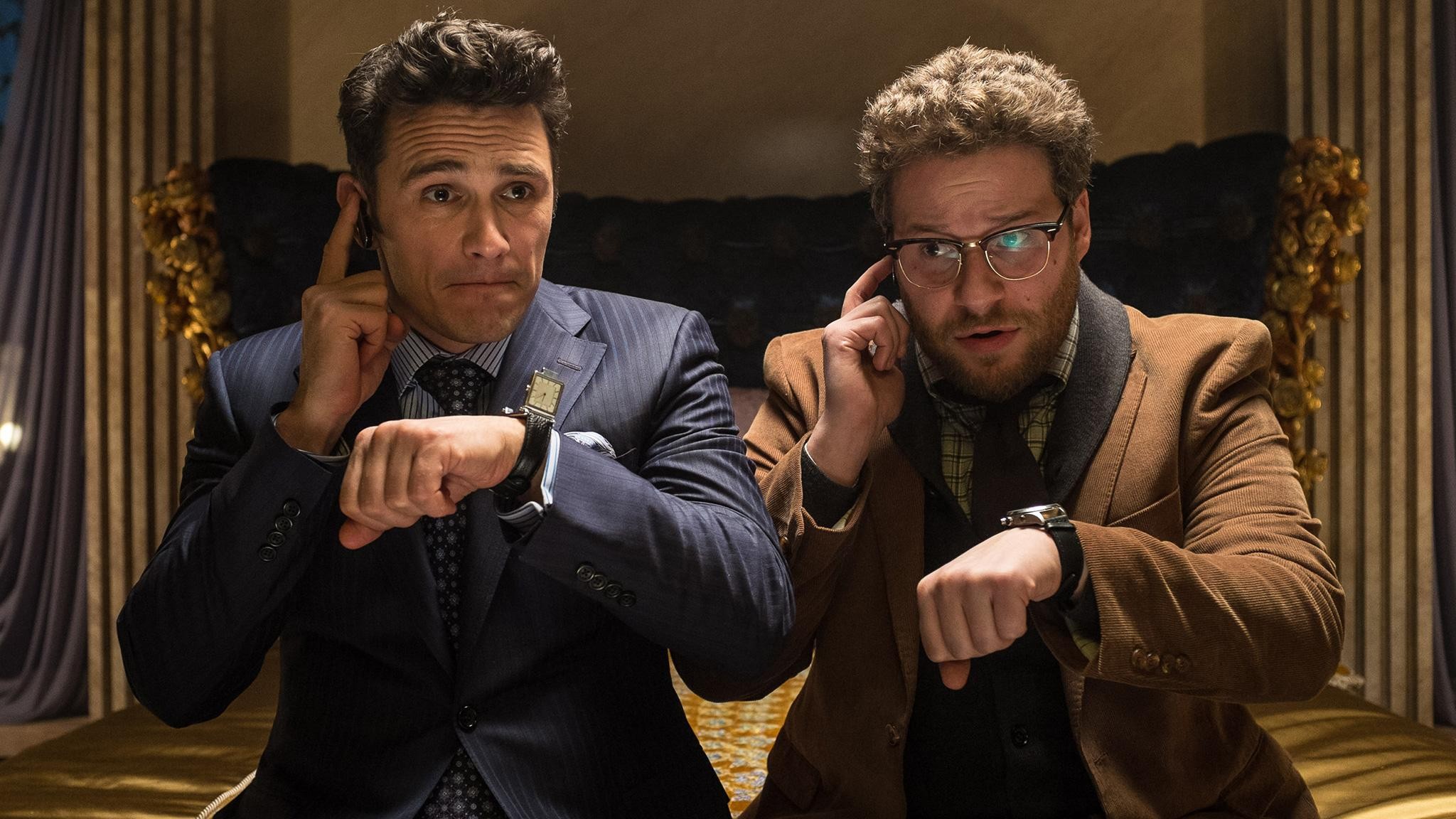
    So, The Interview was finally released (not only in select cinemas, but also online - a first for Sony) and I watched it last night. Unsurprisingly, it channels the same crude humour and vulgar language from Pineapple Express and This is the End. Yet The Interview is a standout film from Seth's repertoire, especially in light of the drama it has aroused.


    Firstly, the movie is actually pretty funny. Seth makes effective use of juxtaposition throughout: an innocent-looking girl sings a terrorist anthem at the beginning of the movie, Katy Perry's Firework is the soundtrack to the supreme leader's airborne incineration and Dave runs out of the compound clutching a puppy (an ADORABLE puppy).

    So, Seth Rogen knows what he is doing! One particular critic has argued that Randall Park and Diana Bang deliver the best performances in the movie, but I disagree. I was especially impressed by Rogen's acting chops in the taxi scene (racist as his Chinese accent was).

    His partner in crime, James Franco, pulls off an incredible and memorable Dave Skylark in The Interview. Uninformed, unreasonable, impressionable, shallow, self-centered, unprofessional, caring, goodnatured, presumptuous, unabashed - Franco is all of this and he is brilliant. Watching his energetic performance, one wouldn't imagine that this is the same guy who, with shades over his eyes and a baseball cap pulled down low, shuffles wearily down a line of selfie-ready fans after weekly showings of Of Mice and Men.

    Yet it is the goofy Dave Skylark who finally delivers the most serious line of the movie: "So why don't you feed them?" Directed at his interviewee, the supreme leader of North Korea himself, this question segues into great scripted conversation between Dave and Kim that reveals the vulnerability of both men. There's Dave, who - although unabashed on the outside - is hurt by the media's criticism of him (like James??). Well, he gets by through subscribing to his maxim: They hate us 'cause they ain't us. Then there's Kim, who still finds himself living in his father's shadow and has to disguise his love for foreign entertainment (specifically, Katy Perry). Despite the "seriousness" of the second part of the interview itself, however, the movie still retains its farce because Dave (as he even insists on mentioning) only has his great epiphany about Kim's tyranny because of a GRAPEFRUIT.

    Structurally, the pacing of the movie is sublime. The plot unravels brilliantly, except for Dave and Kim's first encounter - that segment was slow, uninspiring and unconvincing. Yet the movie as a whole wraps up well and ties the whole storyline together. Dave is saved by a bulletproof vest, he and Aaron get rescued by SEAL and he gets to write his final tell-all (just as he predicted). Democratic elections will be held in NK, Kim is out of the picture and Sook has gotten Skype.

    Near the end of the film, however, not everything is all smiles. On the boat with Dave and his adorable puppy, Aaron remarks that he was "honeypotted" by Sook, just as Dave was initially "honeypotted" by Agent Lacey; they were both manipulated to cooperate with others' plans. Although both incidents of "honeypotting" were done for a good cause, the whole concept of "honeypotting" (if a woman is behind it) or "honeydicking" (if a man is behind it) extends beyond the movie.

    I cannot believe the following sentence is about to be published on my blog, but - is Kim Jong-un not the greatest honeydicker of all? In the movie, we only see him honeydicking the gullible Dave so that he will ask him 'good questions' during their interview (which, as he furiously says afterwards, failed). In the movie, Kim bursts into tears and destroys his carefully-crafted cult of personality on live TV. In real life, however, he continues to honeydick a nation.

    So, The Interiew is entertaining, silly, crude, sometimes gruesome and packed with perfect (actually perfect) LoTR references - but it is also a comedy that exposes the consequences of "honeydicking." You might forever remember The Interview as that-Seth-Rogen-and-James-Franco-film-that-exacerbated-NK-US-relations, but also remember it for its message: don't be honeydicked.


    Sunday, December 28, 2014

    La Délicatesse

    La délicatesseLa délicatesse by David Foenkinos
    My rating: 5 of 5 stars

    In David Foenkinos's La délicatesse, the beautiful and enigmatic Nathalie becomes a widow after her husband's sudden death. From thereon impenetrable, she coolly deflects the sexual advances of Charles, her boss, and channels her grief into her work. Yet the unexpected happens when Nathalie - out of the blue - kisses her Swedish colleague Markus on the lips. Although the kiss is merely "un acte gratuit" (an unwarranted act) to Nathalie, Markus - old, balding, single, awkward and unlucky with the ladies - is overwhelmed, stupified and approaches her. Between them, a friendship forms and finally develops into 'something more' that is both unlikely and lovely.

    The theme of chance, as evidenced by le baiser gratuit (the unwarranted kiss), runs throughout the novel. The idea of coincidence determining destiny is also clear in one of the most-cited extracts from La délicatesse, the scene in which Nathalie and her husband go on their first date:
    "Le jus d'abricot, c'est parfait. Si elle choisit ça, je l'épouse... -
    Je vais prendre un jus... Un jus d'abricot, répondit Nathalie. Il la regarda comme si elle était une effraction de la réalité.
    It is because Foenkinos makes us wonder at these miracles that we are so easily drawn into the novel. Despite everything that seems to happen by chance in the novel, however, Foenkinos ties the whole story together in 117 'mini' chapters, which are not only told from the points of view of Nathalie, Markus and even Charles, but sometimes also consist of nothing but facts. For instance, one chapter will describe Nathalie and Markus having dinner together and then next will simply enumerate the ingredients used to make their risotto. One chapter will tells us about how Nathalie hops on a train and the next will detail the arrival and departure times of her journey. In some ways, this is the juxtaposition between the surreal and banal, the circumstantial and deliberate.

    It is in one of these chapters that Foenkinos cites Larousse in explaining the literal meaning of the title:
    La délicatesse : n.f.
    1. Fait d’être délicat. (To be delicate)
    2. Litt. Etre en délicatesse avec quelqu’un : être en froid, en mauvais termes avec quelqu’un. (To be in delicacy with someone: to be on bad terms with someone)
    Indeed, delicacy manifests itself throughout the novel. Nathalie herself is delicate in a petit and charming way and is the outwardly embodiment of delicacy. Yet after she becomes widowed, she finds herself in a delicate situation of which the indelicate Charles hopes to take advantage. As Nathalie herself concludes, even Chloe - her colleague - asks indelicate questions and cares only for "des ragots" (gossip). Nathalie becomes "en délicatesse" with them. On the other end of the delicacy spectrum, however, is Markus. Considerate of Nathalie's feelings and gentle towards her, Markus encapsulates the warmth and understanding of delicacy. It is through such delicacy that Nathalie finds solace and renewed love. For example, we are told in the first page of the novel that is "assez rare pour une Nathalie" (rare for a Nathalie) to not feel any nostalgia. Yet after Markus gives her un distributeur de Pez as a gift, she is transported back into her childhood past. How lovely is it that Foenkinos shows us delicacy in a man whom is otherwise regarded by those around him as graceless and ungainly?

    Finally, the novel itself is also a work of great delicacy. In the final chapters, Nathalie reveals that she used to play hide-and-seek in her garden and would open her eyes after 117 seconds. Of course, the question of chance and coincidence now emerges in not only the story but also in the work, for it is in the 117th chapter that the novel concludes with a one-liner: Nathalie ouvrit les yeux. In a poetic and delicate way, it is indeed as if each chapter of the novel was only a second.

    It is within one of these "seconds" that Foenkinos writes one of the most striking lines I have ever read in any French novel: "le Larousse s'arrête là où commence le coeur" (Dictionaries stops where the heart starts). So, although Foenkinos intersperses what appears to be fortuitous with facts and definitions throughout La délicatesse, it is finally emotion from le coeur - the impulsive act of un baiser gratuit - that trumps rationality and brings two seemingly disparate, but delicate, individuals together.
    La vie peut être belle quand on sait l'inconvénient d'être né.
    Pourquoi sommes-nous autant marqués par un détail, un geste, qui font de ces instants minimes le coeur d'une époque?
    On peut penser, toujours dans la folie, d'un mouvement presque démiurge, que l'on est au coeur du coeur de l'autre. Que la vie se résume à un vase clos des valves pulmonaires.
    Le sentiment amoureux est le sentiment le plus culpabilisant. On peut alors penser que toutes les plaies de l'autre viennent de soi. On peut penser, toujours dans la folie, d'un mouvement presque démiurge, que l'on est au coeur du coeur de l'autre. Que la vie se résume à un vase clos des valves pulmonaires.
    La vie peut être belle quand on sait l'inconvénient d'être né.
    Le sommeil est un chemin qui mène à la soupe du lendemain.
    Après leur dernier échange, il était parti lentement. Sans faire de bruit. Aussi discret qu'un point-virgule dans un roman de huit cents pages.


    View all my reviews


    Thursday, December 25, 2014

    Joyeux Noël

    Every year, I write up and publish a Christmas blog post. So, although I didn't do many Christmassy things today, I - knowing that this is the last December 25th I will spend in Hong Kong as a high schooler - nonetheless want to wish whoever is reading this a convivial christmas!


    One year later, Petit Papa Noël is still my favourite French Christmas carol and I still insist on wearing my "Joyeux Noël et Bonne Année" sweater around the house. Yet much has changed. The festive weight of Christmas day is much lighter this year. Wheeling a shopping trolley around a packed supermarket this afternoon, my eyes glued to the feet of distracted shoppers, I couldn't help but wonder - what makes this day ostensibly "Christmas" apart from the obligatory (and flat) carols one hears beneath the din of creaky carts and cashier register beeps? Now, at ~11:58pm, I think that I could have carved out a larger portion of today to reading/writing Christmas poems (or perhaps going all out and baking gingerbread men). I've decided that society does need Christmas - in December, economy soars, depression rates drop (I believe) and the new year is ushered in while the glittery debris of tinsel still sparkle around the house.

    Merry Christmas, everyone!


    Sunday, December 21, 2014

    The Geography of Thought

    The Geography of Thought: How Asians and Westerners Think Differently... and WhyThe Geography of Thought: How Asians and Westerners Think Differently... and Why by Richard E. Nisbett


    Richard E. Nisbett's The Geography of Thought examines the age-old question that has intrigued  psychologists (and anyone, really) for centuries: how do Eastern and Western modes of thought differ, and why?

    In the book, Nisbett begins by explaining the core foundations of thought on either side. In the East, Confucianism states that the world is a complex place that "consists of continuous substances." In the West, Aristotelianism asserts that "the world is composed of discrete objects or separate atoms."

    So, it is natural that the people who suscribe to the first system of thought value harmony; to them, a world of "continuity" can only exist and function if its units interlink and cooperate. As Nesbitt puts it, a "sense of self was linked in a network of relationships." He discusses the ecology of China to support this thesis, pointing out how the flat plains of the mainland demanded farmers to work together in ancient times (even the irrigation system remained fixed under centralized control). If we consider China's political present and history - communism, communes, cooperatives - it is easy to see that collectivism has taken precedence. Anyone who has grown up in a Chinese family will also understand the importance of family dinners, long meals that take place around a round table with not only one's immediate family, but also one's cousins, grandparents, aunts and uncles. The Chinese developed a strong concept of social obligation that stressed relationships.

    On the other hand, Westerners - whose world is composed of discrete objects - place more emphasis on individualism. Indeed, looking to ecological roots once more, Nisbett explains that the sloping mountains of Greece allowed for occupations such as hunting that were more or less independent - and commercial. In the West, we see a culture that is famous for vineyards, not paddy fields. Moreover, debate was common in the political assembly of ancient Greece, whereas arguments were considered threats to the harmony of the East. Here, we already see a Western inclination towards expressing personal viewpoints instead of relapsing into the collective. While Western societies encourage one to "stand out," Eastern societies strive to maintain equilibrium. Thus, it is no surprise that America is capitalist and perhaps the world's staunchest advocator of independence and human rights.

    Of course, pros and cons accompany such differences. For example, Eastern societies' reluctance to reduce information into simple models due to their belief in the world's complexity might be justifiable; however, the West does classify its objects into categories and use such groupings to develop simple models, rules and theorems that forward opportunities for scientific and technological breakthroughs. Unsurprisingly, the West has the upper hand in the field of scientific development.

    (To explore the Western tendency to categorize and the Eastern preference to focus on relationships, Nesbitt asked students of different backgrounds to group two of the following three organisms together: a chicken, a cow and some grass. Westerners tended to group the chicken and cow - the animals - together. Asians, noting the relationships of cow eats grass, left out the chicken.)

    Where the East succeeds, argues Nesbitt, is their readier acceptance of change. After all, they believe that different elements must adapt in order to coexist in a world of continuous substances. Relationships cannot work without compromise. The reason why Asians are thus better at math, Nesbitt proposes, can be attributed to their drive to "work harder" - to change - as opposed to the Western belief that one may simply lack the "innate skills" to be good at math. (To be honest, I found Malcolm Gladwell's argument much more convincing.)

    Interestingly, Nesbitt also discusses how the difference in modes of thought affect language. One of the most memorable examples in the book is about how the Chinese will say, "drink more," whereas Westerns inquire, "more tea?" during social gatherings. The former, whose culture revolves around relationships, use a verb; the latter, who focus on the object, use a noun.

    The Geography of Thought is a lucid exploration of the differences between Eastern and Western modes of thinking. Yet at the end of the book, I couldn't help but wonder - is that it? Surely, there must be more? How would one categorize Russia, for instance, a country that could be considered Eastern and Western? What about further studies conducted in places like Hong Kong, which Nesbitt himself even acknowledges as a great laboratory for cross-cultural study? What happens to the development of thinking in places that have been much influenced by the West?

    Certainly read this book if you are interested in the ways the East and West think differently. I find The Geography of Thought to be is a springboard, a well-researched platform that will push you to read more widely on the subject it investigates.


    View all my reviews

    Wednesday, December 17, 2014

    I turn to paths that lead home

    That feeling you get when you walk into the cinema to watch the last cinematographic stretch of Middle-earth greatness is a nostalgic one.
    The Hobbit: The Battle of the Five Armies is a looong film, much dominated by the battle waged between elves, men, dwarves, goblins and wargs. Trust Peter Jackson to transform a couple of chapters into ~2.5 hours!

    Cinematically speaking, the graphics were stunning. 3D HFR is still tough to adjust to, but Smaug swooping into Lake-town was quite the visual experience. Not to mention the choreography for all the battles. Could a chunk of the fighting have been cut out? Certainly, although I must say that Legolas's showdown with the goblin nearly tops his slaying of the Oliphaunt.

    In many ways, The Hobbit movies have been much swayed by their marriage and persistent homage to the LoTR trilogy. After all, there are irresistible scenes in this film that only seem to serve the purpose of channeling LoTR:
    1) The part where Legolas goes off to seek "Strider" (hence LoTR!!)
    2) The final scene that takes us right back to the start of The Fellowship
    3) Bilbo with Thorin in his final moments, a scene that poignantly recalls Aragorn and Boromir's mybrothermycaptainmyking scene
    4) Galadriel unleashing her full power
    5) Alfred is basically Wormtongue

    Yet I think this is Jackson's way of ensuring that the film remains quintessentially 'LoTR' to Tolkienites. Most LoTR perceptions have been indelibly defined by the film trilogy.

    Hobbit-LoTR comparisons aside, however, The Battle of the Five Armies does further engage its audience with deeper elements of Middle-earth that LoTR hadn't exposed as thoroughly (and no, I am not just referring to how Legolas is finally thrust into an arrow-less situation).


    What love means to elves, notably, is explored throughout the movie. Early on, Tauriel struggles with her feelings for Kili because acknowledging them would be a betrayal to her kin. Legolas supposedly loves Tauriel, but speaks to her like a soldier; why is he so icy? Perhaps, as is hinted towards the end of the film, it is because of his mother's death. Thranduil, whom Tauriel accuses of having no heart, seems to be the epitome of the heartless, cold-blooded, unfeeling, immortal elf. Yet he later tells Tauriel that she feels heartbreak after Kili's death because her love for him "was real" just as he himself still mourns his wife.

    In this movie (and relevant chapters of the book), we also see in Thorin a King Lear-esque character, someone who admits that he was "too blind to see" under the shadow of 'Dragon sickness' - the autocracy and unreasonableness that overcomes one who lusts after gold and prestige. Indeed, the Arkenstone is Thorin's ring; it seduces and manipulates him.

    The one most immune to dragon sickness, and bravest to try and put a cork on the battle, is naturally Bilbo. Thorin's last words to him are,

    "If more people valued home above gold, this world would be a merrier place."

    The hobbit mentality encapsulated in Thorin's words is what has captured LoTR fans for centuries - the homeliness and warmth of the Shire and indeed of home. Bilbo doesn't say much in the movie (mostly just wrinkles his nose endearingly) but whenever he pipes up, we love it. Just as Galadriel is the Lady of Light, Bilbo is the pure token of home in The Hobbit. No matter how far one will bash these three Hobbit movies, there is no doubt that they all share that familiar, quintessentially Tolkien echo of home.

    As Billy Boyd sings the end credits of the film, we know that it is not only Bilbo who is bidding "a very fond farewell" to the company, but also the LoTR crew who is bidding adieu to their Middle-earth cinematic journey. Yet I don't think anybody will be saying farewell to the LoTR legacy anytime soon. The mark it has left on literature and film will and should inspire generations of readers, writers and dreamers to come.


    Sunday, November 30, 2014

    It is the things we love most that destroy us

    If I had to use a single word to describe Mockingjay: Part One, it would be tense.

    The opening of the film takes us to the aftermath of District 13's destruction. Katniss has been directly shipped from the games to the underground base where President Coin (Julianne Moore) and Head Gamemaker/rebel commander Plutarch Heavensbee (Philip Seymour Hoffman; R.I.P) recruit her to be the face of the new rebellion. She agrees - on the condition that Coin will pull Peeta and the other tributes out of the Capitol at the earliest opportunity. The remainder of the film revolves around Katniss's role as "The Mockingjay," tracing the impact she spurs in the other districts and in the Capitol.

    So, why tense? Humour is offered to us in sparse doses throughout the film. (The Hunger Games movies are not, after all, comedies.) We laugh when Katniss requests that Prim can keep her cat, chortle when the ever-fashionable Effie Trinket complains about having to wear a bland, grey jumpsuit, and smile as we watch Katniss tease her cat with a flashlight.

    So, the film does not thrust us into complete darkness. Yet most of Mockingjay: Part One is destruction and dread. Death swamps Katniss as she witnesses the wreckage of District 13 with her own eyes, seeing her home reduced to rubble. We watch her go through anguish as the threat of losing "them both" - Gale and Peeta - becomes increasingly likely towards the end of the film. It's a tense and heavy first half of a movie to watch.

    While Mockingjay: Part One concludes with Coin keeping her word, Peeta's return is not quite what Katniss had imagined. We barely get a look at his gaunt, bruised face before he lunges for Katniss's throat and begins what becomes the most chilling scene of the entire film. What more proof is needed of the Capitol's torture tactics once you see how it turns the antithesis of monstrosity - Peeta Mellark - into a monster?


    While that remains the most terrifying part of the film, its best scene is, without a doubt, the singing scene. "You want me to sing?" Katniss asks - and off she goes, delivering a rendition of The Hanging Tree that soon morphs into a full-blown choir of rebels who storm the Capitol's dams in a suicide mission to wipe out its electricity; this is how a revolution kicks off! The political roots of the film run deep. Troops keep to their formations in the navy-blue rain, echoing Nazi rigidity and channeling dictatorship vibes. They remind us that the Capitol is unrelenting and headed by the cold and merciless President Snow.

    So, the film owes its appeal to its daring themes - but also its characters. Again, Gale emerges as the loyal and stubborn best friend (emphasis on stubborn and friend), Haymitch makes welcome cameos (the sober life does not suit him), doe-eyed Sam Claflin sheds light on the exploits of the Capitol, but of course it is Katniss - or should I say Jennifer Lawrence - who completely robs the spotlight. Katniss is the face of the rebellion just as JLaw is the face of the movie. And, why not? She and Katniss are both bold and unafraid to speak up. (I just wish Katniss wouldn't be so self-effacing.)

    Mockingjay: Part One was tense - but it has set the stage for its next half, which I wait for with anticipation.