Showing posts with label film. Show all posts

Monday, December 19, 2016

Rebellions Are Built On Hope

Around this time last year, I watched The Force Awakens. It is fitting, then, that the first film I watched upon returning to Hong Kong was Rogue One.

The prequel to A New Hope, the film tells the story of how the Rebel Alliance procured the death star plans (and hence knew they had to blow up the reactor). Action-packed, suspenseful, and right in the heart of the galaxy, Rogue One thoroughly achieves what it sets out to do—although its aim, as I'll later explain, can be considered problematic.  


The film must primarily be commended for its stellar cast. Felicity Jones was bold and badass (this franchise deserves female protagonists), Diego Luna was kind and indefatigable, Riz Ahmed nailed the stressed-out-rebel-pilot vibe. But I must give a special shout-out to Donnie Yen, who is a Big Deal in Hong Kong and absolutely kills it as Chirrut (I was super happy to see his Yip Man skills strengthened by the Force). The action scenes in the film were well-paced and thrilling— by the time the Jedah scene was over, I had already stress-eaten all of my popcorn.

Rogue One is in many ways a classic Star Wars film—ships jump into hyperspace (and there's always some anxiety regarding this jump), an endearing talking droid is present, the Force is ~there~ but often scoffed at, the Empire is making everyone miserable, the protagonist has unresolved questions about her father, and so on.

But Rogue One is also different from the other films in that it is considerably darker (although that opening slaughter scene from The Force Awakens still gives me chills). ONLY a film like this—sandwiched between existing (and very successful) films, Episodes III and IV—could pull off killing all its main characters. After I walked out of the cinema, I somehow could not remember the names of Chirrut, Baze, Bodhi, and this usually isn't a problem for me. It's almost as if the film set up its characters to be unmemorable, nameless nobodies (Bodhi is more often referred to as "the pilot" than by his name). Through killing off the rebels, the film implicates (without every explicitly saying it) that the rebellion on the ground level is essentially a suicide mission. This perspective puts a *yikes* but also realistic spin on the film, which repeatedly tells us that "rebellions are built on hope".

The ending—despite the predictable yet nevertheless much-welcomed Leia entry—is truly kind of unsettling, given that it was preceded by a string of deaths (and nasty ones, too, at the merciless hands of Darth Vader). Leia tells us in the final scene that the chip she holds represent hope, but that somehow doesn't seem like a very satisfying answer. For me, it represents the tenacity and sacrifice of the rebels we just spent the past two-ish hours following; condensing all their efforts into 'hope' feels unjust.

And how many moviegoers genuinely care that pretty much every character we just rallied for died by the end of the film? They were never part of the 'big' picture. Ultimately, any new Star Wars film will always hinge upon the shadow of episodes IV-VI. That's why C-3PO, R2-D2, Vader, and those familiar headshots of goggled rebel pilots flying their ships had to be in the film. That's also why so much effort was made to extremely impressively and unsettlingly recreate Grand Moff Tarkin and Leia via CGI (honestly, I was floored by the results).

So, Rogue One did feel a little extra in the context of the whole Star Wars saga (the obliteration of the opening crawl already seemed to distance it from the other films). But I do like how it introduces more diversity into the galaxy and presents a view of the Star Wars universe that is less lightsaber-centric than its predecessors were. I grew up watching Star Wars as a kid and am honestly just happy that I get to keep watching these films as an adult.

As the url of this blog will always read, may the force be with you!

Saturday, August 20, 2016

Look for the bare necessities


I finally watched The Jungle Book (on the plane, of all places). It only took a minute of Mowgli darting through the jungle for me to start kicking myself for not watching the film in 3D—the animation and cinematography are stunning.
                                      
Although the opening scene suggests danger, we realize soon after Bagheera pounces on Mowgli that our protagonist has a special place in the jungle. Raised by wolves, the man-cub calls the pack his family and considers the jungle his home. Yet he has never assimilated completely into the wild; unlike his brothers and sisters, he matures slowly and has a penchant for ‘tricks’ that set him apart from the animals. He lives in contradicting circumstances as someone who is at once accepted in the pack but also a clear exception to ‘The Law,' which emphasizes the importance of being wolf-like.

Mowgli’s sense of belonging is not seriously thrown in question until the water truce brings all the animals—including Shere Kahn, the most feared and menacing tiger of the jungle—to the same place. Bent on killing Mowgli, whose father scarred him with fire (the ‘red flower’) years ago, Shere Kahn will stop at nothing to get his revenge. Thus, Mowgli is told to return to the ‘man village,’ the only place he will be safe.

Threats are abound in the jungle, from the hypnotic Kaa (not the first time Scarlett Johansson’s voice has been used to seduce) to the towering and power-hungry King Louie (truly reminiscent of Jabba the Hutt).

“Don’t run away from who you are,” King Louie tells Mowgli, thinking that he is destined to wield the flower of death and destruction. His advice, however, can be reinterpreted to reflect the truth; Mowgli defeats Shere Kahn by fighting “like a man,” demonstrating the power of channeling one’s true aptitude through devising ‘tricks’ instead of repressing his instinct for tool making.  

It seems symbolic that Mowgli does not finish reciting The Law at the end of the film, for much of The Jungle Book is about the beauty of bending the rules. Bagheera’s very decision to take in Mowgli at the beginning already sets such a precedent. The story is an important reminder that anyone can harness their potential and overcome the stereotypes that entrap them (even the initially slothful and plodding Baloo, who ends up scaling a cliff).

The animals came together once during the water truce, but it is ultimately Mowgli who unites them in a sense of solidarity and shows them that friendship can transcend the barriers in a community that may seem dictated by a food chain.

The film was so enjoyable to watch—intense, humorous (can Bill Murray go wrong?), and moving. I love how the elephants command an Ent-like presence (the similarities are uncanny: both are venerated, walk slowly, and use great volumes of water to their advantage). Of course, I also love the soundtrack (apart from the two swing dance classics performed by Baloo and King Louie, the film’s epic orchestral rendition of The Bare Necessities is what made me want to watch it in the first place).


“I wanna be like you,” sings King Louie. But the film shows us that it is much better to be the individual you really are, no matter where you come from or who you live with. Mowgli is not a man or a cub; he is a man-cub, and he belongs in the jungle all the same.      

Friday, August 7, 2015

破風

Dante Lam's 破風 (To The Fore) is the latest Taiwanese film to grace Hong Kong cinemas, and it does not disappoint. It's a movie about Taiwan's "national sport" - cycling - but also a fast-paced, suspenseful and refreshing exploration of the lengths one will go to for success and what it means to know (or push) one's own limits.


As the movie informs us from the onset, the “破風手" (called "the domestique") of any cycling team is the right-hand man who helps the sprinter facilitate a final sprint to the finish line by riding in his slipstream, blocking opposition. Despite the important role the domestique must play, however, it is only the sprinter who gets to stand on the podium of victory after each race. Domestique, after all, means "servant" in French.

破風 revolves around three bikers: 仇銘, 鄭知元 and 邱田. They all start off in the same team, in which 鄭知元 (Siwon Choi) is the sprinter, 仇銘 (Eddie Peng) is his domestique, and 邱田 (Shawn Dou) - although strong - stays near the rear. 仇銘's cockiness, 鄭知元's skill and 邱田's under-doggedness are all established early on. At first, such a trio brings their cycling team, Radiant, to glorious heights as they win race after race. 仇銘's bullheaded confidence is not yet disastrous, while 邱田's reserve does not take a toll on him yet. Once Radiant disbands, however, turning the three riders into immediate rivals from different teams, the film picks up - and each cyclist must face his flaws (and swallow his pride).

Although at times loophole-heavy and conspicuously CGI-ed, 破風 also teaches you more than you'd expect about biking tactics, competition rules, and the rigid (yet changeable) nature of human capabilities. Does the sidekick ever have the chance to be the star? How far can endurance take someone? Why do we go after the victory that we desire? These are the questions the movie poses and answers, supplying two-hours worth of humor, drama and explosive cinematography that will have your feet itching for a bike ride afterwards!

Thursday, July 23, 2015

Take her to the moon for me, Joy

Pixar and Disney have done it again. Inside Out is the best animated movie of the year (sorry, Minions). Innovative in concept, instantly loveable, hilarious and heartwarming, it is a timeless film for all ages.

"Ever wonder what goes inside your head?" is the question the movie asks and answers. The movie opens with a newborn baby, Riley, crying - and then takes us immediately inside her head, where we are introduced to Joy - Riley's first emotion. It's a lovely and optimistic (and very Disney) thought, that happiness is the first feeling a human being experiences. But the golden, brightly-dressed and sparkly-haired Joy is not alone, for she is quickly followed by the blue, plump and somber Sadness, the purple, lanky, jumpy Fear, the red, stout and thick-browed Anger, and the green, sassy and stylish Disgust. 
(Yes, they left out Surprise - Fear seemed to embody her role, though). 


This ensemble directs Riley's internal narrative from "HQ," the headquarters of her feelings (the limbic system?). True to Pixar and Disney, the whole film is fabulously imaginative - inside Riley's head, we watch an actual "train" of thought go speeding by, see how she is who she is because of her "islands of personality," and even understand how the most ridiculous songs get stuck in her head (they get sent up to HQ by the "Forgetters"). Riley's memories are captured in large, glowing marbles - most of which take on Joy's golden-hue - and the major ones become "core memories" that are safely stored away to form the bedrock of her personality. 

"I'm not really sure what Sadness does," Joy remarks at the beginning of the movie. Indeed, Joy takes the steering wheel throughout Riley's childhood. Whenever a sad moment threatens to appear, it is always Joy who saves the day, while Sadness is ushered to a side. It is only when Sadness and Joy are accidentally ejected from HQ that Joy begins to realize the importance of a tear, of a quiet moment, of sorrow.

Throughout the film, Joy always tries to help Sadness understand happiness ("we'll work on this when we get back to HQ," she says). However, it is Joy who needs to understand the power of sadness the most. When Riley's imaginary friend Bing Bong is upset, it isn't Joy's jokes that cheer him up, but rather Sadness's empathy that helps him pick himself up again. When Joy and Sadness are trying to wake up Riley, it isn't a bundle of laughs that jolts her awake, but Fear. You need sadness in your life - it is catharsis, relief, and - as one of Riley's core memories prove - a door to happiness. 

There is so much that this film gets right about emotions and the human brain. For starters, what Sadness says is spot on: "Crying helps me slow down and obsess over the weight of life's problems." On the train, Joy rightly remarks, "All these facts and opinions look the same. I can't tell them apart." 

Moreover, when we zoom into the parents' heads, we see that their emotions all seem to get along. For example, the father's "Joy" is all for "putting the foot down," something that is Anger's job. Inside mom's head, Sadness sits at the centre, although all emotions take part in decision-making. And finally, once Riley turns twelve, her HQ "upgrades" - her "emotional panel" expands so that all emotions have a say in what dials to turn. Her feelings become more complex, Anger now has access to all the swear words he likes, and there is a big "Puberty" button that will be pressed sooner or later. 

This is a film that will make you laugh and cry. Joy using a tower of Riley's imaginative boyfriends to get back to HQ is hilarious, as is what goes on inside the parents' heads ("Signal the husband!") And the most poignant moment of the film is undoubtedly Bing Bong's sacrifice, for this episode carries with it the sad truth that we do forget about parts of our childhood in order to grow up. 

There are going to be times in your life when Joy just isn't there (hopefully not lost in the maze of your long-term memory or trapped in your subconsciousness). Sometimes, that's just what you'll need - yet at the same time, Joy might be there all along, just on the others side of your marble or around the corner. Ah, emotions. They are complex, extensively researched and part of our mental network since day one. No matter what, it is always better to feel something - than nothing at all.


Now I need to RAVE about Lava. My heart melted. It is most lava-ly short I've ever, ever seen. I'd forgotten that mini animations precede every animated movie (I definitely had an "am I in the right room moment," though). I've already played the song on my uke and listened to it endlessly on Youtube. How precious and warm. Adorable, visually gorgeous, funny, brilliantly imaginative. Best pun ever. I didn't know I could feel so much empathy for an animated volcano. It's the perfect lullaby and lover's duet. I lava that short with all my heart. 

Saturday, March 7, 2015

There are no two words in the English language more harmful than 'good job'

Whiplash is a film that seizes you from its opening notes and does not let go until the end. Like Birdman, it was nominated for Best Picture at this year's Oscars, involves a lot of drumming and is about a journey to become great - in this case, "one of The Greats."


A sense of growing intensity is established right at the beginning by the crescendoing sound of drums in the dark, followed by stellar dialogue between the film's two protagonists: Andrew Neiman (played by a focused, convincing Miles Teller) and Terence Fletcher (an astounding J.K. Simmons), whose enigmatic entrance from the shadows befits his near-Satanic personality. Of course, there are moments in the film when we see the tender side of him - when he high-fives a little girl and when he tears up at the thought of one of his old students. Yet as Damien Chazelle himself said to Simmons, "I want to see a monster, a gargoyle, an animal." This is what Simmons brings to the big screen.

Neiman is a first-year jazz student at the Shaffer Conservatory, where he is initially an unconfident alternate for the core drummer of a practice band. However, his dreams are big and music is everywhere. The jazz score in the opening scenes brings the promise of possibility, despite the eerie green lighting and a road sign that appears for a brief second, bearing the following warning: "watch your step on the road ahead."

As Fletcher tells Neiman amiably before he plays for the first time, Charlie Parker only became 'Bird' because Jo Jones threw a cymbal at his head. We are meant to bear this analogy in mind throughout the film as Fletcher hurls a chair at Neiman, screams profanity-laced insults at him and even slaps him to make a point about tempo (the famous rushing/dragging scene). Finally, traumatized and driven in a demoniac way, Neiman becomes so drawn into drumming that nothing - not even near, literal "whiplash" from a car accident - can diminish his desire to play his part and impress. Indeed, the myriad close-up shots of sweat, ears and eyes in the film only further reinforce the intense, intimate and sensual nature of drumming. It is electric and all-consuming.

Thus, the philosophy of Whiplash is one that has, no doubt, raised eyebrows. It defines the price of success as sacrifice, maddening commitment and sweat and blood (literally) to an inhumane extent. Those who can reach that peak are immune from humiliation or discouragement. In the film, Neiman approaches such a dimension by wrapping bandaid after bandaid on his bleeding hand, drumming at breakneck speed for five hours straight to "earn" a part, and by finally going back on stage to challenge his conductor in an exhilarating finale that leaves your ears ringing. The fearful face of Neiman's father through the door crack is striking as he watches his son play - it is as if he knows his son is transcending the mortal, going beyond "what's expected" and approaching a terrifying territory of greatness that he cannot touch.

So, watch Whiplash - be it for its message, Fletcher's astonishing insults, or ~108 minutes worth of great jazz and drumming!


Sunday, February 8, 2015

Sometimes it is the very people who no one imagines anything of who do the things that no one can imagine.

Morten Tyldum's The Imitation Game is a beautifully shot, sequenced and acted film about Alan Turing, the unsung British hero who saved 14 million lives by breaking the German Enigma machine during the Second World War.

The word "game" fittingly belongs in the title; at once, it suggests both the eagerness with which the geniuses approach their task as they say, "let's play," and the complexity of a puzzle that master linguists have deemed impossible to crack. War itself is also a game, but no one wins. Turing, who finally succeeds in building his incredible machine - what does he win in the end?


Turing (Benedict Cumberbatch at his best) is a character who is "out of the ordinary." At a professional level, he thinks differently from his colleagues by insisting on designing a machine to decrypt German codes: by using "a machine" to "defeat another machine."

Although it is his success in building "Christopher" that turns him into a hero, Turing has, in many ways, been a hero all his life. Knowing that one sometimes "can’t do what feels good" but instead "what’s logical," Turing lets the first British ship that they discover is in danger sink, tells Joan he doesn't care about her in an attempt to protect her, and even as a child refused to cry in front of his principal in a fierce attempt to hide his feelings for Christopher, his childhood love.

Yet such heroism is not immediately perceptible by those around him, for in taking on the endeavour of building "Christopher," Turing isolates himself, is perceived as narcissistic by his colleagues and also considered a great mystery. Thus, it makes sense that Graham Moore has not structured the film in a linear way, but instead reveals the puzzle pieces of Turing's life through moments from his childhood as the film progresses: the threads of his life are being sewn together because the man, like the codes he cracks, is an enigma. He even seems to understand "electrical brains" better than the subtleties human speech. "I can't judge you," Detective Nock says with a air of stupefaction after he interrogates Turing. "You’re holding on to more secrets than the best of [spies]," Stewart Menzies, the head of MI6, tells him.

Indeed, Turing is considered "different" for another reason in the film: his homosexuality, which is well-foreshadowed through the scenes we see of him as a child with Christopher. The film indeed takes a dark turn at the end by addressing this secret, showing how Turing - a man who had helped end the war early and swore to keep that a secret - cannot even properly use his hands to write out the answers to a crossword puzzle. It is heartbreaking to see how he is being forced to reject what made him capable of such success in the first place: his differences.

The highest commendations must be paid to the actors in the film. Notably, Cumberbatch is extraordinary. He is well-suited for playing sophisticated and calculating British geniuses (Holmes and Turing), and all of his emotional scenes are heartrending. Alex Lawther, the young man who plays young Alan Turing, is also astounding.  Keira Knightley delivers a sharp performance as Joan Clarke, although I sometimes did not buy into her role, just as Turning's running scenes seemed oddly out of character. Yet I think this film takes a bold (and just) stance on women's rights: who says a lady cannot outwit a room of men?

The screenplay maintains a sublime balance of suspense and humor; there is never a dull moment. Both elements are even mixed when Turing has his epiphany about cracking the code, for in doing so, he inadvertently spoils Hugh's date.  "Love just lost the Germans the whole bloody war!"

Similarly, the cinematography of the film is stunning. A particular striking scene is when the rotating wheels of the Enigma machine translate into the wheels of British tanks on the warfront as both rotate in time to a crescendoing ticking clock. Through interspersing clips from the warfront into the film, Tyldum ensures that the audience knows - just as Peter, the youngest codebreaker, does - that "there are actual soldiers  out  there  trying  to win an actual war."

But The Imitation Game is more than just a "war movie" or a "British biopic." It is an important film about remembering, as we are so often reminded in the movie, that it is sometimes "the very people who no one imagines anything of who do the things that no one can imagine." Such a line is true for Turing, true for Joan Clarke and the results that follow when one heeds it are extraordinary.


Sunday, February 1, 2015

There's a whole world out there where people fight to be relevant every day

As the opening lines from Raymond Carver's Late Fragment suggest, Alejandro González Iñárritu's Birdman is about characters who want to feel "beloved on the earth" and will go to extreme lengths achieve a sense of self-worth.


60-year old Riggan Thomson (Michael Keaton), once famous for having played the "Birdman" in a Hollywood blockbuster, is now adapting and acting in Raymond Carver's What We Talk About When We Talk About Love for Broadway. Right from the beginning of the movie, we know that life is not going well for Riggan; his daughter, Sam (Emma Stone), was not able to get him the lilac flowers he wanted, he is struggling with anger management issues and the deep, taunting voice of Birdman continues to haunt him by reminding him of what he is "capable of" but not achieving. Indeed, Riggan is years beyond his prime. The contemporary allusions drawn throughout the film, such as the mentions of Fassbender, Renner, Twitter and Facebook, plant the film in a modern-day context to further emphasize the fact that the world is moving on without him. All of a sudden, there is so much fuss over "trending topics" and "action" movies that no one, as Riggan's hallucination of Birdman sneers in his face, cares about "talky, depressing, philosophical bullsh*t" anymore. In this way, the film is a powerful commentary on the modern-day film industry and its audience.

But the biggest question in the film, reiterated so often by Riggan as he plays "Eddie" in Carver's play, is this: What is love? What does it mean to feel "beloved?" It seems that all characters in Birdman share the desire to feel loved. Lesley (Naomi Watts), for instance, wonders why she does not have any "self-respect;" Riggan's compliment makes her feel better but Laura (Andrea Riseborough), overhearing it, laments that Riggan has never said anything like that to her in the two years during which they have been together. No degree of professional acting can mask the pain she feels when Riggan very obviously seems less-than-enthusiastic at the prospect of having her child. When Laura and Lesley kiss, they seem to be searching for the answer to Carver's question; finding some way to feel loved when the men around them disrespect them. Even Mike Shining (Edward Norton), who smoothly lies to the media and seems to have a self-inflated ego on the surface, struggles with his self-worth because of his inability to "get it up."

Yet the character that struggles most with love is, of course, Riggan. As his ex-wife reminds him, he even struggles with the definition itself by confusing "love for admiration;" this is why he incorrectly assumed that constantly telling his daughter that she was "special" would substitute for his lack of parental presence. Thus, as Sam yells at him in her speech, he is not producing Carver's play "for the sake of art." He is doing it to "feel relevant again" and thus represents the "entitled, selfish, spoiled children" that the critic Tabitha lambastes. When striding naked through the streets of New York City to get back on stage, Riggan only seems to confirm the media's opinion that he is nothing but an attention-seeking, ego-inflating "celebrity" trying to make a comeback as an "actor." As Sam's therapeutic drawing technique teaches her, the brief time that humans have spent on the earth serves to "remind us that that's all our ego and self-obsession are worth.”

Yet what the public eye and Tabitha don't see is that Riggan, despite his ego, is risking everything for the play - putting his self-worth on the line to once again become a "superhero". "Why do I have to end up begging people to love me?" he asks. "I spend every f*cking minute praying to be someone else." This line echoes Sam's question to Mike about how he can "go out there and pretend to be someone else in front of all those people" as an actor on a daily basis. Yet Mike - who drinks real gin on set and even wants to do "it" for real with Lesley in their motel scene - claims that he is not pretending when on stage.

The blurred lines between performance and life are quite telling in the film and are made even more realistic by the visually astonishing and extraordinarily captivating one-take (well, almost) shot. What We Talk About When We Talk About Love indeed directly reflects the characters' lives, especially when Laura recites her monologue about pregnancy and when the characters sit around the table talking about love. It is fitting, therefore, that Lesley (in character as Terri) says that Eddie "shot himself in the mouth" and "screwed that up, too." All this foreshadowing culminates as Riggan, after eerily walking down the hallway with his loaded gun and passing an extra dressed like the Grim Reaper, attempts suicide by shooting himself. Iñárritu also foreshadows this by mentioning "Icarus," the Son of Daedulus from Greek mythology, twice in the film (in one scene, Mike is even reading Labyrinth, the maze in which Icarus was trapped). Icarus, driven by his own hubris, flew too close to the sun and perished.

In the end, however, Riggan survives - with a distorted nose that makes him actually look like a birdman. In the final moments of the film, Riggan seems to have everything he originally wanted - Sam was finally able to buy his lilacs, he is front-page of the Times and Tabitha has given his adaptation a stellar review. But there is no sense of ego here and the voice of the Birdman has indeed vanished. As Tabitha remarks, Riggan has finally demonstrated the "unexpected virtue of ignorance." Like how Icarus, ignorant of his weak feathers, flew up to the sun to achieve greatness, Riggan risked everything and spent all his energy for his play, "willfully" ignoring "a place" that had already forgotten" him." In the end - he flies.

Sunday, January 18, 2015

Our lives are not fully lived if we are not willing to die for those we love and for what we believe

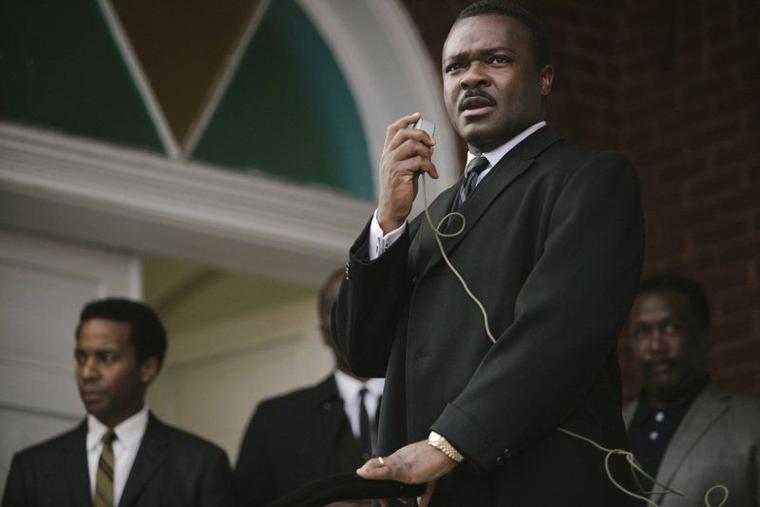
Selma, one of this year's Best Picture contenders at the Oscars, is sublimely directed and driven by its actors' powerful performances. It traces Martin Luther King's campaign for equal voting rights - starting from the day he wins his Nobel Prize to the moment his dream is realized.


As a Martin Luther King biopic, the film does his character justice. We immediately get a sense of Dr. King's elocutionary prowess at the beginning of the film as he rehearses the opening lines of his Nobel acceptance speech. Even before we see him, we hear his voice speaking light into darkness the way it did for so many African Americans during the civil rights movement. His humility does not escape us either, as he laments that it is "not right" how he looks like he's "living high on the hog dressed like this" while "folks back home" are suffering. In sharp contrast to President Johnson, who insisted that "this voting thing's just gonna have to wait," Dr. King persists in his determination to "build the path
rock by rock" through civil disobedience. There is palpable hope among his allies for such an endeavour. For example, when Coretta King worries that she didn't have enough time to "prepare" prior to meeting Malcolm X, Amelia Boynton (leader of the American Civil Rights Movement in Selma), says to her: "We are the descendants of a mighty people [...] They've prepared you. You are already prepared."

The film is carried by its cast, most notably the astonishing David Oyelowo. He sustains a regal poise throughout the film, one that is most evident when Dr. King turns his supporters around at the start of the second planned march to Montgomery, deciding to forgo bloodshed. Through Oyelowo's performance, we are closer to vicariously experiencing the stunning impact that Dr. King's speeches hand (and have) on people. Oprah Winfrey, although only in the film for brief scenes, delivered the second-best performance in the film. 

But the true star of the film is its director. Ava DuVernay has a fine sense of timing and acute grasp of visual detail. A great touch is the inclusion of "F.B.I notes" to show how J. Edgar and his team routinely logged Dr. King's activity. Scenes with these notes are shot from a distance to give us some perspective. DuVernay also shocks us effectively (very effectively) with the explosion in the opening of the film, but not at the expense of elegance. Indeed, she captures grace in violence through the slow-motion aftermath that follows: young girls float through debris as if they were weightless ballerinas. Such technique is echoed later on in the most striking scene of the film, as men on horses charge and whip protestors during their first march to Montgomery. Music beats in the background as people, running for their lives through cloud, are chased and terrorized. DuVernay knows how to run an action scene. The tensest and most heartbreaking of these is that of Jimmie Lee Jackson's death. (That was the first instance where I cried when watching the film; the second was, of course, the ending.)

In some ways, Selma does not have the sense of novelty that it would need to beat out its opponents for the Best Picture race. Moreover, because the writers trimmed the scope of the film's depiction of Dr. King, it does not cover the entirety of his legacy. Whereas The Grand Budapest Hotel is driven by its plot and Birdman by its cinematography, Selma - more limited in plot and empowered mostly by its actors - is at a disadvantage. Yet Selma is timeless. As Common raps in what is a sure-win at this year's Oscars for Best Original Song, "Resistance is us ... That's why we walk through Ferguson with our hands up." The path to equality still extends before us; I hope that many remain with the tenacity to build that path "rock by rock." 


Friday, January 16, 2015

The moments


Boyhood is an extraordinary film and an astonishing endeavour. Directed by Richard Linklater and filmed over a span of 12 years, it tracks the boyhood of six-year-old Mason from 2002 to 2014. The actor who plays Mason, the now-20-year old Ellar Coltrane, was cast at age six, just as the other actors in the film signed up for their roles 12 years ago. So, without a finalized script or clairvoyance (that we know of, at least), Linklater shot segments of the film annually for a 12-year period while the actors got on with their lives. Indeed, we even see elements of the actors' personal lives in the film itself.

Throughout the film, music, allusions and clothing are the markers that guide us through this 12-year span of time. Right at the start, Coldplay's Yellow indicates that the movie is set in the 2000s. Mason's trip to see The Chamber of Secrets in cinemas takes us up to 2002. Near the end of the film, Gotye's Somebody That I Used To Know transports us to 2011. Towards the end of the film, Facebook and iPhones become a part of the story.

The beginning of the film is set in Texas, where Mason lives with his older sister, Samantha (Lorelai Linklater), and his mother, Olivia (Patricia Arquette is fabulous). Mason's father, Mason Sr. (played by the amazing Ethan Hawke) and Olivia have separated, but Mason Sr. soon returns to Texas and begins to visit the children weekly.

From here onwards, the film touches upon all the chapters of boyhood: young Mason daydreams in class, is fed up with his annoying older sister, flips through lingerie magazines with childish curiosity, goes through an acne phase, gets himself a girlfriend, turns fifteen, graduates...and finally heads off to college.

The interim is interspersed with meaningful scenes that capture the relationships between father and son, son and mother, boyfriend and girlfriend, and so on. One of my favourite scenes is the one in which Mason. Sr. has the "birds and the bees talk" with his children - it is as awkward for them as it is for him and nothing about that scene seems falsified in any way. Another memorable scene takes place when Mason. Sr. drives his children to a park on one of his weekend visits. Here, we see his attempts to  be a good dad: he asks his children how their week was, wanting to get to the heart of the question and refusing to be "that guy," refusing to be the stereotypical dad-who-visits-every-weekend in the divorce. So, what is lovely about the father-son dynamic in this film is the way Mason Sr. - although initially lost and with a drinking problem - cleans himself up and forms a meaningful bond with his children. The most moving instances of this are the scenes in which Mason and his father go hiking, and when Mason. Sr. confronts his son after his break up.

Speaking of father-son relationships, it is important to consider the men in the film because this is, after all, a movie about boyhood. Mason's father is wonderful, but he is not immune to placing expectations on his son. When he takes Mason out bowling, for instance, he insists that Mason forgo the bumpers (through another lens, this could be seen as Mason Sr.'s way of teaching his son perseverance). When Mason and Samantha show him dry Canadian grass and basketball team photos, respectively, it is the latter that grabs his attention. As Mason ascends to the eighth grade, his perceptions of manhood are further influenced by the seniors he meets. Spouting out profanity and challenging "are you gay," these seniors capture the stereotypical immaturity and self-consciousness of teenage boys.

Yet none of this is too troubling, unlike the disturbing "mansplaining" attitude of Professor Bill, Olivia's second husband. He demands Mason to cut his hair, saying that he will now "look like a man instead of a little girl." He orders his own children to do their chores rigorously. He dictates the way his son plays golf. Worst of all, he is tyrannical and abusive - what kind of boyhood will his son experience?

So, as much as the film is about boyhood, it is also about parenthood. Early on, Olivia exclaims, "I'm a parent, that means responsibility." Indeed, she does an astounding job at being a mother - having to face her daughter's "horsesh-t attitude," pulling her family out of poverty and raising Mason and Samantha until they graduate. She uses the tiger as an example to explain love during one of her classes, saying that mother tigers abandon their cubs and "throw them down" in the face of danger. For her, however, the opposite is true; she is the one who clings onto her children despite all danger and strife. Her motherly instinct is further strengthened at the end of the film, when the family runs into Ernesto, the man who had fixed their sewer pipes years ago. Now one of the managers of the restaurant they dine at, Ernesto credits Olivia for inspiring him to learn English and find his current. "[Olivia] is a smart woman," he tells Mason and Samantha. "You should listen to her."Yet the day Mason leaves for college, Olivia breaks down, crying, "I just thought there would be more."  Although the audience will inevitably get caught up in the journey of Mason's boyhood, we must not forget that it is his mother - not his father, stepfathers or peers - who does the best and most wholesome job of raising him.

Speaking about the film's ending, the whole film retains its structural integrity. For instance, it opens with the family moving and ends with another instance of moving, but it is only Mason that moves the second time round - into adulthood. Similarly, we can draw a clear link between Mason's childhood love for staring out of the window to his eventual passion for photography. Even Jimmy, the friend of his father whom Mason met when he was still young, reappears at the end as if to reinforce the length of time that has elapsed since.

So, it is fitting that Mason says to Nicole, one of the first girls he meets at college, that the young kids she tutors "haven't reached the awkward years yet."He, after all, has just gone through those awkward years - and what a journey they have been!

The fact that Linklater actually tracked his characters for 12 years contributes to the most striking element of this film: its realism. Yet he also achieves this because the dialogue in the film is so spot-on that it ceases to seem like scripted material. Indeed, I  saw myself reflected in the way Sheena, Mason's ex-girlfriend, chats with Samantha. The awkward laugh, the tucking of the hair behind her ear...I mean, I do that too!

At the same time, Boyhood - for all its realism - cannot be considered a faithful representation of "boyhood," although it may come close to capturing an idealized American boyhood (hence Mason's baseball games, a shotgun for his 15th birthday, a graduation party). Where was Mason's real teenage angst and where were his wild adolescent years of rebellion? Boyhood, striking as it is, deals with certain troubles of boyhood in some parts - but lacks to address some others.

Nonetheless, the final line of the film pithily captures its essence: "It's constant, the moments, it's just — it's like it's always right now, you know?" Linklater, after all, filmed Boyhood in the "right now" moments. He has translated a coming-of-age story onto screen in a way that allows the audience to vicariously experience - and truly witness - the passage of time through film. Boyhood is a work of incredible scope that is, despite its flaws, the most important contribution to cinema in a long while.


Friday, January 9, 2015

On s'est bien battus

Deux jours une nuit is a mesmerizing film about tenacity, human nature and the meaning of value. It traces the story of Sandra, a mother of two, who struggles with depression and anxiety but is given the chance to recover her job in the timespan of two days and one night. To do so, Sandra must confront her sixteen colleagues over the weekend and convince at least nine of them to cast a vote on Monday morning that will decide whether she gets to keep her job - or whether she will lose it while her coworkers, now fewer in number, will receive a 1000-pound bonus.
Sandra ou la prime? is the question that is asked before the votes are cast near the end of the film. Sandra or the bonus? These words pithily capture the primary ethical question that looms before us in the film: Compassion or pragmatism? Utilitarian or egotism? 

Such a question, difficult as it already is, is further complicated in the film. Sandra, for instance, is not an indispensable worker. Thin, bedridden and dependent on Xanax, she herself questions her competence and self-worth. If her colleagues choose to keep her, therefore, they will be doing so purely out of humanitarian reasons. Furthermore, her colleagues must take their own financial bearings into account when making their decision. As Sandra visits their homes, the audience realizes quickly that the people she works with also belong to the lower-middle class of Belgian society. Some work double jobs, some live in dingy apartments.  

What is most intriguing about the film is, of course, the ways in which the colleagues respond to Sandra. The first man she meets seems almost willing to side with her, but his wife interjects and angrily reminds him that they have to pay their daughter's college tuition. Another colleague, Nadine, flat-out refuses to even answer the door. She instead makes her daughter do the dirty work and pretend that no adults are home. It is Timur, on the other hand, who shows the most empathy - crying, even - when Sandra approaches him. It is also Timur who reminds Sarah of a time when she once showed him kindness; I suppose there is still good karma after all.

At the same time, Sandra's meetings do not simplify down to yeses and nos. Alphonse, for instance, struggles because he is afraid that Jean-Marc, his contremaître (and the one who threatened the colleagues to vote Sandra out), will revoke his contract upon knowing that he decided to vote for Sandra. Graver still, Sandra's visits - as she herself notes - provoke conflicts, ranging from spats between spouses to actual fistfights between employees. The miraculous turn of events is that one of these fights finally pushes Anne, one of the colleagues, to leave her abusive husband. There is the idea that Sandra's visit offers her sixteen colleagues the opportunity to reflect, reconsider and reevaluate. Yet how many choose to do so? It is fitting, then, that the vote ends in a draw. Indeed, this ending works out not only because it elaborates the plot, but also because it perpetuates the question the film asks: Sandra ou la prime? 

The presence of children in the film is particularly striking. Firstly, the fact that almost all of Sandra's colleagues have children means that the question for most of them is not only Sandra ou la prime, but also Sandra ou la prime [et le bien-être de ma famille]. Moreover, the children add a layer of innocence and lightness to the otherwise heavy, adult-dominated film. It is lovely that a child walks her to the laundry room as she heads there to meet Alphonse. Despite all the unkindness that she has been shown by some of her coworkers, not a single child looks at her meanly. So, it is ultimately Sandra's children and her dedicated and tenacious husband, Manu, who form her backbone. It is them for whom she fights. 

Throughout the film, we often see Sandra under sunlight as she rushes from door to door; instead of appearing illuminated or emboldened by the glow, however, she appears weak and overcome. Yet this is in stark contrast to Marion Cotillard's performance. Capturing anxiety and despair but also renewed hope and gratitude, she powerfully portrays a character who - despite feeling like "un mendiant" -  persists with her long journey to rediscover self-worth. She is fearless and flawless.

Deux jours une nuit is truly a film that deserves the 15-minute standing ovation it received at the 2014 Cannes Film Festival!


Tuesday, December 30, 2014

Honeydicking

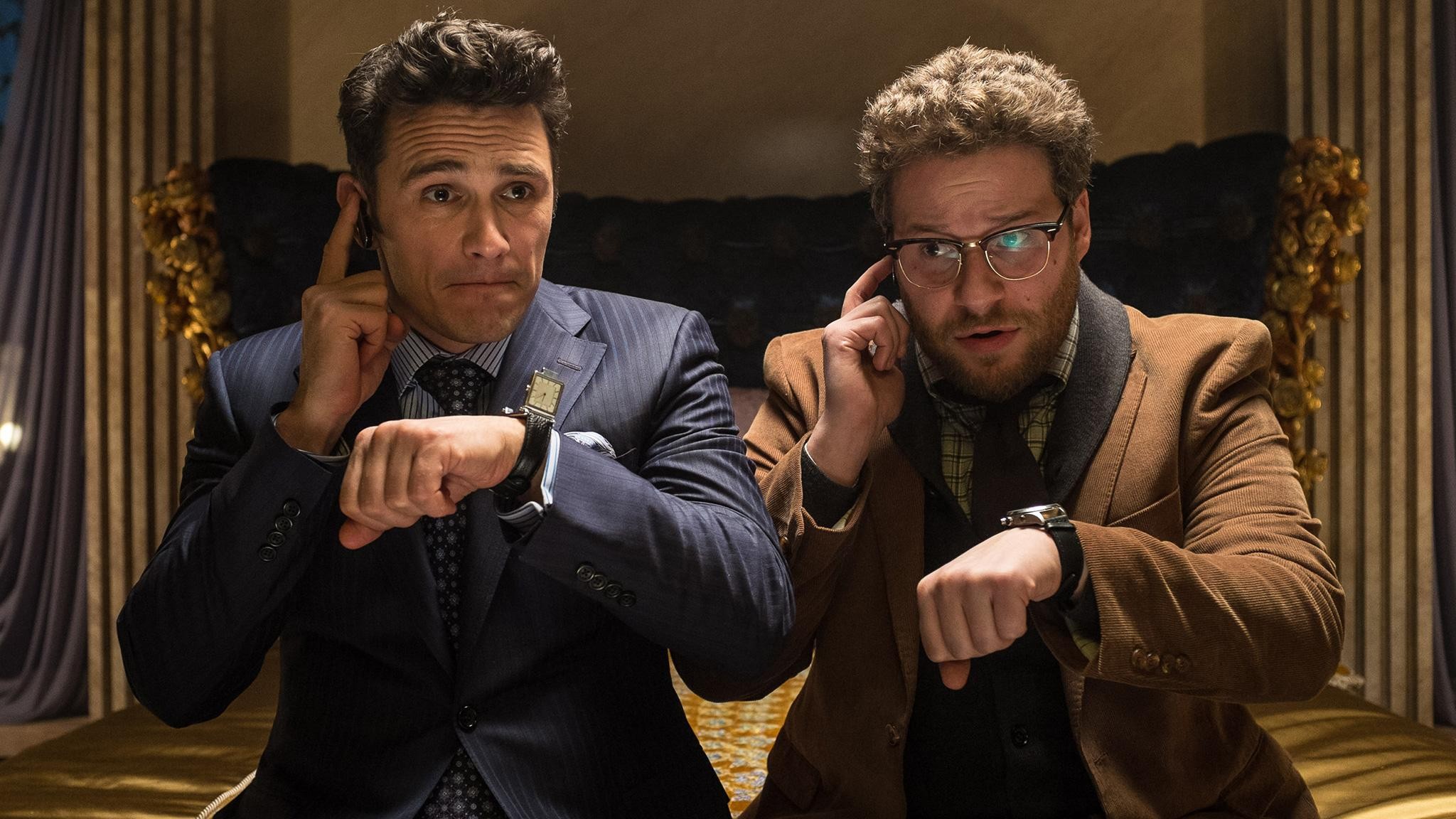
As a long-time James Franco fan, I am generally supportive of his various but oft-perplexing endeavours (his Instagram gallery is more than adequate proof of this). Yet when I first heard that he and Seth Rogen, Hollywood's favourite bromance, were making a movie about assassinating Kim Jong-un - I balked. This is a terrifying and ill-advised idea, I thought to myself. Indeed, when threats from North Korea began rolling in, I could not help but ascertain that Sony should have seen this coming. But when the movie was ACTUALLY pulled from cinemas - what?! That's when the maddening injustice of the whole hacking business and controversy regarding the film began to settle in.

Obama put it best: "We cannot have a society in which some dictator someplace can start imposing censorship here in the United States."

So, The Interview was finally released (not only in select cinemas, but also online - a first for Sony) and I watched it last night. Unsurprisingly, it channels the same crude humour and vulgar language from Pineapple Express and This is the End. Yet The Interview is a standout film from Seth's repertoire, especially in light of the drama it has aroused.


Firstly, the movie is actually pretty funny. Seth makes effective use of juxtaposition throughout: an innocent-looking girl sings a terrorist anthem at the beginning of the movie, Katy Perry's Firework is the soundtrack to the supreme leader's airborne incineration and Dave runs out of the compound clutching a puppy (an ADORABLE puppy).

So, Seth Rogen knows what he is doing! One particular critic has argued that Randall Park and Diana Bang deliver the best performances in the movie, but I disagree. I was especially impressed by Rogen's acting chops in the taxi scene (racist as his Chinese accent was).

His partner in crime, James Franco, pulls off an incredible and memorable Dave Skylark in The Interview. Uninformed, unreasonable, impressionable, shallow, self-centered, unprofessional, caring, goodnatured, presumptuous, unabashed - Franco is all of this and he is brilliant. Watching his energetic performance, one wouldn't imagine that this is the same guy who, with shades over his eyes and a baseball cap pulled down low, shuffles wearily down a line of selfie-ready fans after weekly showings of Of Mice and Men.

Yet it is the goofy Dave Skylark who finally delivers the most serious line of the movie: "So why don't you feed them?" Directed at his interviewee, the supreme leader of North Korea himself, this question segues into great scripted conversation between Dave and Kim that reveals the vulnerability of both men. There's Dave, who - although unabashed on the outside - is hurt by the media's criticism of him (like James??). Well, he gets by through subscribing to his maxim: They hate us 'cause they ain't us. Then there's Kim, who still finds himself living in his father's shadow and has to disguise his love for foreign entertainment (specifically, Katy Perry). Despite the "seriousness" of the second part of the interview itself, however, the movie still retains its farce because Dave (as he even insists on mentioning) only has his great epiphany about Kim's tyranny because of a GRAPEFRUIT.

Structurally, the pacing of the movie is sublime. The plot unravels brilliantly, except for Dave and Kim's first encounter - that segment was slow, uninspiring and unconvincing. Yet the movie as a whole wraps up well and ties the whole storyline together. Dave is saved by a bulletproof vest, he and Aaron get rescued by SEAL and he gets to write his final tell-all (just as he predicted). Democratic elections will be held in NK, Kim is out of the picture and Sook has gotten Skype.

Near the end of the film, however, not everything is all smiles. On the boat with Dave and his adorable puppy, Aaron remarks that he was "honeypotted" by Sook, just as Dave was initially "honeypotted" by Agent Lacey; they were both manipulated to cooperate with others' plans. Although both incidents of "honeypotting" were done for a good cause, the whole concept of "honeypotting" (if a woman is behind it) or "honeydicking" (if a man is behind it) extends beyond the movie.

I cannot believe the following sentence is about to be published on my blog, but - is Kim Jong-un not the greatest honeydicker of all? In the movie, we only see him honeydicking the gullible Dave so that he will ask him 'good questions' during their interview (which, as he furiously says afterwards, failed). In the movie, Kim bursts into tears and destroys his carefully-crafted cult of personality on live TV. In real life, however, he continues to honeydick a nation.

So, The Interiew is entertaining, silly, crude, sometimes gruesome and packed with perfect (actually perfect) LoTR references - but it is also a comedy that exposes the consequences of "honeydicking." You might forever remember The Interview as that-Seth-Rogen-and-James-Franco-film-that-exacerbated-NK-US-relations, but also remember it for its message: don't be honeydicked.


Wednesday, December 17, 2014

I turn to paths that lead home

That feeling you get when you walk into the cinema to watch the last cinematographic stretch of Middle-earth greatness is a nostalgic one.
The Hobbit: The Battle of the Five Armies is a looong film, much dominated by the battle waged between elves, men, dwarves, goblins and wargs. Trust Peter Jackson to transform a couple of chapters into ~2.5 hours!

Cinematically speaking, the graphics were stunning. 3D HFR is still tough to adjust to, but Smaug swooping into Lake-town was quite the visual experience. Not to mention the choreography for all the battles. Could a chunk of the fighting have been cut out? Certainly, although I must say that Legolas's showdown with the goblin nearly tops his slaying of the Oliphaunt.

In many ways, The Hobbit movies have been much swayed by their marriage and persistent homage to the LoTR trilogy. After all, there are irresistible scenes in this film that only seem to serve the purpose of channeling LoTR:
1) The part where Legolas goes off to seek "Strider" (hence LoTR!!)
2) The final scene that takes us right back to the start of The Fellowship
3) Bilbo with Thorin in his final moments, a scene that poignantly recalls Aragorn and Boromir's mybrothermycaptainmyking scene
4) Galadriel unleashing her full power
5) Alfred is basically Wormtongue

Yet I think this is Jackson's way of ensuring that the film remains quintessentially 'LoTR' to Tolkienites. Most LoTR perceptions have been indelibly defined by the film trilogy.

Hobbit-LoTR comparisons aside, however, The Battle of the Five Armies does further engage its audience with deeper elements of Middle-earth that LoTR hadn't exposed as thoroughly (and no, I am not just referring to how Legolas is finally thrust into an arrow-less situation).


What love means to elves, notably, is explored throughout the movie. Early on, Tauriel struggles with her feelings for Kili because acknowledging them would be a betrayal to her kin. Legolas supposedly loves Tauriel, but speaks to her like a soldier; why is he so icy? Perhaps, as is hinted towards the end of the film, it is because of his mother's death. Thranduil, whom Tauriel accuses of having no heart, seems to be the epitome of the heartless, cold-blooded, unfeeling, immortal elf. Yet he later tells Tauriel that she feels heartbreak after Kili's death because her love for him "was real" just as he himself still mourns his wife.

In this movie (and relevant chapters of the book), we also see in Thorin a King Lear-esque character, someone who admits that he was "too blind to see" under the shadow of 'Dragon sickness' - the autocracy and unreasonableness that overcomes one who lusts after gold and prestige. Indeed, the Arkenstone is Thorin's ring; it seduces and manipulates him.

The one most immune to dragon sickness, and bravest to try and put a cork on the battle, is naturally Bilbo. Thorin's last words to him are,

"If more people valued home above gold, this world would be a merrier place."

The hobbit mentality encapsulated in Thorin's words is what has captured LoTR fans for centuries - the homeliness and warmth of the Shire and indeed of home. Bilbo doesn't say much in the movie (mostly just wrinkles his nose endearingly) but whenever he pipes up, we love it. Just as Galadriel is the Lady of Light, Bilbo is the pure token of home in The Hobbit. No matter how far one will bash these three Hobbit movies, there is no doubt that they all share that familiar, quintessentially Tolkien echo of home.

As Billy Boyd sings the end credits of the film, we know that it is not only Bilbo who is bidding "a very fond farewell" to the company, but also the LoTR crew who is bidding adieu to their Middle-earth cinematic journey. Yet I don't think anybody will be saying farewell to the LoTR legacy anytime soon. The mark it has left on literature and film will and should inspire generations of readers, writers and dreamers to come.


Sunday, October 19, 2014

The Disappearance of Eleanor Rigsby: Him

WARNING: PLOT SPOILERS AHEAD

When I first heard about the genius of an idea that is Ned Benson's The Disappearance of Eleanor Rigsby, my first thought was: wow, lucrative. Indeed, Benson tells the same story of a married couple three times in three films: once from the perspective of "him," once from the perspective of "her" and once from the perspective of "them."

Him opens at the peak of Connor and Eleanor's relationship. They're about to leave a diner but neither of them can pay for the meal. So, they make a run for it - laughing, breathless and in love. We absorb all of this, of course, but there is one more thing we should keep in mind while watching this scene - Eleanor is the one who gets up from her seat and leaves first.

In The Disappearance of Eleanor Rigsby, we learn through snatches of conversation that the reason for Eleanor's depression is the death of her two-month-old baby. So, there are two disappearances in the film: Eleanor's and her child's. In this way, the film focuses on how we deal with the unsaid. "Why does it feel like I had to go through all of it on my own?" Eleanor asks Connor early on in the film. Indeed, Connor looks distressed at the beginning of the film (short-tempered at work, wearing black), but it is Eleanor who - bed-ridden and pale - is truly suffering.

The cast of The Disappearance of Eleanor Rigsby is one of its greatest selling points, and for good reason. James McAvoy and Jessica Chastain (especially her!!) are stellar. Ciarán Hinds is brilliant as the hesitant, counselling father, and Billy Hader is effortlessly amusing.

We quickly arrive at conclusions about the characters the first time they appear, but Benson does a wonderful job at changing the way we think about them. When we first meet Connor's father, he seems thoroughly unimpressive while sitting on the couch and battling short-term memory. The next time he reappears, however, he is all decked out in suit and tie, owner of a highly successful bar in New York. Our impression of Eleanor certainly shifts as well, as we - from Connor's perspective - spot her new hairdo and wonder, both relieved and puzzled, about her seemingly impulsive decisions. Eleanor is, without a doubt, the "star" of Connor's life. Like Connor, our whole movie-watching experience revolves around her disappearances and sudden reappearances.

Yet Him left something to be desired. At one point in the film, Alexis, the waitress at Connor's restaurant, says that it is "indecent to have things so worked out." Even so, things sort of do patch themselves together by the end of the film. For example, Connor eventually becomes the successor of his father's restaurant albeit having staunchly refused his offer many times. Even the subdued ending shot of Eleanor walking behind Connor seems too "perfect." While romantic, it lacks the depth I had expected to find in the film.

Yet one cannot judge The Disappearance of Eleanor Rigsby solely through the lens of Him. When Connor follows Eleanor to one of her classes, we can hear the professor in the background giving a lecture on Descarte's concept of "subject and subjectivity." Indeed, subjectivity is what Benson addresses through these three films. He presents us with one relationship yet reminds us that it is subject to three different perspectives. So, even though Him was a mild let-down, I'll still be heading to the cinemas to watch Her and Them!


Monday, August 18, 2014

This is Berk...

ksdasd;alsd;alsd;'asd';asld';ald';ald';ald'ada;'djalkhdawndad;akd;asdla
^struggling to find the right words to describe my experience of watching How to Train Your Dragon 2 

Today, I did what I did not have the guts (or time) to do two months ago: watch How to Train Your Dragon 2, the sequel that I feared would ruin my impression of my favourite 21st century film, How to Train Your Dragon.

Post-movie, I am glad to say that no dreams have been crushed and that I hope
1) there will be a third movie (pretty please, Dreamworks) and that
2) How to Train your Dragon 2 gets recognized by the Academy!!!

Unless you, like me, have watched these shorts on Youtube, you arrive at a very different Berk at the beginning of How to Train Your Dragon 2. The villagers are no longer the conservative, dragon-fearing Vikings they were five years ago (Berk-time) but happy dragon riders who, like our protagonist Hiccup (Jay Baruchel)  have adopted the dragons as pets and consider them their friends. There is even an old cat-lady, or should I say dragon-lady, who makes sporadic and amusing appearances throughout the movie.

But Berk's dragon-viking alliance is soon threatened by the dark and hulking Bludvist, who has an evil plan to eradicate the dragon race by building an army of dragons and turning them against each other - OR, as Hiccup accurately surmises, by using the dragons' power to conquer the world. Classic.

While Bludvist is plotting away, Hiccup is having a mild identity crisis: he is unsure about becoming chief, much keener on mapping new lands with his dragon, Toothless, AND - on top of all this - finds his long-lost mother, Valka (Cate Blanchett), who is as much of a dragon-lover as he is and has made the dragon lair her home.

It is in this lair that we meet, for the first time, one of two beasts whose species is the "king of all dragons:" The Bewilderbeast.

These Bewilderbeasts have the power to summon and control all dragons at will (hence, bewilder). The  Snowy Bewilderbeast in the lair uses his powers to take care of his fellow dragons and feed them; the Muddy Bewilderbeast, however, is vicious, dangerous and the tool Bludvist uses to rally up his dragon army.

How to Train Your Dragon 2 is about change: there's Hiccup, who is initially uncertain about chiefship but finally realizes that he does not have to be the same kind of chief his father was. There are the aforementioned Bewilderbeasts who can change and control any dragon's actions. Even Eret, Son of Eret, changes his mind about dragons after Astrid's (America Ferrera) dragon saves his life.

At the beginning of the movie, however, Stoick (Gerald Butler) tells Hiccup that - despite all the change Berk has experienced - change is impossible. Drago Bludvist is quite set on this idea too, and decides to prove it to Hiccup by using the Muddy Bewilderbeast to turn Toothless against him, a tragic move that results in Stoick's death.

Stoick's funeral is moving, the monologues are tear-inducing and everything, as a Youtube commenter rightly put it, has a Qui-Gon-Jinn's-funeral vibe. It's the darkest and most moving moment in the whole movie.

But Hiccup, as his mother reminds him, has "the heart of a chief and the soul of a dragon." So the dragon riders return to Berk to catch Bludvist in the middle of rallying all the dragons there.

Then, in an incredibly moving scene that captures everything I love about the How to Train Your Dragon films, audiences witness the truest proof of change: Toothless fights and throws off the Bewilderbeast's hypnosis as Hiccup says to him, "you're my best friend."

That is how you win the loyalty of the dragon.

Of course, How to Train Your Dragon 2 is not without its flaws - numerous happenings are unexplainable (HOW did Stoick find the lair?) and, thanks to CGI, many improbabilities are dismissible (all those insane dragon turns). There are also illogical but hilarious (therefore, forgivable) moments that crop up, such as Ruffnut's whimsical infatuation for Eret. Sometimes, I also felt like the action was a bit much.

Yet How to Train Your Dragon 2 is a maturer movie than its precursor. It is more of a bildungsroman although it has less plot development since the milestones that made How to Train Your Dragon so beautiful and important, such as Toothless and Hiccup's friendship and Hiccup and Astrid's relationship, had already been established.

But How to Train Your Dragon 2 succeeds as a sequel because it takes us a step further in Hiccup's coming of age journey, amplifies an already spectacular soundtrack and reinforces the strength of a one-in-a-million friendship - not a bond that Bludvist and his pathetic iron staff can destroy so easily.

P.S. Thank goodness puberty hit Hiccup *swoon*

Tuesday, July 29, 2014

A token of gratitude to Tolkien


10 years ago, as I was searching for Dr Seuss's Green Eggs and Ham on my bookshelf, I caught a glimpse of the novel that would change my life 10 years later: J.R.R. Tolkien's The Lord of the Rings. Inspiring and magical, The Lord of the Rings has impacted not only my love of writing but also my travel destination choices. Frodo and Sam's gruelling yet moving journey to destroy the One Ring will forever remain my favourite coming of age story.

Here's a one-girl-band cover of a self-arranged LOTR medley in honour of the novel's 60th anniversary. I honestly cannot thank Tolkien, Peter Jackson and Howard Shore enough.

P.S. Apologies for squeaky, out of tune recorder

Sunday, May 25, 2014

"We need you to hope again"

PLOT SPOILERS AHEAD

When I announced to my friend a couple months back that a new X-Men film would be coming out, she exclaimed, "another one?!"
I suppose such an outcry is justified, considering how SEVEN X-Men films have been produced in the past 14 years. So why do they keep rolling out?


The opening of X-Men: Days of Future Past is dark and pessimistic. Mutants with a scarred 'M' branded into their foreheads shuffle along a dark corridor to their doom. There is a certain Holocaust overtone to the scene - this is mass slaughter. Patrick Stewart's voice asks, "is the future truly set?"

His question is the undercurrent running throughout the whole movie. Taken back to 1973, a journey facilitated by Kitty Pryde (Ellen Page), Wolverine (Hugh Jackman) has but one task to fulfil: to change the course of the future. He must team up with young Xavier and Eric (James McAvoy and Michael Fassbender) and prevent Mystique from shooting Trask (Peter Dinklage) at the Paris Peace Accords. For Dinklage's murder, contrary to impeding the development of his anti-mutant campaign, rather leads to Mystique's capture and the subsequent exploitation of her DNA to create the mutant-killing Sentinels that wipe out Storm (Halle Berry), Bishop (Omar Sy!!) and indeed the entire mutant race at the very beginning of the film - the 'future.'

Just as how Glee has always been the "Rachel Berry Show," I suppose X-Men is always centered around Logan (I did not just make that comparison) - but the emphasis of this film is undoubtedly placed on the 'younger' generation of mutants; the majority of the actors from First Class reprise their roles. Lucas Till makes a welcome cameo, Nicholas Hoult returns as Beast and of course Jennifer Lawrence takes on the role of Mystique. Yet the true gem of the film is undoubtedly Quicksilver, played by Peter Evans. Unruly, ignorant and capricious, Quicksilver is the key to Eric's prison-break. The best scene in the ENTIRE movie is his single-handed, slow-motion reconstruction of the kitchen so that Xavier, Eric and Wolverine can escape untouched. Jim Croce's Time in a Bottle as the soundtrack to his mischief is just the cherry on top.

Apart from shedding light on new characters, however, Days of Future Past also zooms in on the acute temperaments of its protagonists. When Logan is confronted by a drunken Charles, we get a sense of the utter psychological trauma that followed First Class - Charles is not only obliged to deal with his leg injury but also the heartbreak of losing Mystique and being abandoned by Eric. Eric seems essentially the same man he was before, albeit less preoccupied with the idea of mutant Darwinism. Yet  violence and demonstration remains his key assets: he seems just as ready to kill Mystique as he is to uplift an entire stadium and enforce a siege upon the White House. Somehow, Magneto always turns out to be the antagonist. Thus both Charles and Eric remain ideologically split - the former staunchly believes in appeasement and cooperation whilst the latter gravitates towards the extreme.

The film also offers insights into Mystique's internal struggles and not only those concerning her indecision regarding what she knows she "has to do" and what Charles keeps trying to persuade her to avoid. As in First Class, Mystique struggles with self-identity and image. "Oui, je peux," she responds to the nurse who asks her whether she can imagine waking up to a face "like that." I truly think Jennifer Lawrence leaves a distinct mark in any movie she appears in. It's a magical thing. No wonder everyone in the movie (Eric, Charles, Beast) is in in love with her.

Moreover, X-Men is - as it always has been - visually stunning. I'm not just talking about the effects and the overal grand-scale spectacle - there were so many powerful images in this film. The one that sticks with me the most is perhaps that of Beast hoisted by the metal rings as on public display, his photos snapped as if he were some animal at the zoo. Discrimination and prejudice - are those not still problems we, let alone mutants, continue to face?

Finally, Days of Future Past is ultimately a movie about unity in the face of adversity, and hope - what Xavier calls "the most human power." Beast raises a quantum physics theory about the unalterable nature of time - the current will correct itself no matter how many pebbles are thrown into it, he suggests. But the spirit of hope - the idea that "showing them a better path" can make a difference - is what ultimately leads to the denouement that Logan set out to achieve. Hope is what drives Xavier out of his pity-party and hope is what gives Kitty the willpower to continue facilitating Logan's time travel despite her injury.

Despite the plot turns in the movie, its ending is expected - but not any less satisfying. The scenes of the academy at the end of the movie, complete with Jean, Summer and Rogue, send X-Men fans' minds way back (haha, get it) to 2000, all the way back to X-Men One.

In terms of the final scene of the movie, Stryker's appearance makes sense since his importance was expertly foreshadowed throughout the film. Yet the fact that he is actually Mystique in disguise does seem to suggest a brighter future for Logan and confusingly nullify the contents of X-Men Origins... or does it? Admittedly, Days of Future Past didn't go to great lengths to clarify finer details.

So to respond to the question I posed at the beginning, I suppose the easy answer to why X-Men films keep coming out is that they are lucrative - Hollywood is, after all, a money-sponge to a certain extent. Yet the continued release of these films and their popular reception suggests that there is a 'public demand' element that factors into the making of the X Men films. The actors loves it, the press loves it, WE love it.

Bring on X Men Apocalypse... in 2016!

Monday, March 31, 2014

Il faut vous accrocher à l'humain qui est en vous et vous survivrez

After suffering a stroke in December 1995, Jean-Dominique Bauby - the former editor in chief of the magazine Elle - found himself a victim of 'locked-in-syndrome:' fully paralysed, trapped inside his diving-bell-esque rigid chamber of a body and only able to blink his left eyelid.

Yet instead of wallowing in self-remorse, Bauby composed The Diving Bell and the Butterfly in his head over the course of his paralysis and then proceeded to 'write' it via (for medical terminology's sake) "partner assisted scanning." Here's how it worked: a very patient and dedicated nurse/significant other would read the alphabet out-loud (an alphabet rearranged in order of letter usage frequency) and Bauby would simply blink his left eyelid to select letters and spell out sentences.

Such a system resulted in the publication of Le Scaphandre et le Papillon in 1997, and the production of a film (I am about to review) 2007. I decided to watch The Diving Bell and the Butterfly over the weekend primarily because I'm reading the original text in French class but also because I wanted to justify staying up late. Plus, who can resist the temptation of watching a film that was nominated for 4 Academy awards?

In the beginning of the film, we observe the world through Bauby's lens - through his blinking (and sometimes wandering, men's gaze-esque if you know what I mean) left eye. There's an incredible, instantly gripping dialogue sequence where Bauby zones half in/out of consciousness while doctors and nurses peer at him and repeatedly speak to him in assuaging tones - and all the while Bauby is muttering in the background, trying to piece together his own conclusions.

Then, one can't admire the genius camera work that ensues when Bauby blinks - and opens his eyes again to reveal to us audiences a snapshot of his past, of his moving/fast-paced life as editor in chief of Elle. Throughout the film, such 'clips' recur to not only add a bit of much-welcomed movement to the film but to also reveal much about Bauby before his stroke. Indeed, there's a part in the book where he wonders to himself whether the nurses around him know anything of his identity before he became paralysed. Perhaps the movie's visual flashbacks are attempts to reconstruct some of that identity.

Above all, the film - like the book - highlights two main facets to Bauby's situation: firstly, it reveals how his condition affects his life and relationships. Indeed, there is a brilliant scene where a fly lands on Bauby's nose and he - unable to lift a finger - watches it with a wild eye before it is swatted away. On a more emotionally-striking level, the one-sided phone calls he has with his father and lover are heart-wrenching .... not to throw in a major plot spoiler but when Inès calls and he responds "chaque jour je t'attends," have your tissues ready.

Secondly, Bauby's story compellingly reveals the indisputable force of imagination, without which the book would have never been written. And it is imagination that sends Bauby on mental holidays and fantasies, scenes the film pays particular attention to.

Another little detail the film honed in on was capturing tiny symbolic motifs - from the corner of the camera frame, one will see a tiny butterfly flutter by the window...

Also, the soundtrack is fabulous and I haven't been able to get La Mer out of my head for a week already.

All in all, The Diving Bell and The Butterfly is a stunning film, one that certainly does the book justice (although perhaps not Bauby himself, as his friends seem to argue).


There is no doubt that Bauby sits on the highest tier of human competence - it is remarkable that his strenuous internal-editing, determination and focus evolved into a 100+ page novel. And upon reading the novel and watching the film, one may understand how Bauby's imagination, free as a butterfly, was what kept him tethered to reality - and will inspire readers and audiences for generations.