Showing posts with label books. Show all posts

Saturday, December 31, 2016

Its sound is my sound. I can't bear to part with it.

An Equal MusicAn Equal Music by Vikram Seth
My rating: 4 of 5 stars

When violinist Michael Holme's past lover reenters his life unexpectedly in Vikram Seth's An Equal Music, he suddenly finds himself dealing with both the struggles of quartet life and the unrest of his own broken heart. Julia, now a married mother, is not the woman she was before, and Michael cannot—despite how hard he tries—bring back the music of their past. Yet music permeates the entire novel. At the bass line of the story's main melody, which follows the adulterous duet between the two protagonists, the tensions within the quartet, and Michael's lonely solo life, is music.

Seth clearly knows what he is talking about, musically. The classical music speak throughout the novel is the best thing about it, and makes it a delight to read for music lovers. There are passages in the novel that nail how I feel about Beethoven's Piano Trio in C minor, Op.1 No.3, playing the second violin part, and even my own violin:

"I agree with whoever said it should more properly be called "the other violinist". Its role is different, not lesser: more interesting, because more versatile. Sometimes, like the viola, it is at the textural heart of the quartet; at others it sings with a lyricism equal to that of the first violin, but in a darker and more difficult register."
"I love it and it loves me. We have grown to know each other. How can a stranger hold and sound what has been in my hands so long? We have been together for twelve years. Its sound is my sound. I can't bear to part with it."
At the same time, there were times when I felt I was being lied to—Seth would foreshadow disaster in a concert, only to later reveal that the performance went wonderfully. Towards the end of the novel, as Michael grows sentimental, his narrative voice also becomes poetic and erudite in a way that does not seem to befit his character at all:
"A walk at the end of the world, the earthquake plate, alone; the mudflats of subsidence and flood, and the hermitage of the one who found the true cross. . . . If we had four hands, would Bach's mind have further branched? Let our thumbs be opposable at the opposite edge. Let our teeth be pulled, let us have baleen like whales, that our plankton love might grow, that we might ungnashing plash and play."
This shift in tone, combined with Seth's use of an apostrophe ("the little dog ... knows that what is, is, and, O harder knowledge, that what is not is not"), points towards what Seth wants us to realize: Michael is an unreliable narrator. Indeed, moments in the book make us detest him. "You're a bully, Michael," Julia tells him when he insists that they play in the church. His imperative tone ("make that a promise") and relentless pursuit of her don't help us empathize with him.

But ultimately, his love of music and his love for his violin are what matters. That is the love that, unlike his relationship with Julia, is at the heart of the novel.

View all my reviews

Monday, September 12, 2016

So much of life was the peeling away of illusions.

We Are Not OurselvesWe Are Not Ourselves by Matthew Thomas
My rating: 4 of 5 stars

It was National Read A Book Day on September 6th, and I pretty much devoured Matthew Thomas's We Are Not Ourselves. I've had a problem all summer where finding time/energy to read has been difficult, but binge-reading We Are Not Ourselves made me feel a lot better.

The novel begins with our protagonist, Eileen Tumulty (tumulty / tumultuous is not a coincidence). As the rest of the book will reveal, she spends her whole life trying to take care of others and fulfil personal dreams that - although more disillusioned at times than practical - make us sympathize with her nonetheless. She marries Ed Leary (again, Leary / King Lear is not a coincidence), an intense, practical, and extremely productive academic. They have a child, Connell, who is bright like his father and as subject to the pressures to conform as his mother can be. The novel revolves around this trio, usually tracing their shared yet individual lives from one angle at a time, putting distance between each of them in a way that accentuates their different perspectives and concerns. In all ways, we see how they all act in ways that are not entirely themselves - be it Connell's decision to act like a jerk in order to fit in with the cooler kids, Eileen's fleeting cult experience, or -- most distinctly -- Ed's Alzheimer's.

Figuring out what was wrong with Ed was my main incentive for reading on. I should have gotten the hint because of the Leary-Lear connection, but I kept thinking it was OCD until the reveal. He was the least clichéd character in the novel. Eileen, with her ambition to buy a house + escape Jackson Heights, and Connell, with his adolescent urge to fit in, were the closest to being stock characters. But Ed stood out as the one who was most 'not himself,' not only because of his illness, but also his attempts to masquerade his discomfort around his family and friends when Eileen threw parties. His letter to Connell was one of the most poignant points of the novel.

Matthew Thomas is an alumn, so perhaps it's no big surprise that Connell eventually goes to UChicago. The description of campus - Cobb, the Med, the Rockefeller Chapel all honestly made me feel pretty nostalgic for college.  I'm flying back in two weeks, and am going to make it a mission to leisure read as often as I can. I might not be able to produce a review after every book, but I've decided that is okay - getting the words into my system will be good enough.
“Life, she thought, was like that sometimes; for years, things were a certain way, and then in an instant, almost without conscious thought, they weren’t that way any longer, as if all the hidden pressure on their having been the way they’d been had found release through a necessary valve.”
“You are not in this life to count up victories and defeats. You are in it to love and be loved. You are loved with your head down. You will be loved whether you finish or not.”
View all my reviews

Tuesday, August 16, 2016

A sliver of light

Flash Fiction Forward: 80 Very Short StoriesFlash Fiction Forward: 80 Very Short Stories by James Thomas
My rating: 5 of 5 stars

I've been binge-reading a lot of flash fiction lately, which is a pretty easy and wonderful thing to do anytime and anywhere. Riding the MTR, waiting for mom to finish her errands at the bank, sitting on the toilet ... you name it.

As the title of the anthology suggests, the stories in Flash Fiction Forward are each over in a flash, and the authors only have so many pages that they can use to surprise or move us.

Sometimes, the stories end too soon and expectations are not met. Most times, however, the pieces in this collection have shown me the magic of short form.

Many of the writers use the brevity of their stories to experiment with style: "Currents" is told backwards, "To Reduce Your Likelihood of Murder" is a list of of orders ("Do not go outside. Do not go outside, on dates, or to the store..."), "Test" is a four-part 'exam' that makes you rethink your life (with Extra Credit, "Fully explain the ways in which you are wrong").

A lot of the stories also use their endings to effectively reverse the impressions that we formed at the beginning, meaning that our initial assumptions still linger in our heads by the time a story is over (after all, each one is so short) and make us wonder about what on earth just happened. In "Accident," a car accident that could have gone terribly wrong turns into an opportunity for the protagonist to potentially make new friends and come to terms with his loneliness; in "The Handbag," a crime devolves into an unusual and low-key romance story. In "The Good Life," a woman who seemingly has it all going for her turns out to be stuck in a rather dark place.

Due to their brevity, the stories also have the space to capture single symbols very wholesomely and memorably. In "Parrot Talk," our protagonist - like the parrot she talks about - has also "adapted to a hostile environment" and flourishes in it. In "Toasters," the image of two slices of bread popping out simultaneously (plus the heat/suspense/force that comes with it) echoes the double domestic fights happening in the story.

Short and daring, some stories also just simply throw you something bizarre and let you absorb it for a spell. "My Date with Neanderthal Woman" transfixes you from start to finish in all its brilliant strangeness and unconventionality, the ending of "Crazy Glue" feels like a dream, and "The Orange" is about a fruit that ruled the world (until it was eaten).

The last piece in the collection is called "Death of the Short Story," but the imagination and gusto of the stories in this anthology prove that the short-short story is more alive than ever. Even the ending of that last piece, which reveals how everyone started making up "lies about the Story," demonstrates the immortality of fiction. As writers and readers, we are indeed always waiting for "a sliver of light" to "break loose from the oblong, suspended momentarily like a musical note on fire before streaking recklessly into the surrounding night," inspiring our writing and illuminating our lives with a literal flash of fiction.


View all my reviews

Tuesday, August 2, 2016

The whole world was this symphony, and there was not enough of her to listen

The Heart Is a Lonely Hunter  The Heart Is a Lonely Hunter by Carson McCullers
My rating: 4 of 5 stars

Carson McCullers's The Heart Is A Lonely Hunter is a tragedy told through the lives of five main characters who are ultimately unable to overcome the condition that afflicts them all, loneliness, in a Southern town polluted with racial inequality, poverty, and the disseminating promises of the American Dream.

Without spoiling too much...
Biff Brannon, who runs the café that is the main setting of the novel, struggles with not only defining the nature of his feelings for young Mick Kelly after he becomes a widow, but also his own gender and sexuality. Mick, who is the novel's protagonist and dreams of becoming a conductor one day, must pursue her ambitions alone in the aftermath of a turbulent adolescence and lost friendship. Dr. Copeland is too intellectual for his own good and is unable to rally allies who can understand his views on civil rights, while Jake Boult's plans for violent revolt destine him for isolation. Even John Singer, the deaf-mute who is a "home-made God" to characters like Jake and Mick, cannot escape loneliness. Despite the frequent visits that others pay him, Singer remains lonely due to his separation from his long-time and dangerously obese friend, Antonapoulos, for whom he never ceases to feel an intense (and absurdly deferential) attachment. All these characters, who differ in race and status, are linked in more ways than it may appear at first glance .

Indeed, some kind of disability also afflicts them all. Apart from the fact that a blind/deaf/mute character is always bound to be symbolic, the ideal of disadvantage is particularly important to this novel, which focuses on characters that are unfavored due to reasons that range from class to skin color. Singer and Antonapoulos are both deaf, Biff has "a special friendly feeling for sick people and cripples," Blount gave people the impression that "something was deformed about him," and even the seemingly picture-perfect Baby does not make it out of the novel unscathed (her fate is a harsh reminder that her mother's dream for her child to be in the movies is but a fantasy).

Reading the novel, I was fascinated by the way characters depend on Singer through divulging their feelings to him and considering his stoic silence an anchor of security. Somehow, through his soundless responses, Singer becomes whatever people want him to be (which makes his 'real' life all the more intriguing by comparison, for he himself is ironically and disastrously dependent on Antonapoulos). McCullers captures the core of the desperation in such dependence best as she writes,
"Maybe when people longed for a thing that bad the longing made them trust in anything that might give it to them.” 
"... in some men it is in them to give up everything personal at some time, before it ferments and poisons--throw it to some human being or some human idea."
And such longing/relinquishment of everything personal highlights the need for escape and self-validation in an era and environment of helplessness.

Terrible deaths happen in this novel due to illness, murder, and suicide; love is often unreciprocated; mutual understanding is cripplingly difficult. Perhaps Mick's ending can be interpreted as hopeful as she still aims to pursue music, but I was definitely struck by a sense of defeat at the end of the novel. It's the kind of book I think I would teach in a classroom - there's so much in it that is worth writing about.

I'm utterly blown away that Carson McCullers published this novel when she was only 23; with its complex characters and intricate structure (fun fact: the book was split into three parts to imitate a fugue), The Heart is a Lonely Hunter is a work that lives up to its name.


View all my reviews

Tuesday, July 26, 2016

For some of us, books are intrinsic to our sense of personal identity

Higher Gossip: Essays and CriticismHigher Gossip: Essays and Criticism by John Updike
My rating: 4 of 5 stars

John Updike's essays are such a pleasure to read because his writing voice masters the combination of eloquence and amiability. When reading his work, I'm at once acutely aware of how elegant and refined the prose is yet also drawn to its effortless sense of approachability.

Higher Gossip is a compilation of Updike's thoughts on various subjects, such as people (ranging from Tiger Woods to Kurt Vonnegut), writing, and art. The book also contains the introductions, forewords, and afterwards that he wrote for numerous books. I did not read every essay, but Higher Gossip has been informative and all-encompassing in terms of covering the scope of his non-fiction.

Most of what this book has done, though, is inspire me a lot.

In "A Poetics of Book Reviewing," Updike gives advice that I wish I had read when I first started this book review blog: https://www.brainpickings.org/2012/05...

In "The Game," Updike once again* shows me how comparisons should be executed by comparing golf to a woman for whom he has an unrequited love: "I fell in love with golf when I was twenty-five. [...] Sometimes I wish she and I had never met. She leads me on, but deep down I suspect--this is my secret--that I'm just not her type." Updike extends the metaphor to describe her "pretty green curves and "snug little sand traps," and the way she lets a long putt rattle in just when "you think she's turned her back on you forever." Golf is an intuitive old girl, a tease, an accountant.

*Fun fact: my favourite simile of all time comes from Updike's Self-Consciousness, in which he captures the intimidating nature of public speaking by describing how the microphone before him was "uptilted like the screened face of a miniature fencer."

Updike continues to inspire in "The End of Authorship," defending the future of books:
"Books traditionally have edges: some are rough-cut, some are smooth-cut, and a few, at least at my extravagant publishing house, are even top-stained. In the electronic anthill, where are the edges? The book revolution, which, from the Renaissance on, taught men and women to cherish and cultivate their individuality, threatens to end in a sparkling cloud of snippets.

So, booksellers, defend your lonely forts. Keep your edges dry. Your edges are our edges. For some of us, books are intrinsic to our sense of personal identity."
All in all, vicariously gossiping with Updike through his numerous essays has indeed been wonderful. Until next time!

View all my reviews

Saturday, June 25, 2016

We die containing a richness of lovers and tribes, tastes we have swallowed, bodies we have plunged into and swum up as if rivers of wisdom, characters we have climbed into as if trees, fears we have hidden in as if caves.

The English PatientThe English Patient by Michael Ondaatje
My rating: 4 of 5 stars

The first Michael Ondaatje book I read was his memoir, Running in the Family. I remember it for its range of intriguing characters and poetic portrayal of landscape. These two elements also marked my reading of The English Patient, which is perhaps Ondaatje's most famous work.

The English Patient is a novel that crosses continents, a fact that is foremost apparent in its characters: Hana, a Canadian nurse, is tasked with treating a man who has been severely burned during the war (Hana thinks the patient is English but later discovers that he, Almásy, is not). She becomes lovers with an Indian sapper, Kip, but kind of has a complex platonic/romantic relationship with Caravaggio, an Italian-Canadian thief whose skills were enlisted for the war. There are also the Cliftons, who become important when we learn about the 'English' patient's backstory. All of the characters are affected by the Second World War, a total war that was dominated by the "choreography of power" and had widespread effects on people. The primary setting of the novel that shapes its characters is a post-war time.

Yet for me, the most striking setting in the novel is the desert. On the one hand, there is the magic of its vast and endless landscape: "In the desert you have time to look everywhere, to theorize on the choreography of all things around you."

At the same time, the desert also reveals Almásy’s wish for "an earth that had no maps," a transnational territory that does not keep us bound to "the clothing of our countries." Nationality is a malady in the novel; on a global level, it is one reason for war. On a personal level, Almásy's nationality is what precludes him from being able to save his lover (a bit more on that later).

As Ondaatje writes, “the desert could not be claimed or owned–it was a piece of cloth carried by winds, never held down by stones, and given a hundred shifting names." Although Hana speaks in a different context when she asks, “do you understand the sadness of geography?” her comment points to the way we must label ourselves on a map like the names of rich men and women on buildings" even though a cartography that marks us "by nature" would allow us to remain as "communal histories communal books." The desert, like a great mediator of nationalities, removes the territorial frameworks that send people to war and divide humanity.

I've never read about the desert in that way before and I don't think I'm ever going to forget it.

While set in a time of great conflict and combat, The English Patient is also a story about love. In the main plot, there is the love that Hana has for Kip, Almásy and Caravaggio. But it is the affair between Almásy and Katherine Clifton that appears later on in the novel that truly illuminates Almásy's past and grips you. It's tumultuous, romantic and heartbreaking as hell.
“When we meet those we fall in love with, there is an aspect of our spirit that is historian, a bit of a pedant who reminisces or remembers a meeting when the other has passed by innocently…but all parts of the body must be ready for the other, all atoms must jump in one direction for desire to occur.”
“A love story is not about those who lost their heart but about those who find that sullen inhabitant who, when it is stumbled upon, means the body can fool no one, can fool nothing—not the wisdom of sleep or the habit of social graces. It is a consuming of oneself and the past.”
The English Patient is a powerful novel, which is relevant as it also explores the power of books and language; we learn about a time in Hana's life when "she fell upon books as the only door out of her cell. They became half her world.”
“She had always wanted words, she loved them; grew up on them. Words gave her clarity, brought reason, shape.” 
“A novel is a mirror walking down a road" is a memorable line from the novel and it is striking to think that there are people for whom this novel - with all its heartbreak and war - is a mirror. Yet I hope that this mirror also captures the love and hope for transnationality in The English Patient.


View all my reviews


View all my reviews

Thursday, December 31, 2015

Music is something more than an individual possession

The Cambridgeshire Report on the Teaching of Music: Music and the CommunityThe Cambridgeshire Report on the Teaching of Music: Music and the Community by Cambridgeshire Council of Music Education
My rating: 3 of 5 stars

I noticed Music and the Community on a bookshelf six minutes before the public library was about to close and couldn't resist grabbing it.

Originally published by the Cambridgeshire Council of Music Education in 1933, the whole book is a primer for the way music education should be conducted in schools. In the introduction, the importance of this teaching is first made clear: music is a language. Later on in the book, the authors strengthen its connection to literature by saying that "old English music should be as familiar as old English poetry." Yet just as not every English-speaker has to be well-versed in all the nuances and subtleties of poetry, not every person who receives a music education needs to be a virtuoso. The important thing is that the music is learned.

According to the book, however, there are problems that prevent music from becoming "a guiding principle to regulate and illumine all the activities of our existence." Firstly, music deserves to be listened to intensely, but music nowadays is so ubiquitous that
most people who hear music do not really listen to it at all; they let it fall upon their ears as a pleasant succession of sounds, making no effort to understand it and taking their chance of being soothed or stirred by it.
So, the bulk of the book is dedicated to instructing teachers on how to teach music. Music education should begin early with singing (starting from the age of four), be non-restrictive, and quite often be communal because making music together offers "mutual accommodation, a mutual sense of giving rather than of taking, such as no other communal occupation demands in the same degree." At an early age, kids should be taught nursery rhymes, which are important parts of "musical heritage" and have simple melodic structures that help with rhythm retention. Another thing that helps with the "development of the rhythmic sense," the authors note, is dancing - as somebody who has recently caught the jitterbug, I could not agree more. Music learning should also encompass historical and instrumental education as the students progress, and curriculums will differ depending on whether the schools in question are preparatory, public or universities. Yet regardless of the type of institution, "a vigorous musical life is undoubtedly an important factor in improving the tone of a school."

And there are many things that the government sector can do to facilitate the accessibility of music: they should not tax tickets sold at concerts given by local choral or orchestral societies, for example, and public libraries should expand their music sections.

Despite the eagerness with which the book vouches for inclusive music education, however, it also offers words of warning about the extent to which music is perpetuated:
Music should contribute to the life of the community an attitude of social harmony and tolerance; if we do not recognize that there are times when music is out of place we fail in one of the virtues that music is supposed to foster.
And this line made me crack up:
Lovers of music should be most careful not to cause annoyance to others; they may always hope that those who lack fervour will one day see the light, but the change will not come through the antagonizing effect of over-enthusiasm.

So, there is a "danger of making music available at all times" - heard under the "wrong conditions," it will only become an "irritant to nerves."

The whole book is a quick, engaging read. It definitely has a predominantly classical, traditional and British focus concerning music education (it was, after all, published in 1933 by Cambridge), which is perhaps a drawback in modern times, but also presents an interesting point of comparison to today's music scene. Instead of ensuring that every school has a piano, for instance, would a modern-day rendition of Music and the Community insist that every student have an iPod? Or Garageband installed on their computers? Should vocal training take rap into account?

It is fitting that this is the last full-length book I'll read this year (although I'm trying to read a collection of Chinese short stories before I fly out) because it's made me think about all that has changed not only since 1933 regarding music, but everything that has transpired globally and personally in just 2015.

It's been a year of great change and music has continued to be in my life for all of it - experiencing my first snow in Chicago during my orchestra rehearsal, dancing until 1 a.m. in the city to swing music, listening to songs on 15 hour plane rides to and from home.

I started this post as a book review, but as I write this last paragraph I realize that it has also been a way for me to bid goodbye to 2015 and look forward to the new year. I'm excited for the new books I'll read, words I'll write and music I'll hear in 2016!

View all my reviews

Monday, December 28, 2015

This desire to govern a woman--it lies very deep, and men and women must fight it together before they shall enter the garden

A Room with a ViewA Room with a View by E.M. Forster
My rating: 4 of 5 stars

E.M. Forster's A Room with a View is set in Italy and England during the Edwardian era of the 1900s, a time that was less repressive than the Victorian era but still not entirely divorced from its traditionalistic values. The novel opens in the charming and exciting city of Florence, where "all kinds of other things are just outside," but the viewless room in which Lucy Honeychurch finds herself is fashioned so closely after an English drawing room that she feels as if she were still "in London." As Lucy and her cousin Charlotte lament their lack of scenery, two men - Mr. Emerson and his son, George - suddenly offer them their room, which has a view. Yet Charlotte rejects their offer flat-out, "repressing Lucy" throughout their conversation with the Emersons, concluding a brief yet revelatory scene that sets up much of the context and characterization the later events of the novel continue to develop.

Forster writes that "there is much that is immortal in this medieval lady," but that "in her heart also there are springing up strange desires." Lucy, as he says, "does not stand for the medieval lady." She refuses to "be stifled," "would really like to do something of which her well-wishers disapproved" and wants to "care for liberty and not for men." However, she is too easily swept under the domineering arms of her cousin Charlotte, who certainly falls somewhere on the 'medieval lady' spectrum. At the extreme end is Mrs. Honeychurch, Lucy's mother, who thinks that "if books must be written, let them be written by men." For Charlotte,
It was not that ladies were inferior to men; it was that they were different. Their mission was to inspire others to achievement rather than to achieve themselves. Indirectly, by means of tact and a spotless name, a lady could accomplish much. But if she rushed into the fray herself she would be first censured, then despised, and finally ignored.

This is a quote that I reread multiple times because I cannot say that I disagree with all of it. I wholly believe that a woman's mission can be to achieve for herself; however, it is also true that a woman in the Edwardian era would struggle if she "rushed into the fray herself." The first line of Charlotte's statement, however, does show that she is not as repressive as she often appears to be. This is an observation that is also made at the end.

Before all that happens, however, Lucy first locks herself into an engagement with the dreary and conservative Cecil Vyse, who considers it a "test of refinement" to "[despise] the world as a whole," believes that "women revere men for their manliness" and always feels "that he must lead women, though he knew not whither and protect them, though he knew not against what." Unsurprisingly, every time Lucy thinks of Cecil "it's always as in a room" with "no view."

Which brings us back to the men who offered her a view in the first place (got to love that symbolism), the Emersons. Of all the characters in the novel, Mr. Emerson harbors the most advanced and modern ideas. He is against the church, is confident that men and women "shall be comrades" and - instead of praising some divine power - believes in the "holiness of direct desire" - love. It is from him that we hear the boldest, most quote-worthy statements about love:
“It isn't possible to love and part. You will wish that it was. You can transmute love, ignore it, muddle it, but you can never pull it out of you. I know by experience that the poets are right: love is eternal.”

Mr. Emerson is thus the greatest optimist in the novel. On the contrary, his son George is a "young man melancholy because the universe wouldn't fit." When George throws Lucy's blood-stained photographs into the river, we get a sense of his vulnerability. And it is this gesture, as well as his awkwardness, that moves Lucy because such behaviour shows her that "men were not gods after all, but as human and as clumsy as girls; even men might suffer from unexplained desires, and need help."

George and Cecil show us that "men fall into two classes – those who forget views and those who remember them, even in small rooms." Indeed, Mrs. Honeychurch and Lucy also show us that women fall into these classes, too. A Room With a View is a timeless read because we will always be surrounded by Cecils and Mrs. Honeychurches, albeit under ever-evolving political and social circumstances. The ending of this book and the new friends that I have met this year give me hope that more and more people in the world will remember the importance of views, want to have them and not be afraid to accept them when they are offered.


View all my reviews

Sunday, December 20, 2015

“Sure, some news is bigger news than other news. War is bigger news than a girl having mixed feelings about the way some guy fucked her and didn't call. But I don't believe in a finite economy of empathy; I happen to think that paying attention yields as much as it taxes.”

The Empathy Exams: EssaysThe Empathy Exams: Essays by Leslie Jamison
My rating: 5 of 5 stars

I have wanted to read Leslie Jamison's The Empathy Exams for a very long time because the questions she grapples with are ones that I, too, often try to answer: what is empathy? What kind of territory do I find myself in when I empathize with someone? And what do I make of my own emotional response to the pain of those with whom I empathize? 

The Empathy Exams is a fitting title that captures the nature of the eleven essays in it. The title essay traces Jamison's experience as a medical actor, a job that required her to play the role of sick patients in simulated scenarios and speak to medical students whose performances she would later evaluate via a checklist: how well could they assess her condition? Did they give the right advice? And, checklist 31: how well did they express "voiced empathy" for her "situation/problem?"

For the medical students, the 15-minute session was simply an exam they had to take. Yet an "empathy exam," like all tests, takes work, and can herald disastrous consequences if failed. What distinguishes it from a regular exam is that passing is not simply a matter of getting over half of the questions right:
Empathy isn’t just remembering to say that must really be hard—it’s figuring out how to bring difficulty into the light so it can be seen at all. Empathy isn’t just listening, it’s asking the questions whose answers need to be listened to. Empathy requires inquiry as much as imagination. Empathy requires knowing you know nothing. Empathy means acknowledging a horizon of context that extends perpetually beyond what you can see
“Empathy isn't just something that happens to us - a meteor shower of synapses firing across the brain - it's also a choice we make: to pay attention, to extend ourselves. It's made of exertion, that dowdier cousin of impulse. Sometimes we care for another because we know we should, or because it's asked for, but this doesn't make our caring hollow. This confession of effort chafes against the notion that empathy should always rise unbidden, that genuine means the same thing as unwilled, that intentionality is the enemy of love. But I believe in intention and I believe in work. I believe in waking up in the middle of the night and packing our bags and leaving our worst selves for our better ones.”
The parts of the book with which I resonated the most strongly were those in which Jamison looked at empathy from a self-analytical (and sometimes criticizing) standpoint, discussing what one might call the 'problems' of empathy:
“When bad things happened to other people, I imagined them happening to me. I didn’t know if this was empathy or theft.” 
When does empathy actually reinforce the pain it wants to console? Does giving people a space to talk about their disease -- probe it, gaze at it, share it -- help them move through it, or simply deepen its hold? Does a gathering like this offer solace or simply confirm the cloister and prerogative of suffering? Maybe it just pushes on the pain until it gets even worse, until it requires more comfort than it did before. 
This is the anxiety of the empathizer, a self-consciousness that Jamison - and I, honestly - have never been able to escape. Is empathy still empathy when we "trust the fact of suffering, but not the source?"  
How do I inhabit someone’s pain without inhabiting their particular understanding of that pain? This anxiety is embedded in every layer of this essay; even its language—every verb choice, every qualifier. Do people have parasites or claim to have them? Do they understand or believe themselves to have them? I wish I could invent a verb tense full of open spaces—a tense that didn’t pretend to understand the precise mechanisms of which it spoke; a tense that could admit its own limits. As it is, I can’t move an inch, finish a sentence, without running into some crisis of imputation or connotation. Every twist of syntax is an assertion of doubt or reality.
While it is only in "Pain Tours" that Jamison examines empathy in specific geographical locations, she conveys the territorial nature of suffering in all her essays. After all,
“Empathy comes from the Greek empatheia - em (into) and pathos (feeling) - a penetration, a kind of travel. It suggests you enter another person's pain as you'd enter another country, through immigration and customs, border crossing by way of query: What grows where you are? What are the laws? What animals graze there?” 
In some ways, we can derive a sense of self-gratification from such travel: we are often inclined towards sentimentality, just as "we like who we become in response to injustice: it makes it easy to choose a side." Yet the foray into "another person's pain," of course, also hurts: "empathy bleeds." Jamison's geographical analogy works so well because visiting a troubled country and trying to help it is a lot like taking a tour of somebody's broken emotional landscape: the journey may not be pleasant, but the traveller must always strive to remember the purpose of the visit and the people for whom it is made. Throughout her book, Jamison approaches the subject with a critical eye, an often-innovative form and piercing introspection to convey that empathy is difficult, demanding - but also indisputably important.


View all my reviews


Tuesday, September 8, 2015

for life's not a paragraph / And death i think is no parenthesis

Selected Poems, 1923-1958Selected Poems, 1923-1958 by E.E. Cummings
My rating: 5 of 5 stars

Although I don't believe that one can ever truly 'finish' reading a poetry collection (this is truer said about poetry than prose), I have officially marked E.E. Cummings's Selected Poems, 1923-1958 as 'read' on my Goodreads account.

E.E. Cummings is well-known for his unconventional use of form  (see: "Grasshopper," which seems to 'leap' off the page), syntax and punctuation, and we see why from the first and sparsely punctuated poem of the collection: "in Just-spring". Just looking at a Cummings poem is an adventure in itself. Yet what I learned from his selected poems is that it is just as important to hear one being read aloud. You will have to pronounce every word in the bizarre "ygUDuh," notably, to access the depths of what is mere 'jibberish' on the surface. And you must read "may i feel said he" out loud because it reads so, so well. Just be careful who you read it around (trust Cummings to make one of the most erotic poems I've ever read sound like a nursery rhyme).

Working your way through a collection is the best way to become quickly acquainted with a poet's style, in both literary and thematic terms. Aside from his syntax eccentricities, for example, Cummings also plays with meter (tetrameter and trimeter alternate wonderfully in Ever-Ever land), shifting tense and the most brilliant juxtapositions. Here are some of the oxymorons/sharp contrasts that appear in his work: "big dark little day," "a gift called dying born," "Because / only the truest things always / are true because they can't be true."

Theme-wise, Cummings writes most commonly about love, death, time and life (as do most other poets, I suppose). Yet he very memorably personifies all these abstracts:
"death(having lost)put on his universe / and yawned: it looks like rain."
"Life is an old man carrying flowers on his head"
"Death is young / life wears velour trousers / life totters, life has a beard"
(the last two lines are taken from "suppose," one of my favourite poems by him.

And Cummings shows that there is almost nothing in the literary world that is lovelier than a poet in love:
"For love are in you am in i are in we"
"we're wonderful one times one"
"love is a deeper season / than reason"
The lines (composed of simple words that rhyme nicely) convey such a comfortable sense of simplicity and effortless togetherness.

It's always a joy to read Cummings because he uses (or even coins) the most delightful of words and phrases. "Scented merde," for instance, is quite unforgettable. So is his wordplay on the months of the year in "my father moved through dooms of love," as he writes about the "septembering arms of year" and an "octobering flame." Cummings doesn't draw from a terribly arcane lexicon; in fact, many of the words he chooses are monosyllabic. So whenever a special one (or ones) comes up, it's always warmly welcomed.

One can easily be overwhelmed by a sense of 'i-don't-get-this' when reading Cummings; sometimes, we don't even know how to piece a sentence, let alone a thought, together. But I love, love, love how he can place a single, perfect, quotable line into a seemingly inaccessible poem and utterly transform it. It is fitting that not a single poem has its own separate title; we remember them rather by the individual lines that define them:
"Tomorrow is our permanent address"
"I'd rather learn from one bird how to sing / than teach ten thousand stars how not to dance"
"lovers alone wear sunlight."
"and history immeasurably is / wealthier by a single sweet day's death:"
In this collection, Cummings serenades, seduces, satirizes, speculates and stuns. His poems are magic on the page, even though they don't take up too much space (especially with the lowercase). As Cummings writes in one of the poems in this collection, "there is a time for timelessness" - and timelessness is the quality to which his poems, experimental, wonderful and challenging as they are, should always be ascribed.

 (yes, I did intentionally try to use more parentheses in this review than I normally do).

View all my reviews

Thursday, September 3, 2015

The way of the world is to bloom and to flower and die but in the affairs of men there is no waning and the noon of his expression signals the onset of night. His spirit is exhausted at the peak of its achievement. His meridian is at once his darkening and the evening of his day.”

Blood Meridian, or the Evening Redness in the WestBlood Meridian, or the Evening Redness in the West by Cormac McCarthy
My rating: 4 of 5 stars

Cormac McCarthy has been one of my favourite authors ever since I read All The Pretty Horses back in 2012 (I read The Road first, but it was The Border Trilogy that won me over). So, after having buzzed through four McCarthy books in under half a year, I decided that - in order to preserve/lengthen the magic of reading the rest of his oeuvre - I would have to establish a "Cormac McCarthy Reading Plan" and pace myself with his novels in order to always have some new McCarthy to return to whenever I need the bare honesty, dark beauty and astonishing landscapes he delivers with such stark detail.  According to my CMRP, the summer before college would be reserved for reading Blood Meridian, so that I'd have plenty of time to digest it (or recover from it in case of nightmares). And that's just what I've done! I finished Blood Meridian two days ago and it's been haunting me since. (warning: it is not for the faint of heart).

The novel is a bildungsroman, but the most violent one that McCarthy has written yet. It takes place in the brutal Wild West, during the mid-1800s, a time when savage "scalp hunters" would murder Indians along the Mexican and American border and then - quite literally - collect their scalps as evidence of the massacre. Our protagonist, "the kid," runs away from home at 14 to become "a solitary migrant" and a worker in a diptheria pesthouse before finally ending up with the scalp-hunting "Glanton Gang" - led by none other than the enigmatic and terrifying Judge Holden.

The judge, who is "close on to seven feet in height," "bald as a stone," adept at coin tricks and exceptionally knowledgeable about geography/history/science, belongs on an inaccessible tier. As he says, "Whatever in creation exists without my knowledge exists without my consent.” Yet it is only at the end, when he is dancing, young as ever, vowing that "he never sleeps" and saying "he'll never die," that readers believe he may be supernatural. And perhaps it is true that only a demon could have done the things he did - doom the innocent (even a preacher!), commit brutal murders, abduct children. At one point in the novel, the kid asks this about the judge: "judge of what?" For this is a 'judge' that does not subscribe to standard, legal laws, but rather believes in bloodshed through war:
“This is the nature of war, whose stake is at once the game and the authority and the justification. Seen so, war is the truest form of divination. It is the testing of one's will and the will of another within that larger will which because it binds them is therefore forced to select. War is the ultimate game because war is at last a forcing of the unity of existence.War is god.”
“War was always here. Before man was, war waited for him. The ultimate trade awaiting its ultimate practitioner.”
Such an acceptance of war echoes the 'normalcy' with which the horrors of the novel are portrayed. The following sentence, for example, is delivered so casually despite all its terrifying implications: “They passed through small villages doffing their hats to folk whom they would murder before the month was out." Moreover, McCarthy describes the Glanton Gang parading through a town with human heads on splinters while their arrival is celebrated by a "fantasy of music and flowers" (amazing juxtaposition). Even more chilling is how the children, accustomed to this culture of violence, eat "pastry skulls" at the parade while the judge tries to tempt them with his pockets full of "little candy deathsheads"(CHILLLLSSSS).

The language of the book itself accounts for much of its appeal. And I don't just mean McCarthy's delightful use of arcane plant terminology ("golden grounsel and zinnia"), but also the form of the prose itself. In the opening chapter, for example, the unforgettable and monosyllabic opening words introduce us to the kid: "See the child. He is pale and thin, he wears a thin and ragged linen shirt." Blunt, stark and brilliant. As with his other novels, McCarthy also beautifully weaves the darkness of the times with the landscape his characters trespass:  "in the long red sunsets the sheets of water on the plain below them lay like tidepools of primal blood." They pass the "blackened bones of trees." Amazing.

As mentioned earlier, Blood Meridian is a bildungsroman. At the beginning, "the child's face is curiously untouched behind the scars, the eyes oddly innocent," but he is shot below the heart on page two and then "finally divested of all that he has been." There is a poignant moment near the end of the book where the kid sees an old woman bent over in the desert, speaks to her for a long time, tells her that "he would convey her to a safe place," but then realizes that she had been "dead in that place for years" and is nothing but "a dried shell." The hopelessness of the place hits home right there.

"The kid" is not a child for long, even though he is called "the kid" until the end of the novel. Indeed, despite all the fighting he engages in, he never reaches the level of violence that the men around him do. He cannot shoot the judge and he cannot leave the ex-priest to die (by the way, this is the ~2nd ex-priest I have come across in McCarthy's works. Brilliant symbol of loss of faith.)  The judge even says that he loves the kid "like a son."

So that brings us to the end of the novel, where "the kid" becomes "a man." The ending is terrifying. And, given all that the judge is capable of doing to children and men, I am going with the worst-case scenario regarding the kid's fate. The judge "gathered him in his arms against his immense and terrible flesh.” That carnal imagery suggests at much, although we never know what truly happens to him, except that whoever sees him at the end can only comment, "good god almighty."

Blood Meridian is stunning, especially as so much of it is historically backed (scalp hunting, the Glanton gang, even Judge Holden himself). Reading it was like living in a trance - in some chapters, nothing seems to be happening except moving through barren terrain (thankfully, the synoptic chapter headings help one keep track of the plot). I think this is the main shortcoming of the novel. In other chapters, evil is described so explicitly, you don't want to believe what you read (I swore outloud so many times while reading this book).

But regardless of how shocking and horrifying the story becomes, McCarthy's magic never diminishes - the sheer beauty of his prose, his ability to etch out bygone landscapes with stunning believability. Blood Meridian is a book that will leave you speechless, restless and astounded.
Rumor has it that McCarthy's The Passenger may be out next year. Yes!!!
“The truth about the world, he said, is that anything is possible. Had you not seen it all from birth and thereby bled it of its strangeness it would appear to you for what it is, a hat trick in a medicine show, a fevered dream, a trance bepopulate with chimeras having neither analogue nor precedent, an itinerant carnival, a migratory tentshow whose ultimate destination after many a pitch in many a mudded field is unspeakable and calamitous beyond reckoning.
The universe is no narrow thing and the order within it is not constrained by any latitude in its conception to repeat what exists in one part in any other part. Even in this world more things exist without our knowledge than with it and the order in creation which you see is that which you have put there, like a string in a maze, so that you shall not lose your way. For existence has its own order and that no man's mind can compass, that mind itself being but a fact among others.”
The smallest crumb can devour us. Any smallest thing beneath yon rock out of men's knowing. Only nature can enslave man and only when the existence of each last entity is routed out and made to stand naked before him will he be properly suzerain of the earth.” 
The man who believes that the secrets of the world are forever hidden lives in mystery and fear. Superstition will drag him down. The rain will erode the deeds of his life. But that man who sets himself the task of singling out the thread of order from the tapestry will by the decision alone have taken charge of the world and it is only by such taking charge that he will effect a way to dictate the terms of his own fate.


View all my reviews

Monday, August 24, 2015

“I think I would rather be a man than a god. We don’t need anyone to believe in us. We just keep going anyhow. It’s what we do.”

American Gods (American Gods, #1)American Gods by Neil Gaiman
My rating: 4 of 5 stars

“Yes, it's still God's Own Country,” said the announcer, a news reporter pronouncing the final tag line. “The only question is, which gods?”
I opened Neil Gaiman's American Gods with 0 idea of what would follow, so gradually unpacking its mythical references to understand what the gods represent was an absolute joy. What are gods? Figures of worship, deities to whom we make sacrifices. Yet as we learn from the novel, "It's not always a good thing to be a god." Certainly not in America, which is not "good growing country for gods." (The same can be said about a lot of places, actually).

Shadow Moon, an ex-convict and recent widow, meets gods quite early on in the novel. The first (or so we think...) is the elusive and one-eyed Mr. Wednesday, who later becomes his employer and is eventually revealed to be Odin ("Wōden"), the Norse God. Other gods include the sledgehammer-wielding, chess-playing Czernobog, the truth-telling Zorya Vecernyaya, the goddess of warfare, Bast, and many more. These are all "real" gods, by the way, in the sense that they all have roots in Norse mythology.

(side note: Gaiman also raises the question of whether or not gods are "real" in the first place -
“Religions are, by definition, metaphors, after all: God is a dream, a hope, a woman, an ironist, a father, a city, a house of many rooms, a watchmaker who left his prize chronometer in the desert, someone who loves you—even, perhaps, against all evidence, a celestial being whose only interest is to make sure your football team, army, business, or marriage thrives, prospers, and triumphs over all opposition. Religions are places to stand and look and act, vantage points from which to view the world. So none of this is happening. Such things could not occur. Never a word of it is literally true.
"People believe, thought Shadow. It's what people do. They believe. And then they will not take responsibility for their beliefs; they conjure things, and do not trust the conjurations. People populate the darkness; with ghosts, with gods, with electrons, with tales. People imagine, and people believe: and it is that belief, that rock-solid belief, that makes things happen.")
The gods with whom Shadow is affiliated are old gods, fading into irrelevance. We meet Easter, to whom Wednesday says, "They mouth your name, but it has no meaning to them." The old gods are no longer being worshipped. When gods "truly die, they are unmourned and unremembered. Ideas are more difficult to kill than people, but they can be killed, in the end.” However,
“There are new gods growing in America, clinging to growing knots of belief: gods of credit card and freeway, of Internet and telephone, of radio and hospital and television, gods of plastic and of beeper and of neon. Proud gods, fat and foolish creatures, puffed up with their own newness and importance. "They are aware of us, they fear us, and they hate us," said Odin. "You are fooling yourselves if you believe otherwise.” 
This is where Gaiman hits home. The whole idea about "gods" is a perfect metaphor - what do we worship, these days? To what do we offer our sacrifices? The media, the television, entertainment, excess? (Indeed, one of the new goddesses that Shadow meets is a woman called Media).
"People gamble to lose money. They may brag about the nights they won, the money they took from the casino, but they treasure, secretly treasure, the times they lost. It's a sacrifice, of sorts."
And thus broods the impending war between the old gods and new gods, the tensions of which form our main storyline.

What also makes the whole story special is that it is one loooong road trip. All the gods' important meetings take place at "road side attractions," considered sacred places in America, while their interactions also occur "Backstage," in the mind, in the world of the gods.

“In the USA, people still get the call, or some of them, and they feel themselves being called to from the transcendent void, and the respond to it by building a model out of beer bottles of somewhere they’ve never visited, or by erecting a gigantic bat house in some part of the country that bats have traditionally declined to visit.  Roadside attractions: people feel themselves being pulled to places where, in other parts of the world, they would recognize that part of themselves that is truly transcendent, and buy a hot dog and walk around, feeling satisfied on a level they cannot truly describe, and profoundly dissatisfied on a level beneath that.


American Gods is dark, edgy, and funny. Gaiman ties different characters and plot lines together in a way that is sometimes messy, but also gripping. He's an expert foreshadower, from hinting at Shadow's fate ("EVERY ENDING IS A NEW BEGINNING. / LIKE FATHER, LIKE SON") to Mr. Wood's death... ("No one alive will take your life. You will die a soft, poor death. You will die with a kiss on your lips and a lie in your heart.” every word is true.) Wood's murder has got to be one of my favourite scenes in the whole book.

Given all the gods mentioned in the book, an appendix would have been extremely helpful for the less-mythology-savvy readers of this book (e.g. me). It is also interesting to consider all the gods that are left out of the book (e.g. Tyr)- why did Gaiman make such choices?

Anyhow, American Gods is explosively fun to read. It's always wonderful to pick up a book outside one's preferred genre!

Gaiman's musings on life/death:
I believe that life is a game, that life is a cruel joke, and that life is what happens when you're alive and that you might as well lie back and enjoy it.
"What you have to remember," said Mr. Ibis, testily, "is that life and death are different sides of the same coin. Like the heads and tails of a quarter."
"And if I had a double-headed quarter?"
"You don't. They only belong to fools, and gods."
And here is an ode to fiction: 
No man, proclaimed Donne, is an island, and he was wrong. If we were not islands, we would be lost, drowned in each other's tragedies. We are insulated (a word that means, literally, remember, made into an island) from the tragedy of others, by our island nature and by the repetitive shape and form of the stories. The shape does not change: there was a human being who was born, lived and then by some means or other, died. There. You may fill in the details from your own experience. As unoriginal as any other tale, as unique as any other life. Lives are snowflakes- forming patterns we have seen before, as like one another as peas in a pod (and have you ever looked at peas in a pod? I mean, really looked at them? There's not a chance you'll mistake one for another, after a minute's close inspection) but still unique.

Without individuals we see only numbers, a thousand dead, a hundred thousand dead, "casualties may rise to a million." With individual stories, the statistics become people- but even that is a lie, for the people continue to suffer in numbers that themselves are numbing and meaningless. Look, see the child's swollen, swollen belly and the flies that crawl at the corners of his eyes, this skeletal limbs: will it make it easier for you to know his name, his age, his dreams, his fears? To see him from the inside? And if it does, are we not doing a disservice to his sister, who lies in the searing dust beside him, a distorted distended caricature of a human child? And there, if we feel for them, are they now more important to us than a thousand other children touched by the same famine, a thousand other young lives who will soon be food for the flies' own myriad squirming children?

We draw our lines around these moments of pain, remain upon our islands, and they cannot hurt us. They are covered with a smooth, safe, nacreous layer to let them slip, pearl-like, from our souls without real pain.

Fiction allows us to slide into these other heads, these other places, and look out through other eyes. And then in the tale we stop before we die, or we die vicariously and unharmed, and in the world beyond the tale we turn the page or close the book, and we resume our lives.


View all my reviews

Monday, August 17, 2015

“You need to learn how to walk the world, he told me. There's a lot out there.”

DrownDrown by Junot Díaz
My rating: 4 of 5 stars

I just finished reading Drown (signed copy, YAY), Junot Díaz's debut short story collection, and have confirmed that he is ever-reliable. In it are 10 stories that revolve around Yunior, the son of an immigrant family and also the protagonist of all Díaz's works. The immigrant experience is anything but smooth, and we see this at all stages of Yunior's life in terms of his family situation, relationships and work life.

Primarily, abuse - mental and physical - never leaves the pages of the book. In the first story, Ysrael, we learn about a boy who was attacked by a pig when he was a baby and thus has a partially deformed face, the reason why he is ostracized and bullied. Abuse, in the form of drug, physical and psychological abuse, is particularly potent in Aurora, in which Yunior and his girlfriend "hurt too well to let it drop." Violence and suffering weave their way into the characters' daily life and stay there. Yet as Yunior says at one point, "I had heart-leather like walruses got blubber." Toughness and machismo are tied to masculine identity.

Yet perhaps heart-leather is what you'll need in order to achieve the goal all immigrants-to-be are after - escape.
Back then I didn't have a clue what she was thinking but now I know what to pencil into all those empty thought bubbles. Escape. Escape.
Yunior's father - as the 'man of the family' - bears the unspoken responsibility to facilitate this escape for his family. Due to this, however, Yunior spends 5 years of his childhood father-less while his Papí goes to New York, works two jobs to support his family, starts a new family, becoming a U.S. citizen through that marriage, and eventually returns, abandoning his aforementioned second family - the second act of abandonment he commits. Abandonment and betrayal run their course throughout the short story collection, denting all relationships.

Despite all the difficulty the characters experience, however, Yunior puts it best when he says,
“Sometimes you just have to try, even if you know it won’t work.”
That is why I love how Ysrael comes back to us in No Face, this time as somebody who can yell FLIGHT, STRENGTH and INVISIBILITY (yes, all in caps) and keep running, still an outcast but at least hoping for a better future. That is also why young Yunior's frequent car rides as a child are terribly poignant - time and time again he is forced to sit in the car and try to not vomit, although time and time again, he does. When one is drowning, the fight for survival becomes desperate gasps for air and a frantic scramble of limbs. Even when "life smacks everybody around," you must still try to get back to the surface.

Drown is not as explosively entertaining as The Brief Wondrous Life of Oscar Wao or spot-on witty as This is How You Lose Her, but it puts into words the frustrations, pitfalls and experiences of immigrants in a way that is accessible, memorable and strikingly personal. It's always a pleasure to read anything by Díaz (on a side note, he has a fabulous Facebook page).

View all my reviews

Saturday, August 15, 2015

Like most people in the slum, and in the world for that matter, he believed his own dreams properly aligned to his capacities

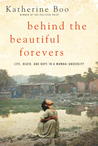
Behind the Beautiful Forevers: Life, Death, and Hope in a Mumbai UndercityBehind the Beautiful Forevers: Life, Death, and Hope in a Mumbai Undercity by Katherine Boo
My rating: 5 of 5 stars

Katherine Boo's Behind the Beautiful Forevers is a beautifully written, impressively thorough book about the lives of slum dwellers in Mumbai, India. It is hard to believe, especially when we are in the middle of witnessing the shocking, immediate aftermath of Fatima setting herself on fire (not exactly self-immolation, though), that what we are reading is not fiction but narrative nonfiction - outstanding journalism writing, top-class reporting. Here is important world news stylistically, memorably and truthfully delivered to us in 244 pages.

The events of the book take place in Annawadi, a "sumpy plug of slum" where "three thousand people had packed into, or on top of, 335 huts." Here is where our protagonist, Abdul Husain, supports his family by being a "trafficker in rich people's garbage" - sorting out trash (plastics, metals) to sell for profit. Despite his efficiency, however, "fortunes derived not just from what people did, or how well they did it, but from the accidents and catastrophes they dodged." Thus the fortunes of the Husain family take a sharp turn when Fatima, their disabled, one-legged neighbor, sets herself on fire and then blames them for the act. Is it at all surprising that Fatima does this while the Husains are in the middle of renovating their hut, conspicuously (and noisily) bettering their lives right next door? What drives a woman to use "her own body as a weapon against her neighbors?"
"Mumbai was a hive of hope and ambition— to a profitable corollary. Mumbai was a place of festering grievance and ambient envy. Was there a soul in this enriching, unequal city who didn’t blame his dissatisfaction on someone else? Wealthy citizens accused the slumdwellers of making the city filthy and unlivable, even as an oversupply of human capital kept the wages of their maids and chauffeurs low.

Slumdwellers complained about the obstacles the powerful erected to prevent them from sharing in new profit. Everyone, everywhere, complained about their neighbors. But in the twenty-first- century city, fewer people joined up to take their disputes to the streets. As group identities based on caste, ethnicity, and religion gradually attenuated, anger and hope were being privatized, like so much else in Mumbai."
From Airport Road, the outskirts of Annawadi, the slum's horrors are hidden from view. All one sees is a concrete wall covered with a seemingly unending row of "sunshine-yellow advertisements" that each read, "BEAUTIFUL FOREVER," advertising Italianate floor tiles (the irony, right??). Boo takes us behind this wall and deep into the complexities of slum life.

A part of this life includes the sacrifices one makes for survival. Collecting garbage next to the rapidly expanding airport, for example, means living with the debris and dust of ongoing construction work; "bad lungs were a toll you paid to live near progress." Yet the most complicated sacrifice - one made so habitually that it ceases to be understood as a sacrifice but rather a necessity - is a moral one. Asha, who dreams of being officially recognized as slumlord, has long-discarded any residues of guilt ("a luxury emotion") within her. She profits by manipulating those around her, taking their money in return for 'favors' that mostly amount to under-the-table dealings with the police. Along a similar vein, others like her set up schools in the slums under the guise of "charity," but only 1) show up to teach on days when they will be inspected 2) abandon ship the moment the school receives government funds (which then go into the 'teacher's' pocket).
“The big people think that because we are poor we don’t understand much,” she said to her children. Asha understood plenty. She was a chit in a national game of make-believe, in which many of India’s old problems---poverty, disease, illiteracy, child labor---were being aggressively addressed. Meanwhile the other old problems, corruption and exploitation of the weak by the less weak, continued with minimal interference.

In the West, and among some in the Indian elite, this word, corruption, had purely negative connotations; it was seen as blocking India’s modern, global ambitions. But for the poor of a country where corruption thieved a great deal of opportunity, corruption was one of the genuine opportunities that remained.
Even the police themselves are corrupt: “The Indian criminal justice system was a market like garbage, Abdul now understood. Innocence and guilt could be bought and sold like a kilo of polyurethane bags.”

So, the most intriguing idea the book presents is that there is as much (maybe more) conflict between slum dwellers as there is between slum dwellers and the outside world; that the decline/absence of your neighbour's moral compass could, for the time being, have a greater say in sealing your fate than a public policy; that your security sometimes depends on sheer luck.
“Your little boat goes west and you congratulate yourself, "What a navigator I am!" And then the wind blows you east.”
Behind the Beautiful Forever wall is a messy mass of people whose forevers are cut short by self-imbibed rat poison, by fate, by overlooked murder.

Yet from the depths of such life emerge hope, the belief that "a boy's life could still matter to himself." That is also why Manju keeps up with her studies, even though all her teachers need her to do to pass is memorize plot summaries. Here is an analogy that will stay with me forever:
Water and ice were made of the same thing. He thought most people were made of the same thing, too. He himself was probably a little different from the corrupt people around him. Ice was distinct from - and in his view, better than - what it was made of. He wanted to be better than what he was made of. In Mumbai's dirty water, he wanted to be ice. He wanted to have ideals.
So, Abdul searches for a "verdict of ice" in waters too dirty for us to distinguish the sewage polluting them. How can we, like Abdul sorting out his garbage, possibly pinpoint all those who have become resigned to the "general indistinction in the mass of need?" Under Boo's sharp gaze, the seams of slum life in Annawadi expose themselves, urging us to stop simplifying poverty or underestimating the degree of personal resentment that influences ever crisis. For instance, Fatima burning herself could be interpreted as a response to "enervating poverty," the "lack of respect accorded the physically impaired" or "a brave indictment of oppressive unions." Yet "almost no one spoke of envy, a stone slab, a poorly made wall, or rubble that had fallen into rice."

Abdul laments, “I tell Allah I love Him immensely, immensely. But I tell Him I cannot be better, because of how the world is.” In a place such as Annawadi, and many others like it, surviving takes endurance, bravery and hope. But it also takes chance, pragmatism and corruption. Behind the Beautiful Forevers gives voices to those whose sufferings are glossed over by false police records and muted by the roaring sounds of an airport that connects to another world entire. It is an eye-opening work that transcends the oft-rigid confines of journalism, crossing into a territory that more fittingly places it on the shelves of literature.


View all my reviews

Sunday, August 9, 2015

The more things change the more they remain the same. History repeating itself, though in a more modest vein. Perhaps history has learned a lesson.

DisgraceDisgrace by J.M. Coetzee
My rating: 5 of 5 stars

*many many many spoilers ahead*

I've been on a blissful reading spree for the past four books, reading books that resonate with me in the best ways. In A River Runs Through It, On Writing, History of Love and History of the Rain, I found characters who eloquently voice how I feel about family/writing/reading/life in general. I connected with Norman MacLean, Stephen King, Alma Singer and Ruth Swain to higher-than-average extents.

Yet because the serious reader should not only stick to reading what makes her/him comfortable, I decided to read a novel that has been on my to-read list for ages and definitely tackles dark themes: J.M. Coetzee's Disgrace.

Our protagonist is the 52-year old and twice-divorced professor David Lurie, who goes through life teaching classes in which he has no interest (with the exception of his one course on romantic poets) and picking up scores of women who help him maintain a "moderated bliss." His one rule, "follow your temperament," is echoed in Byron's Lara, which David teaches to his class:

"... in some strange perversity of thought,
That sway’d him onward with a secret pride
To do what few or none would do beside;
And this same impulse would, in tempting time,
Mislead his spirit equally in crime;"

And thus it is by this "impulse he could not resist" that David begins a short-lived affair with one of his students, is later found out, brought to court, and eventually resigns, leaving civilization to visit his daughter, Lucy, in her farm in South-Africa.

By the way, the court case reminded me very much of Meursault's. Both demonstrate an absence of guilt and the eccentricity of the accused. As David says,
There is a difference between pleading guilty to a charge and admitting you were wrong. Repentance belongs to another world, to another universe of discourse.
And as someone who believes that
No animal will accept the justice of being punished for following its instincts,
David is even able to rationalize the unnecessariness of a issuing a formal apology. He makes the following remark about the women he meets:
“A woman's beauty does not belong to her alone. It is a part of the bounty she brings into the world. She has a duty to share it.”
So by this expert foreshadowing and in a striking turn of the plot, the tables are cruelly turned on David as his daughter - strong, independent, purposeful Lucy - becomes the victim of a double-rape. (I know that Wordsworth, one of the poets frequently alluded to in the novel, often wrote of a Lucy who was young, pure, but died an early death. After her rape, Lucy says that part of her has died, and David grieves for her as Wordsworth did for his Lucy. I can't help but notice the parallel).

Here is where the novel truly takes off, highlighting the grim depths of racial tensions, generation gaps and gender differences Coetzee explores. David has been "disgraced" by his scandal and now his daughter is disgraced by men she never laid eyes on. Men who, in a bitter stroke of irony, share David's views on the forgivability of an impulsive act and the commodification of women.

In the aftermath of the incident, the word "rape" is scarcely mentioned, but it need not be for readers to infer what Lucy suffered. Most troubling/shocking of all is her reaction to the incident, her initial apparent indifference and staunch refusal to raise criminal charges against anyone. Roles reverse as the steadfast Lucy seems maturer than David, who is absorbed by anger, saying, "'I want those men to be caught and brought before the law and punished. Am I wrong? Am I wrong to want justice?'" Again, how ironic is it that he, who was just trialled in court and pit against colleagues demanding an apology, is now begging his daughter (with similar fruitlessness) to accept his advice? How ironic is it that the professor of communications has lost the ability to connect with his own daughter, who does not even address him as 'dad,' but rather David?

The theme of generational gap is captured by David's inability to understand Lucy - her determination to stay on the farm, her love for women (as opposed to men), her decision to not report the rape. With the last point, however, Coetzee points out more troublingly the problems of South-Africa during the post-apartheid era, during which many homes of white farmers were trashed and robbed. Lucy's unwillingness to report the rape is tied to the fact of "this place being South Africa." Perhaps she feels that the rape is too "private" of a matter to be reported? That the rapists' act is in some twisted way rationalizable? That reporting will only bring her further trouble in a troubling society? Early on, David says that "there is a limit to sympathy," but his daughter's limit clearly extends much further than his does.

More on farm attacks, a problem which persists to today, can be found here: http://worldnews.nbcnews.com/_news/2012/11/30/15571149-killings-of-white-farmers-highlight-toxic-apartheid-legacy-in-south-africa

Disgrace haunts nearly all the main characters in the book - the seemingly incorruptible Bev Shaw (who turns out to be not so incorruptible after all), in some ways Petrus's wife (is her brother disgracing her?) and even the animals. At one point in the novel, David speaks of the death of the sick dogs at the animals welfare center as the "disgrace of dying." To be "like a dog," as we learn from David's conversation with Lucy, is "to start at ground level. With nothing. Not with nothing but. With nothing. No cards, no weapons, no property, no rights, no dignity." It is to be disgraced. And David is indeed "sunk in disgrace;" he becomes the "dog-man" who takes the corpses of dogs to the incinerator to be burned.

Yet in the final pages of the novel, he lets go. He gives up the dog to whom he was so attached. He even (in a bizarre way) manages to have dinner with the family of the student he seduced. Even though David insists at the beginning that "his temperament is fixed, set," and that he cannot change himself at this age, he proves himself wrong. Of course, this is the optimistic conclusion. One could equally say that the dog at the end of the novel is being released into the "disgrace of dying" (or being released from the disgrace of living). Yet with David's gentle treatment of the dog, his acceptance of Lucy's pregnancy (not as if he has a choice, anyway) and the somewhat-closure he achieves with his past, I'd like to think that he is less disgraced at the end of the novel than he was initially - that everyone is less disgraced.

Disgrace is best described as striking. It carries a brilliant and gripping plot, shocks us, and asks questions that have no definite answer but provoke important conversation. Should one be convicted for desire? Why does Lucy make the choices she does? Why do three assaulters get away so easily with rape, while David is brought before court in no time at all for seducing a student?
...We cannot live our daily lives in a realm of pure ideas, cocooned from sense-experience. The question is not, How can we keep the imagination pure, protected from the onslaughts of reality? The question has to be, Can we find a way for the two to coexist? 


View all my reviews

Saturday, August 8, 2015

In stories we exist // There's a library inside me

History of the RainHistory of the Rain by Niall Williams
My rating: 5 of 5 stars

Niall Williams's History of the Rain is a beautiful novel that, although set in Ireland, has its heart and soul in all the libraries of the world and in the celestial realms of mythology. I hope this review will explain exactly what I mean by that!
The book opens in the present, in which our protagonist, Ruth Swain describes herself as "Not Coming Right, Terribly Weak, Not Herself, and just A Bit Off." As we will later discover, she has lost both her twin brother, Aengus, and her father, Virgil. Yet before we even get there, we are first introduced to Ruth's grandfather - Abraham Swain - who, as his progeny would all be destined to do, subscribed to "the philosophy of the Impossible Standard" (in more colloquial terms, aimed for perfection). In this way, Williams establishes the idea of of inheritance quite early on in the novel. Virgil inherited his father's desire to "soar," a fate that left him most frequently disappointed in his own poetry (how can one live up to Keats and Shakespeare, the greats? It's no coincidence that Virgil is also the name of the poet who wrote Aeneid). Throughout the novel, we are often reminded of what befits the "Swain Way" ("Swains don't do Normal") or what is classic of the MacCarrolls ("We have mixed metaphors and outlandish similes for breakfast").

And speaking of inheritance, the most important things that Ruth has inherited from her father - to be specific, 3,958 things - are his books. Dickens, Austen, Brontë, Eliot - the list goes on. As she determinedly tells us from the start, "I am going to read them all because that is where I will find him." And this is possible, because "my book has in it all the books my father read, and in that way his spirit survives, as mine does." As Ruth puts it, "my father lives now in the afterlife that is a book." So the history of the rain is another way of describing the history of everything that ever was, and everything that continues to pour into the ongoing cycle of life, for
"The rain becomes the river that goes to the sea and becomes the rain that becomes the river. Each book is the sum of all the others the writer has read. Charles Dickens was a writer because his father had a small library and because solitude was not lonely with Robinson Crusoe and Don Quixote. Each book a writer writes has all the others in it, so there's a library that's like a river and it keeps on going."
Aengus drowned in the river, and Virgil threw his poetry into the river. So, the river is where Ruth goes to search for them - although the her "river" is made up of thousands of books, each a raindrop in its own right. And by writing, Ruth is adding her own pellet of rain to this river of family history:
“We tell stories. We tell stories to pass the time, to leave the world for a while, or go more deeply into it. We tell stories to heal the pain of living.”
The style of the book is magical in the way that we do not travel chronologically, or even realistically, experiencing both the concrete and mythological through Ruth's narration. The most distinctive touch about Williams's style, however, is the way Ruth will express a thought/describe something and, in brackets, detail the specifics of the book that inspired her. Williams is not only giving us book recommendations throughout his novel, but also reinforcing, in an innovative and memorable way, the power of books. For example,
Any number of lovely people are married to horrible ones. Read Middlemarch (Book 989, George Eliot, Penguin Classics, London) if you don't believe me. There's something in me that can't just let it be. Goodness is a tidy bow you just can't help wanting to pull loose.
Indeed, I connect with History of the Rain particularly strongly because of Williams's vocal love for reading. He communicates the way I feel towards books in sentences that are at once poetic and spot-on:
“When my father first took me to Ennis Library I went down among the shelves and felt company, not only the company of writers, but the readers too, because they had lifted and opened and read these books. The books were worn in a way they can only get worn by hands and eyes and minds; these were the literal original Facebooks, the books where faces had been, and I just loved it, the whole strange sense of being aboard a readership.”
I read them all, read them one by one with a kind of constant hunger as if they were apples that fed and made you hungry at the same time.
It's been well-thumbed, at least triple-read, there's that smell the fat orange-spine Penguins get when their pages have yellowed and the book bulges, basically the smell of complex humanity, sort of sweat and salt and endeavour. Like all the fat orange Penguins, it gets fatter with reading, which it should, because in a way the more you read it the bigger your own experience of the world gets, the fatter your soul.=
William also expresses relatable thoughts on writing:
There are a parish of particulars, poets. But they all generally agree, a poem is a precarious thing. It is almost never landed clean and whole in one go.
Writing of course is a kind of sickness. Well people don't do it. Art is basically impossible. [...] Thing is, writing is a sickness only cured by writing. That's the impossible part.
You can't be beautiful and a writer, because to be a writer you have to be the one doing the looking; if you're beautiful people will be looking at you.
There are lines in this book that are pure poetry: "I lay in his lap, small as a sonnet, and just as difficult," "Your blood is a river," "When you're young you're protected by a cloud of vagueness." But History of the Rain is by no means accessible. There are allusions in this book that are gems you'll only be able to admire if you've read widely (I caught all the Great Expectations references, but Williams lost me at Robert Louis Stevenson).

Nonetheless, you, "Dear Reader," will find yourself struck by the rhythm, language and creativity of this book. Ruth read and wrote to find her father, just as I do, and in reading this book, I have also found parts of my whole family and myself. History of the Rain will hit you in the book-loving, childhood and family corners of your heart. 

Here are more quotes that are too good to leave out:

Human beings are not seamless smooth creations, they have insoluble parts, and the closer you look the more mysterious they become.

Each family functions in their own way, by rules reinvented daily. The strangeness of each of us is somehow accommodated so that there can be such a thing as family and we can all live for some time at least in the same house. Normal is what you know.

Hope may or may not be a Thing with Feathers. But it's definitely a Thing with Claws.

My brother was in another boat sailing away, and no matter how much I wanted to, no matter what I did or said I would never be able to get to him.

We thought that fatherhood was this immense weight like a great overcoat and there were all manner of things your father had to be thinking of all the time just to keep the overcoat from crushing him.

Before they are broken small boys are perfect creations.

People are so perishable. That's the thing. Because for everyone you meet there is a last moment, there will be a last moment when your hand slips from theirs, and everything ripples outwards from that, the last firmness of a hand in yours that every moment after becomes a little less firm until you look down at your own hand and try to imagine just what it felt like before their hand slipped away. And you cannot. You cannot feel them. And then you cannot quite see them, there's blurry bits, like you're looking through this watery haze, and you're fighting to see, you're fighting to hold on, but they are perishing right before your eyes, and right before your eyes they are becoming that bit more ghost.


View all my reviews

Tuesday, August 4, 2015

The opposite of disappearing

The History of LoveThe History of Love by Nicole Krauss
My rating: 5 of 5 stars

Immediate thoughts after reading The History of Love: 1) Aaaaah, how can a book be so marvellous.
2) Ken Kalfus was so right when he said this book "will break your heart and at once mend it." 3) I love how this book is not only about love, but also about history.

Nicole Krauss's The History of Love is a book I've been eyeing for ages, but only read today. It's a beautiful and complex story filled with surprises and characters whose stories intertwine despite their differences (halfway through the book, I actually had to draw a diagram to stay on track). I love it when that happens.

Our protagonist is Leopold Gursky, a Jewish immigrant from Poland. In the story, he wrote the book The History of Love for his childhood love, Alma Mereminski. They have a son together, but he is eventually raised by a different father when World War 2 separates the couple and leaves Alma thinking Leo has been killed. Zvi Litvinoff, Leo's friend, shares the same belief and - as the only one with the manuscript of The History of Love in his possession - ends up publishing it in Spanish under his own name. So the book goes out into the open, a certain David Singer reads it, he names his daughter after Alma, Alma's mother is approached by a mysterious stranger to translate the book from Spanish into English after David dies, and the whole story takes off from there as young Alma sets off to find this stranger.

The whole story is about searching. Leopold spends most of his adult life hoarding any records he can find of his son, an established author. Alma's brother, "Bird," never stops searching for an impression of who his father was. And as Alma says,

"I'd started out looking for someone who could make my mother happy again, now I was looking for something else, too. About the woman I was named after. And about me."


Everything that the characters search for ebbs on the brink of the forgotten. Leo, for instance, often says that he is invisible; when his photo is taken with a polaroid camera, his face does not appear on the film. Although he is a locksmith ("I helped those in who were locked out, others I helped keep out what couldn't be let in, so that they could sleep without nightmares"), he ironically remains locked-out of life: forgotten after the war, author of a book that sells under a different name, father to a son raised by a different husband.

Krauss dedicates the novel to her grandparents, who were immigrants from Germany, Ukraine, Hungary and Israel. And at the very end of the book, it seems like it is also dedicated to the Leopold Gurskys of the world who "started dying on August 18 1920," who "died practicing a new way to sign his name," who knew the terrors of the war. In a very poignant moment, we learn that Leo's friend "Bruno," whose was always enigmatically portrayed, is actually a figment of his imagination - that the real Bruno "died on a July day in 1941." When Leo banishes Bruno from his room, he perhaps also banishes some part of the ghost of the war that haunts him.

Aside from its serious meditations on love and history, however, this novel is often humorous, such as when Alma's Judaism-enthusiast of a brother turns out to be surprisingly helpful, and when we realize that it is completely possible Alma may have sketched a naked Leopold during one of her classes. I also love how Krauss describes the only two kisses in the novel in details that vividly suggest their awkwardness: 1) "then we got it right, sort of, opening our mouths at the same time like we were both trying to say something, [...] then my shoulder got accidentally mashed against his accordion." 2) She tried to kiss him, but Litvinoff, taken off guard, backed away, leaving Rosa tipped forward at an awkward angle, neck outstretched. [...] He blindly stuck his neck out into the gulf. But by then, Rosa had already counted her losses and pulled back into safer territory." Alas, love is not easy. "Part of me is made of glass," Leopold admits.

The History of Love is beautiful and innovative. You will treasure both the young and old voices you hear in the novel (although the number of times Leo says "And Yet" is mind boggling excessive). Ah, reading is the best.
To paint a leaf, you have to sacrifice the whole landscape. It might seem like you’re limiting yourself at first, but after a while you realize that having a quarter-of-an-inch of something you have a better chance of holding on to a certain feeling of the universe than if you pretended to be doing the whole sky.
“The first language humans had was gestures. There was nothing primitive about this language that flowed from people’s hands, nothing we say now that could not be said in the endless array of movements possible with the fine bones of the fingers and wrists. The gestures were complex and subtle, involving a delicacy of motion that has since been lost completely. [...] Holding hands, for example, is a way to remember how it feels to say nothing together.
"Having begun to feel, people's desire to feel grew. They wanted to feel more, feel deeper, despite how much it sometimes hurt. People became addicted to feeling. They struggled to uncover new emotions.
“At the end, all that's left of you are your possessions. Perhaps that's why I've never been able to throw anything away. Perhaps that's why I hoarded the world: with the hope that when I died, the sum total of my things would suggest a life larger than the one I lived.”


View all my reviews