Showing posts with label journalism. Show all posts

Sunday, December 20, 2015

“Sure, some news is bigger news than other news. War is bigger news than a girl having mixed feelings about the way some guy fucked her and didn't call. But I don't believe in a finite economy of empathy; I happen to think that paying attention yields as much as it taxes.”

The Empathy Exams: EssaysThe Empathy Exams: Essays by Leslie Jamison
My rating: 5 of 5 stars

I have wanted to read Leslie Jamison's The Empathy Exams for a very long time because the questions she grapples with are ones that I, too, often try to answer: what is empathy? What kind of territory do I find myself in when I empathize with someone? And what do I make of my own emotional response to the pain of those with whom I empathize? 

The Empathy Exams is a fitting title that captures the nature of the eleven essays in it. The title essay traces Jamison's experience as a medical actor, a job that required her to play the role of sick patients in simulated scenarios and speak to medical students whose performances she would later evaluate via a checklist: how well could they assess her condition? Did they give the right advice? And, checklist 31: how well did they express "voiced empathy" for her "situation/problem?"

For the medical students, the 15-minute session was simply an exam they had to take. Yet an "empathy exam," like all tests, takes work, and can herald disastrous consequences if failed. What distinguishes it from a regular exam is that passing is not simply a matter of getting over half of the questions right:
“Empathy isn’t just remembering to say that must really be hard—it’s figuring out how to bring difficulty into the light so it can be seen at all. Empathy isn’t just listening, it’s asking the questions whose answers need to be listened to. Empathy requires inquiry as much as imagination. Empathy requires knowing you know nothing. Empathy means acknowledging a horizon of context that extends perpetually beyond what you can see ”
“Empathy isn't just something that happens to us - a meteor shower of synapses firing across the brain - it's also a choice we make: to pay attention, to extend ourselves. It's made of exertion, that dowdier cousin of impulse. Sometimes we care for another because we know we should, or because it's asked for, but this doesn't make our caring hollow. This confession of effort chafes against the notion that empathy should always rise unbidden, that genuine means the same thing as unwilled, that intentionality is the enemy of love. But I believe in intention and I believe in work. I believe in waking up in the middle of the night and packing our bags and leaving our worst selves for our better ones.”
The parts of the book with which I resonated the most strongly were those in which Jamison looked at empathy from a self-analytical (and sometimes criticizing) standpoint, discussing what one might call the 'problems' of empathy:
“When bad things happened to other people, I imagined them happening to me. I didn’t know if this was empathy or theft.” 
When does empathy actually reinforce the pain it wants to console? Does giving people a space to talk about their disease -- probe it, gaze at it, share it -- help them move through it, or simply deepen its hold? Does a gathering like this offer solace or simply confirm the cloister and prerogative of suffering? Maybe it just pushes on the pain until it gets even worse, until it requires more comfort than it did before. 
This is the anxiety of the empathizer, a self-consciousness that Jamison - and I, honestly - have never been able to escape. Is empathy still empathy when we "trust the fact of suffering, but not the source?"  
How do I inhabit someone’s pain without inhabiting their particular understanding of that pain? This anxiety is embedded in every layer of this essay; even its language—every verb choice, every qualifier. Do people have parasites or claim to have them? Do they understand or believe themselves to have them? I wish I could invent a verb tense full of open spaces—a tense that didn’t pretend to understand the precise mechanisms of which it spoke; a tense that could admit its own limits. As it is, I can’t move an inch, finish a sentence, without running into some crisis of imputation or connotation. Every twist of syntax is an assertion of doubt or reality.
While it is only in "Pain Tours" that Jamison examines empathy in specific geographical locations, she conveys the territorial nature of suffering in all her essays. After all,
“Empathy comes from the Greek empatheia - em (into) and pathos (feeling) - a penetration, a kind of travel. It suggests you enter another person's pain as you'd enter another country, through immigration and customs, border crossing by way of query: What grows where you are? What are the laws? What animals graze there?” 
In some ways, we can derive a sense of self-gratification from such travel: we are often inclined towards sentimentality, just as "we like who we become in response to injustice: it makes it easy to choose a side." Yet the foray into "another person's pain," of course, also hurts: "empathy bleeds." Jamison's geographical analogy works so well because visiting a troubled country and trying to help it is a lot like taking a tour of somebody's broken emotional landscape: the journey may not be pleasant, but the traveller must always strive to remember the purpose of the visit and the people for whom it is made. Throughout her book, Jamison approaches the subject with a critical eye, an often-innovative form and piercing introspection to convey that empathy is difficult, demanding - but also indisputably important.


View all my reviews


Saturday, August 15, 2015

Like most people in the slum, and in the world for that matter, he believed his own dreams properly aligned to his capacities

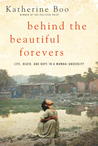
Behind the Beautiful Forevers: Life, Death, and Hope in a Mumbai UndercityBehind the Beautiful Forevers: Life, Death, and Hope in a Mumbai Undercity by Katherine Boo
My rating: 5 of 5 stars

Katherine Boo's Behind the Beautiful Forevers is a beautifully written, impressively thorough book about the lives of slum dwellers in Mumbai, India. It is hard to believe, especially when we are in the middle of witnessing the shocking, immediate aftermath of Fatima setting herself on fire (not exactly self-immolation, though), that what we are reading is not fiction but narrative nonfiction - outstanding journalism writing, top-class reporting. Here is important world news stylistically, memorably and truthfully delivered to us in 244 pages.

The events of the book take place in Annawadi, a "sumpy plug of slum" where "three thousand people had packed into, or on top of, 335 huts." Here is where our protagonist, Abdul Husain, supports his family by being a "trafficker in rich people's garbage" - sorting out trash (plastics, metals) to sell for profit. Despite his efficiency, however, "fortunes derived not just from what people did, or how well they did it, but from the accidents and catastrophes they dodged." Thus the fortunes of the Husain family take a sharp turn when Fatima, their disabled, one-legged neighbor, sets herself on fire and then blames them for the act. Is it at all surprising that Fatima does this while the Husains are in the middle of renovating their hut, conspicuously (and noisily) bettering their lives right next door? What drives a woman to use "her own body as a weapon against her neighbors?"
"Mumbai was a hive of hope and ambition— to a profitable corollary. Mumbai was a place of festering grievance and ambient envy. Was there a soul in this enriching, unequal city who didn’t blame his dissatisfaction on someone else? Wealthy citizens accused the slumdwellers of making the city filthy and unlivable, even as an oversupply of human capital kept the wages of their maids and chauffeurs low.

Slumdwellers complained about the obstacles the powerful erected to prevent them from sharing in new profit. Everyone, everywhere, complained about their neighbors. But in the twenty-first- century city, fewer people joined up to take their disputes to the streets. As group identities based on caste, ethnicity, and religion gradually attenuated, anger and hope were being privatized, like so much else in Mumbai."
From Airport Road, the outskirts of Annawadi, the slum's horrors are hidden from view. All one sees is a concrete wall covered with a seemingly unending row of "sunshine-yellow advertisements" that each read, "BEAUTIFUL FOREVER," advertising Italianate floor tiles (the irony, right??). Boo takes us behind this wall and deep into the complexities of slum life.

A part of this life includes the sacrifices one makes for survival. Collecting garbage next to the rapidly expanding airport, for example, means living with the debris and dust of ongoing construction work; "bad lungs were a toll you paid to live near progress." Yet the most complicated sacrifice - one made so habitually that it ceases to be understood as a sacrifice but rather a necessity - is a moral one. Asha, who dreams of being officially recognized as slumlord, has long-discarded any residues of guilt ("a luxury emotion") within her. She profits by manipulating those around her, taking their money in return for 'favors' that mostly amount to under-the-table dealings with the police. Along a similar vein, others like her set up schools in the slums under the guise of "charity," but only 1) show up to teach on days when they will be inspected 2) abandon ship the moment the school receives government funds (which then go into the 'teacher's' pocket).
“The big people think that because we are poor we don’t understand much,” she said to her children. Asha understood plenty. She was a chit in a national game of make-believe, in which many of India’s old problems---poverty, disease, illiteracy, child labor---were being aggressively addressed. Meanwhile the other old problems, corruption and exploitation of the weak by the less weak, continued with minimal interference.

In the West, and among some in the Indian elite, this word, corruption, had purely negative connotations; it was seen as blocking India’s modern, global ambitions. But for the poor of a country where corruption thieved a great deal of opportunity, corruption was one of the genuine opportunities that remained.
Even the police themselves are corrupt: “The Indian criminal justice system was a market like garbage, Abdul now understood. Innocence and guilt could be bought and sold like a kilo of polyurethane bags.”

So, the most intriguing idea the book presents is that there is as much (maybe more) conflict between slum dwellers as there is between slum dwellers and the outside world; that the decline/absence of your neighbour's moral compass could, for the time being, have a greater say in sealing your fate than a public policy; that your security sometimes depends on sheer luck.
“Your little boat goes west and you congratulate yourself, "What a navigator I am!" And then the wind blows you east.”
Behind the Beautiful Forever wall is a messy mass of people whose forevers are cut short by self-imbibed rat poison, by fate, by overlooked murder.

Yet from the depths of such life emerge hope, the belief that "a boy's life could still matter to himself." That is also why Manju keeps up with her studies, even though all her teachers need her to do to pass is memorize plot summaries. Here is an analogy that will stay with me forever:
Water and ice were made of the same thing. He thought most people were made of the same thing, too. He himself was probably a little different from the corrupt people around him. Ice was distinct from - and in his view, better than - what it was made of. He wanted to be better than what he was made of. In Mumbai's dirty water, he wanted to be ice. He wanted to have ideals.
So, Abdul searches for a "verdict of ice" in waters too dirty for us to distinguish the sewage polluting them. How can we, like Abdul sorting out his garbage, possibly pinpoint all those who have become resigned to the "general indistinction in the mass of need?" Under Boo's sharp gaze, the seams of slum life in Annawadi expose themselves, urging us to stop simplifying poverty or underestimating the degree of personal resentment that influences ever crisis. For instance, Fatima burning herself could be interpreted as a response to "enervating poverty," the "lack of respect accorded the physically impaired" or "a brave indictment of oppressive unions." Yet "almost no one spoke of envy, a stone slab, a poorly made wall, or rubble that had fallen into rice."

Abdul laments, “I tell Allah I love Him immensely, immensely. But I tell Him I cannot be better, because of how the world is.” In a place such as Annawadi, and many others like it, surviving takes endurance, bravery and hope. But it also takes chance, pragmatism and corruption. Behind the Beautiful Forevers gives voices to those whose sufferings are glossed over by false police records and muted by the roaring sounds of an airport that connects to another world entire. It is an eye-opening work that transcends the oft-rigid confines of journalism, crossing into a territory that more fittingly places it on the shelves of literature.


View all my reviews