Showing posts with label love. Show all posts

Tuesday, August 4, 2015

The opposite of disappearing

The History of LoveThe History of Love by Nicole Krauss
My rating: 5 of 5 stars

Immediate thoughts after reading The History of Love: 1) Aaaaah, how can a book be so marvellous.
2) Ken Kalfus was so right when he said this book "will break your heart and at once mend it." 3) I love how this book is not only about love, but also about history.

Nicole Krauss's The History of Love is a book I've been eyeing for ages, but only read today. It's a beautiful and complex story filled with surprises and characters whose stories intertwine despite their differences (halfway through the book, I actually had to draw a diagram to stay on track). I love it when that happens.

Our protagonist is Leopold Gursky, a Jewish immigrant from Poland. In the story, he wrote the book The History of Love for his childhood love, Alma Mereminski. They have a son together, but he is eventually raised by a different father when World War 2 separates the couple and leaves Alma thinking Leo has been killed. Zvi Litvinoff, Leo's friend, shares the same belief and - as the only one with the manuscript of The History of Love in his possession - ends up publishing it in Spanish under his own name. So the book goes out into the open, a certain David Singer reads it, he names his daughter after Alma, Alma's mother is approached by a mysterious stranger to translate the book from Spanish into English after David dies, and the whole story takes off from there as young Alma sets off to find this stranger.

The whole story is about searching. Leopold spends most of his adult life hoarding any records he can find of his son, an established author. Alma's brother, "Bird," never stops searching for an impression of who his father was. And as Alma says,

"I'd started out looking for someone who could make my mother happy again, now I was looking for something else, too. About the woman I was named after. And about me."


Everything that the characters search for ebbs on the brink of the forgotten. Leo, for instance, often says that he is invisible; when his photo is taken with a polaroid camera, his face does not appear on the film. Although he is a locksmith ("I helped those in who were locked out, others I helped keep out what couldn't be let in, so that they could sleep without nightmares"), he ironically remains locked-out of life: forgotten after the war, author of a book that sells under a different name, father to a son raised by a different husband.

Krauss dedicates the novel to her grandparents, who were immigrants from Germany, Ukraine, Hungary and Israel. And at the very end of the book, it seems like it is also dedicated to the Leopold Gurskys of the world who "started dying on August 18 1920," who "died practicing a new way to sign his name," who knew the terrors of the war. In a very poignant moment, we learn that Leo's friend "Bruno," whose was always enigmatically portrayed, is actually a figment of his imagination - that the real Bruno "died on a July day in 1941." When Leo banishes Bruno from his room, he perhaps also banishes some part of the ghost of the war that haunts him.

Aside from its serious meditations on love and history, however, this novel is often humorous, such as when Alma's Judaism-enthusiast of a brother turns out to be surprisingly helpful, and when we realize that it is completely possible Alma may have sketched a naked Leopold during one of her classes. I also love how Krauss describes the only two kisses in the novel in details that vividly suggest their awkwardness: 1) "then we got it right, sort of, opening our mouths at the same time like we were both trying to say something, [...] then my shoulder got accidentally mashed against his accordion." 2) She tried to kiss him, but Litvinoff, taken off guard, backed away, leaving Rosa tipped forward at an awkward angle, neck outstretched. [...] He blindly stuck his neck out into the gulf. But by then, Rosa had already counted her losses and pulled back into safer territory." Alas, love is not easy. "Part of me is made of glass," Leopold admits.

The History of Love is beautiful and innovative. You will treasure both the young and old voices you hear in the novel (although the number of times Leo says "And Yet" is mind boggling excessive). Ah, reading is the best.
To paint a leaf, you have to sacrifice the whole landscape. It might seem like you’re limiting yourself at first, but after a while you realize that having a quarter-of-an-inch of something you have a better chance of holding on to a certain feeling of the universe than if you pretended to be doing the whole sky.
“The first language humans had was gestures. There was nothing primitive about this language that flowed from people’s hands, nothing we say now that could not be said in the endless array of movements possible with the fine bones of the fingers and wrists. The gestures were complex and subtle, involving a delicacy of motion that has since been lost completely. [...] Holding hands, for example, is a way to remember how it feels to say nothing together.
"Having begun to feel, people's desire to feel grew. They wanted to feel more, feel deeper, despite how much it sometimes hurt. People became addicted to feeling. They struggled to uncover new emotions.
“At the end, all that's left of you are your possessions. Perhaps that's why I've never been able to throw anything away. Perhaps that's why I hoarded the world: with the hope that when I died, the sum total of my things would suggest a life larger than the one I lived.”


View all my reviews

Tuesday, July 28, 2015

Our brother's keepers

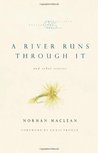
A River Runs Through It and Other StoriesA River Runs Through It and Other Stories by Norman Maclean
My rating: 5 of 5 stars

Norman Maclean's only novella to date, A River Runs Through It and Other Stories, consists of three semi-autobiographical short stories set in Western Montana.  In each story, we are introduced to a specific art and presented with a memorable portrait of a complex character. In the novella's titular story, A River Runs Through It, we learn about the art of fly-fishing and meet Norman's brother, Paul; in "Logging and Pimping and 'Your pal, Jim'", we read about the nature of logging as well as an enigmatic logging expert, Jim; finally, in "USFS 1919: The Ranger, the Cook, and a Hole in the Sky," our characters pass their time playing cribbage, eventually betting on the mysterious and dislikable cook - a cardshark - to win big in Hamilton, helping them "clean out town" at the end of the summer.

Bill, the ranger from "USFS 1919," calls the cook an artist; yet the true artist of the novella is in A River Runs Through It: Paul. Our narrator, Norman, speaks of Paul as an artisan multiple times throughout the story, even calling his fishing stick "a wand."
"At the end of this day, then, I remember him both as a distant abstraction in artistry and as a closeup in water and laughter"
As is the case with so many artists, however, Paul is reckless, troublesome and hard to understand. Everyone in Paul's family adores him and wants to help him - yet the difficulties of both articulating and accepting a help offering stand between them until the final, irreversible end.

The difficulty of extending a helping hand is already captured at the beginning of the story, where Norman humorously admits that giving advice on fly-fishing could pose a "strain on family relations" if not carefully expressed. It's one of those relatable sibling problems where giving tips and suggestions is considered offensive/inappropriately authoritative/nosy. And it is because of this, a problem equally noted in the first part of Paul's father's claim, that Paul is so tragically unhelp-able: "Help," he said "is giving part of yourself to somebody who comes to accept it willingly and needs it badly." The difficulty of mutual understanding is also captured through fly-fishing, particularly in the scene where both brothers are shouting at each other across a raging river, unable to fully interpret the other's words. "Finally, we understood each other," is the remark Norman makes about the end of that conversation - but sadly, it is not a truth he can declare at the end of the story.
“In the loneliness of the canyon I knew there were others like me who had brothers they did not understand but wanted to help. We are probably those referred to as "our brother's keepers," possessed of one of the oldest and possible one of the most futile and certainly one of the most haunting instincts. It will not let us go.”
Neal Burns, the brother of Norman's wife in the story, is another example of a brother who needs help but doesn't accept it. In stark contrast to Paul, Neal is much less likeable, less adventurous, more preened ("Jessie's brother Neal stepped off the train trying to remember what a Davis Cup tennis player looked like") and, to Paul's disgust, fishes with worms (instead of flies). Yet like Paul, he is the subject of worry for those around him; Jessie's family hopes that fishing with the Macleans, the "preacher's sons," will correct Neal's morals, while "Old Rawhide," a horsewoman-turned-whore, thinks that she can help Neal ("He's my man," she keeps insisting).

The frustration and sadness Norman feels about his inability to help is eloquently voiced by both himself and his father:
"Tell me, why is it that people who want help do better without it - at least, no worse. Actually, that's what it is, no worse. They take all the help they can get, and are just the same as they always have been."
"So it is that we can seldom help anybody. Either we don't know what part to give or maybe we don't like to give any part of ourselves. Then, more often than not, the part that is needed is not wanted. And even more often, we do not have the part that is needed. It is like the auto-supply shop over town where they always say, 'Sorry, we are just out of that part.'"
Yet the moving beauty of such a relationship is this:
"But we can still love them - we can love completely without complete understanding.”
“Do you think I could have helped him?” Norman's father asks. “Do you think I could have helped him?” answers Norman in response. As he accurately remarks, How can a question be answered that asks a lifetime of questions? 

But sometimes, as Norman says, "Help doesn't have to be anything that big."
He asked me, "Do you think your mother helps him by buttering his roll?" 
"She might," I told him. "In fact, yes, I think she does."
Does Norman help Paul by taking him fishing? Yes, I think he does.

In the novel, Maclean also portrays a magical quality of the river, and the way it shapes not only rocks and geology, but also our stories and our lives. The water has a certain power over its fishermen ("Eventually, the watched joined the river, and there was only one of us. I believe it was the river") as well as an inclusivity ("As the heat mirages on the river in front of me danced with and through each other, I could feel patterns from my own life joining with them.")

Maclean uses the metaphor of a story to write about "reading the water," and how "it is much easier to read the waters of tragedy." It is thus fitting that he says, "stories of life are often more like rivers than books." For the river that he writes about, Big Blackfoot, was the family river that ran throughout his life, the medium that connected both him and his brother, the landscape in which he witnessed an artist at work, the place where the "Dance of Death" of a fish would foreshadow his brother's, the one place where came closest to understanding and helping Paul.
“Eventually, all things merge into one, and a river runs through it. The river was cut by the world's great flood and runs over rocks from the basement of time. On some of the rocks are timeless raindrops. Under the rocks are the words, and some of the words are theirs. I am haunted by waters.”
If I eventually do become an English teacher/professor, A River Runs Through It is a story I want to teach. It is at once humorous (the hilarious shock of seeing not two "bears," but two "bare asses") and poignant. This may sound childish, but I feel so joyous to have a beautiful short story I can call my all-time favourite.
“One of life's quiet excitements is to stand somewhat apart from yourself and watch yourself softly becoming the author of something beautiful even if it is only a floating ash.”
“Many of us would probably be better fishermen if we did not spend so much time watching and waiting for the world to become perfect.”


View all my reviews

Sunday, June 7, 2015

Clever how the cosmos can, in a single portent, be ingratiating yet sadistic

Three JunesThree Junes by Julia Glass
My rating: 4 of 5 stars

After reading a collection of short stories and a memoir this past week, I found myself yearning for fiction - a world with more interconnected characters and plot twists.

My wish was granted by Julia Glass's Three Junes, a novel in three parts that traces the separate (yet linked) events of three Junes in 1989, 1995 and 1999 respectively.  In the first third of the novel, Collies, Paul McLeod travels to Greece after his wife's death, where he meets new people yet cannot tear his thoughts away from his memories of the past. In Upright, Paul's gay son, Fenno McLeod, recounts his custodiary/ relationship with the enigmatic music critic Malachy Burns. Finally, in Boys, Fern (a girl Paul met in Greece), Fenno, Fenno's lover (Tony, who was also romantically linked to Fern at one point) and Fenno's brother are , and everyone's past and present intertwine.

The most memorable feature of the novel is Glass's use of flashbacks - pieces of the past interspersed everywhere that explain as much about the characters as they do about the present. It is through Paul's memory of his late wife crying about the death of a fellow collie-trainer, for example, that we suspect the possibility of an affair (a suspicion confirmed in Upright). All three parts of the novel are thus connected: they all involve the McLeod family, contain at least one death, and revolve around love. The way the three parts are sewn together, as a triptych, means that each "June" is crucial to our understanding of the other Junes. To some of the characters, fate is the thread that elegantly brings them together:
When it comes to life, we spin our own yarn, and where we end up is really, in fact, where we always intended to be.
And such layering lends the novel its mysteries and complexities. We, looking at the world through Paul's eyes in Collies, believe that his son Fenno is romantically involved with Malachy Burns; however, only in Upright do we learn that Fenno and Mal's relationship (and Mal, for that matter) is far more complex. Similarly, our impression of Fern is shallow at best from Collies, but she is given the depth she deserves in Boys.

The best third of the novel is Upright; it could stand alone and sustain itself marvellously. Indeed, it effortlessly outshines the other two. From Fenno's perspective, we learn about the conflict he feels between meeting his deceased father's expectations of being upright and balancing the complex feelings he harbors for both Tony and Mal. At the same time, we also witness the affection that passes between him and his nieces; such are the joys of family. Furthermore, the dialogue in this story is remarkably witty and its ending is striking (and, I confess, tear-inducing).
Invisible threads connect the three Junes and are understood by the reader, who can often see what the characters cannot. Yet we are also often surprised by what each new June reveals about our understanding of love and family:
To love me, my family does not need to understand me.
Mind who you love. For that matter, mind how you are loved
To have children is to plant roses, muguets, lavender, lilac, gardenia, stock, peonies, tuberose, hyacinth ...it is to achieve a whole sense, a grand sense one did not priorly know. It is to give one's garden another dimension. Perfume of life itself.”
Through Three Junes, I am once again reminded of the true pleasure that reading brings - the intertwining layers of a good story, the secrets of its characters, the sympathy and exasperation we feel towards them. It is certainly a thoughtful, captivating and well-sequenced novel. 
People take their same old lives wherever they go. No place is perfect enough to strip you of that.
Time plays like an accordion in the way it can stretch out and compress itself in a thousand melodic ways. Months on end may pass blindingly in a quick series of chords, open-shut, together-apart; and then a single melancholy week may seem like a year's pining, one long unfolding note.
Splinters in the heart, invisibly and erratically painful: this is how Fern has thought of her accumulating sorrows. Impossible to expel or withdraw; if you’re lucky, they slip out on their own. but perhaps they are more like the seeds inside a brightly patterned gourd, beyond germination but essential to the wholeness of the gourd itself. Without breaking its durable, ossified skin, you cannot remove them; sometimes they will clatter about and make themselves known. It’s just the nature of things.
When it comes to love, there is the timeworn caution that the very qualities you fall hardest for may be those you grow to despise.
Some of us have the infinity of the ocean at our doorstep, others the platitude of a nicely groomed hedgerow. ... And some of us, lucky dogs, see cascading stars while the rest of us see none and think, disdainfully, that they must be a hallucination. ... Some of us get love ... as right as it can be - and others get everything else but.


View all my reviews

Sunday, May 13, 2012

媽媽


3992108365_56ffd8b4c5_largeBefore I hop off to work for real,
a very special Happy Mother's Day
to my beautiful mother who feeds,
clothes, cleans, supports, inspires,
teaches, raises, accompanies, and
loves me! Don't know where I
(or my siblings) would be today
without all her love.
Brother and I made her breakfast
today (nowhere nearly as good
at the ones she makes us) and
we went hiking. Immensely
touched by all she does for us and
also for herself, for us once more.
A very special hero.