Friday, January 9, 2015

On s'est bien battus

Deux jours une nuit is a mesmerizing film about tenacity, human nature and the meaning of value. It traces the story of Sandra, a mother of two, who struggles with depression and anxiety but is given the chance to recover her job in the timespan of two days and one night. To do so, Sandra must confront her sixteen colleagues over the weekend and convince at least nine of them to cast a vote on Monday morning that will decide whether she gets to keep her job - or whether she will lose it while her coworkers, now fewer in number, will receive a 1000-pound bonus.

Sandra ou la prime? is the question that is asked before the votes are cast near the end of the film. Sandra or the bonus? These words pithily capture the primary ethical question that looms before us in the film: Compassion or pragmatism? Utilitarian or egotism? 

Such a question, difficult as it already is, is further complicated in the film. Sandra, for instance, is not an indispensable worker. Thin, bedridden and dependent on Xanax, she herself questions her competence and self-worth. If her colleagues choose to keep her, therefore, they will be doing so purely out of humanitarian reasons. Furthermore, her colleagues must take their own financial bearings into account when making their decision. As Sandra visits their homes, the audience realizes quickly that the people she works with also belong to the lower-middle class of Belgian society. Some work double jobs, some live in dingy apartments.  

What is most intriguing about the film is, of course, the ways in which the colleagues respond to Sandra. The first man she meets seems almost willing to side with her, but his wife interjects and angrily reminds him that they have to pay their daughter's college tuition. Another colleague, Nadine, flat-out refuses to even answer the door. She instead makes her daughter do the dirty work and pretend that no adults are home. It is Timur, on the other hand, who shows the most empathy - crying, even - when Sandra approaches him. It is also Timur who reminds Sarah of a time when she once showed him kindness; I suppose there is still good karma after all.

At the same time, Sandra's meetings do not simplify down to yeses and nos. Alphonse, for instance, struggles because he is afraid that Jean-Marc, his contremaître (and the one who threatened the colleagues to vote Sandra out), will revoke his contract upon knowing that he decided to vote for Sandra. Graver still, Sandra's visits - as she herself notes - provoke conflicts, ranging from spats between spouses to actual fistfights between employees. The miraculous turn of events is that one of these fights finally pushes Anne, one of the colleagues, to leave her abusive husband. There is the idea that Sandra's visit offers her sixteen colleagues the opportunity to reflect, reconsider and reevaluate. Yet how many choose to do so? It is fitting, then, that the vote ends in a draw. Indeed, this ending works out not only because it elaborates the plot, but also because it perpetuates the question the film asks: Sandra ou la prime? 

The presence of children in the film is particularly striking. Firstly, the fact that almost all of Sandra's colleagues have children means that the question for most of them is not only Sandra ou la prime, but also Sandra ou la prime [et le bien-être de ma famille]. Moreover, the children add a layer of innocence and lightness to the otherwise heavy, adult-dominated film. It is lovely that a child walks her to the laundry room as she heads there to meet Alphonse. Despite all the unkindness that she has been shown by some of her coworkers, not a single child looks at her meanly. So, it is ultimately Sandra's children and her dedicated and tenacious husband, Manu, who form her backbone. It is them for whom she fights. 

Throughout the film, we often see Sandra under sunlight as she rushes from door to door; instead of appearing illuminated or emboldened by the glow, however, she appears weak and overcome. Yet this is in stark contrast to Marion Cotillard's performance. Capturing anxiety and despair but also renewed hope and gratitude, she powerfully portrays a character who - despite feeling like "un mendiant" -  persists with her long journey to rediscover self-worth. She is fearless and flawless.

Deux jours une nuit is truly a film that deserves the 15-minute standing ovation it received at the 2014 Cannes Film Festival!


Wednesday, December 31, 2014

2014 -My Year in Books


As the 365-day symphony of 2014 reaches its final bars, I find that a great way to evaluate the music of the year - in both personal and universal contexts - is through books.

Above are the 35 books I read this year (thank you, Goodreads, for helpfully generating the image), listed in chronological order starting from the bottom right.

Well, 2014 was the year of academic reading. 10/35 books this year were read for academic purposes or in an academic context. I have a Goodreads policy of only listing the books I've perused totally as "read," so the number is actually higher. Out of these books, 2 were re-reads (Cormac McCarthy!) in preparation for my extended essay, 2 were Chinese and 1 was French. Despite having read these books "for school," however, I enjoyed them, fell in love with several and was certainly inspired to read further because of what I'd read on their pages.

In 2014, the reading world went crazy for Karl Ove Knausgaard's The Struggle, Donna Tartt won the Putlizer for The Goldfinch and Dave Eggers published Your Fathers, Where Are They? And the Prophets, Do They Live Forever? I also spent the year catching up on the books that had captured the attention of the literary world last year: Alice Munro's Something I've Been Meaning to Tell You and Eleanor Catton's The Luminaries.

This year, I was further convinced that I love reading about the tropical: Jhumpa Lahiri's The Lowland and Michael Ondaatje's Running in the Family filled my year with lyrical prose and enrapturing stories. Speaking of Running in the Family, I also ventured into the realm of memoir/personal narrative this year, not only with My Struggle, but also with Jason Ng's No City for Slow Men, Kim Thuy's Ru, Jean-Dominique Bauby's Le Scaphandre et Le Papillon and Annie Lamott's Bird by Bird.

I was also able to complete some to-reads this year: the aforementioned Bird by Bird, Swamplandia, The Brief Wondrous Life of Oscar Wao and Blink, for instance. Meeting Junot Diaz was just the cherry on top of the literary ice cream.

These books have bookmarked my year like rehearsal letters on sheet music. Remembering them is to recall how I spent my days in 2014. Once the SATs were over, I sequestered myself in the HK Library and at home to devour Bird by Bird and Swamplandia; I remember reading The Luminaries in the car on my way to my violin teacher's home; I read 9 books over the summer (from Les Choses to The Language Instinct); I read Your Fathers while waiting for my flight to Pennsylvania; I bought My Struggle and Tinkers in Boston; I remember reading the latter in the lobby of the hotel I was staying at in New York; I read The Language Instinct in the final week of summer while my brother was at his internship; I devoured The Goldfinch over the second extended essay week period and loved that bildungsroman with all my heart.

Looking at these books, I'm also able to set myself some New Years' Resolutions. This year, the ratio of French books to Chinese books I read was 2:1; next year, I hope to close that ratio un peu. I will continue to immerse myself in more non-fiction books and memoirs. I'll try to read the Pulitzer/Orange Prize/Nobel/etc. winners of 2015 in 2015. Of course, I'll also keep reading nonfiction (I have a bunch of books about intuition on my desk right now).

2014 has been a year well-spent reading and writing; I hope the new year will bring its wealth of words and wisdom into my life.


Tuesday, December 30, 2014

Honeydicking

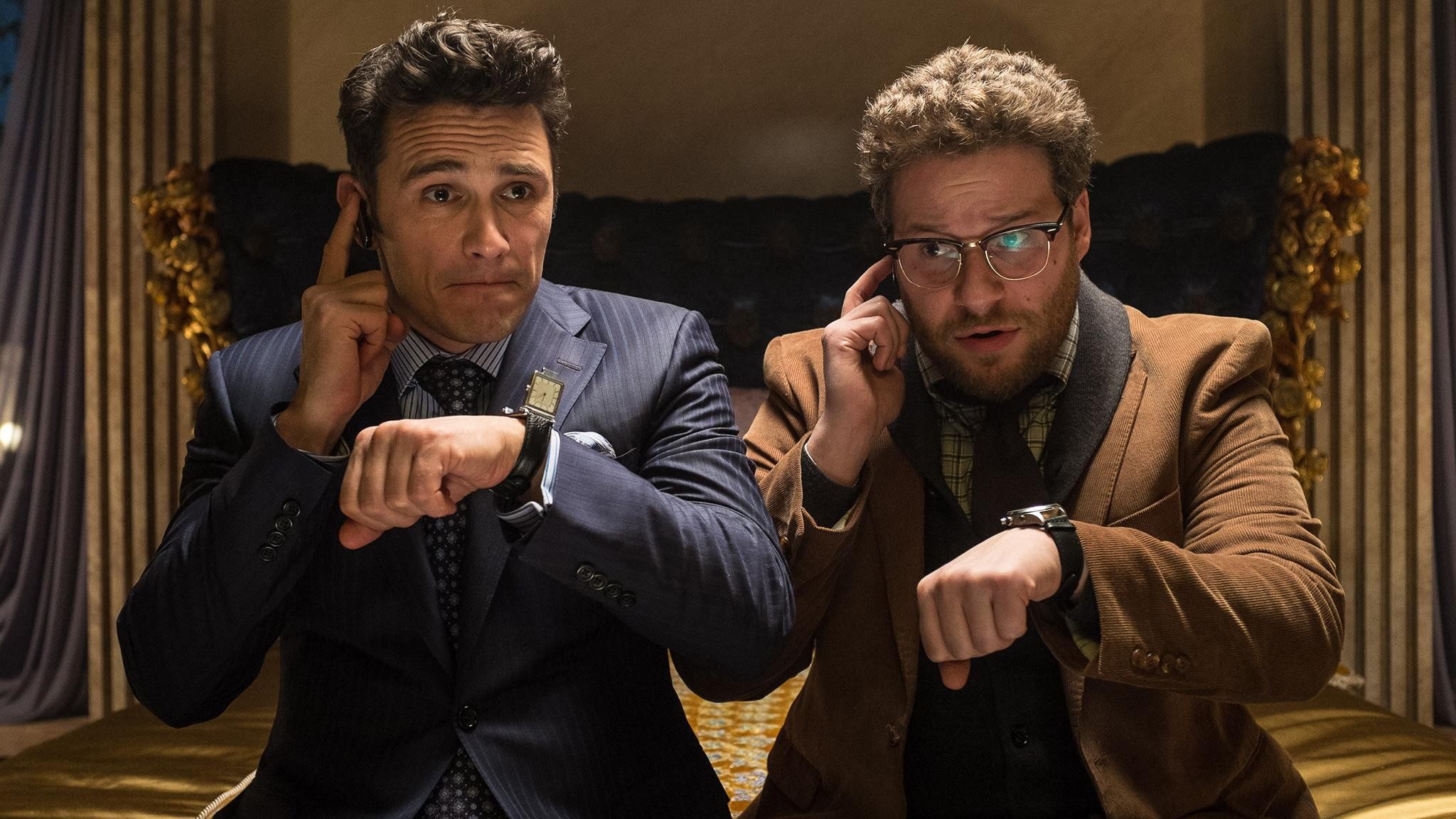
As a long-time James Franco fan, I am generally supportive of his various but oft-perplexing endeavours (his Instagram gallery is more than adequate proof of this). Yet when I first heard that he and Seth Rogen, Hollywood's favourite bromance, were making a movie about assassinating Kim Jong-un - I balked. This is a terrifying and ill-advised idea, I thought to myself. Indeed, when threats from North Korea began rolling in, I could not help but ascertain that Sony should have seen this coming. But when the movie was ACTUALLY pulled from cinemas - what?! That's when the maddening injustice of the whole hacking business and controversy regarding the film began to settle in.

Obama put it best: "We cannot have a society in which some dictator someplace can start imposing censorship here in the United States."

So, The Interview was finally released (not only in select cinemas, but also online - a first for Sony) and I watched it last night. Unsurprisingly, it channels the same crude humour and vulgar language from Pineapple Express and This is the End. Yet The Interview is a standout film from Seth's repertoire, especially in light of the drama it has aroused.


Firstly, the movie is actually pretty funny. Seth makes effective use of juxtaposition throughout: an innocent-looking girl sings a terrorist anthem at the beginning of the movie, Katy Perry's Firework is the soundtrack to the supreme leader's airborne incineration and Dave runs out of the compound clutching a puppy (an ADORABLE puppy).

So, Seth Rogen knows what he is doing! One particular critic has argued that Randall Park and Diana Bang deliver the best performances in the movie, but I disagree. I was especially impressed by Rogen's acting chops in the taxi scene (racist as his Chinese accent was).

His partner in crime, James Franco, pulls off an incredible and memorable Dave Skylark in The Interview. Uninformed, unreasonable, impressionable, shallow, self-centered, unprofessional, caring, goodnatured, presumptuous, unabashed - Franco is all of this and he is brilliant. Watching his energetic performance, one wouldn't imagine that this is the same guy who, with shades over his eyes and a baseball cap pulled down low, shuffles wearily down a line of selfie-ready fans after weekly showings of Of Mice and Men.

Yet it is the goofy Dave Skylark who finally delivers the most serious line of the movie: "So why don't you feed them?" Directed at his interviewee, the supreme leader of North Korea himself, this question segues into great scripted conversation between Dave and Kim that reveals the vulnerability of both men. There's Dave, who - although unabashed on the outside - is hurt by the media's criticism of him (like James??). Well, he gets by through subscribing to his maxim: They hate us 'cause they ain't us. Then there's Kim, who still finds himself living in his father's shadow and has to disguise his love for foreign entertainment (specifically, Katy Perry). Despite the "seriousness" of the second part of the interview itself, however, the movie still retains its farce because Dave (as he even insists on mentioning) only has his great epiphany about Kim's tyranny because of a GRAPEFRUIT.

Structurally, the pacing of the movie is sublime. The plot unravels brilliantly, except for Dave and Kim's first encounter - that segment was slow, uninspiring and unconvincing. Yet the movie as a whole wraps up well and ties the whole storyline together. Dave is saved by a bulletproof vest, he and Aaron get rescued by SEAL and he gets to write his final tell-all (just as he predicted). Democratic elections will be held in NK, Kim is out of the picture and Sook has gotten Skype.

Near the end of the film, however, not everything is all smiles. On the boat with Dave and his adorable puppy, Aaron remarks that he was "honeypotted" by Sook, just as Dave was initially "honeypotted" by Agent Lacey; they were both manipulated to cooperate with others' plans. Although both incidents of "honeypotting" were done for a good cause, the whole concept of "honeypotting" (if a woman is behind it) or "honeydicking" (if a man is behind it) extends beyond the movie.

I cannot believe the following sentence is about to be published on my blog, but - is Kim Jong-un not the greatest honeydicker of all? In the movie, we only see him honeydicking the gullible Dave so that he will ask him 'good questions' during their interview (which, as he furiously says afterwards, failed). In the movie, Kim bursts into tears and destroys his carefully-crafted cult of personality on live TV. In real life, however, he continues to honeydick a nation.

So, The Interiew is entertaining, silly, crude, sometimes gruesome and packed with perfect (actually perfect) LoTR references - but it is also a comedy that exposes the consequences of "honeydicking." You might forever remember The Interview as that-Seth-Rogen-and-James-Franco-film-that-exacerbated-NK-US-relations, but also remember it for its message: don't be honeydicked.


Sunday, December 28, 2014

La Délicatesse

La délicatesseLa délicatesse by David Foenkinos
My rating: 5 of 5 stars

In David Foenkinos's La délicatesse, the beautiful and enigmatic Nathalie becomes a widow after her husband's sudden death. From thereon impenetrable, she coolly deflects the sexual advances of Charles, her boss, and channels her grief into her work. Yet the unexpected happens when Nathalie - out of the blue - kisses her Swedish colleague Markus on the lips. Although the kiss is merely "un acte gratuit" (an unwarranted act) to Nathalie, Markus - old, balding, single, awkward and unlucky with the ladies - is overwhelmed, stupified and approaches her. Between them, a friendship forms and finally develops into 'something more' that is both unlikely and lovely.

The theme of chance, as evidenced by le baiser gratuit (the unwarranted kiss), runs throughout the novel. The idea of coincidence determining destiny is also clear in one of the most-cited extracts from La délicatesse, the scene in which Nathalie and her husband go on their first date:
"Le jus d'abricot, c'est parfait. Si elle choisit ça, je l'épouse... -
Je vais prendre un jus... Un jus d'abricot, répondit Nathalie. Il la regarda comme si elle était une effraction de la réalité.
It is because Foenkinos makes us wonder at these miracles that we are so easily drawn into the novel. Despite everything that seems to happen by chance in the novel, however, Foenkinos ties the whole story together in 117 'mini' chapters, which are not only told from the points of view of Nathalie, Markus and even Charles, but sometimes also consist of nothing but facts. For instance, one chapter will describe Nathalie and Markus having dinner together and then next will simply enumerate the ingredients used to make their risotto. One chapter will tells us about how Nathalie hops on a train and the next will detail the arrival and departure times of her journey. In some ways, this is the juxtaposition between the surreal and banal, the circumstantial and deliberate.

It is in one of these chapters that Foenkinos cites Larousse in explaining the literal meaning of the title:
La délicatesse : n.f.
1. Fait d’être délicat. (To be delicate)
2. Litt. Etre en délicatesse avec quelqu’un : être en froid, en mauvais termes avec quelqu’un. (To be in delicacy with someone: to be on bad terms with someone)
Indeed, delicacy manifests itself throughout the novel. Nathalie herself is delicate in a petit and charming way and is the outwardly embodiment of delicacy. Yet after she becomes widowed, she finds herself in a delicate situation of which the indelicate Charles hopes to take advantage. As Nathalie herself concludes, even Chloe - her colleague - asks indelicate questions and cares only for "des ragots" (gossip). Nathalie becomes "en délicatesse" with them. On the other end of the delicacy spectrum, however, is Markus. Considerate of Nathalie's feelings and gentle towards her, Markus encapsulates the warmth and understanding of delicacy. It is through such delicacy that Nathalie finds solace and renewed love. For example, we are told in the first page of the novel that is "assez rare pour une Nathalie" (rare for a Nathalie) to not feel any nostalgia. Yet after Markus gives her un distributeur de Pez as a gift, she is transported back into her childhood past. How lovely is it that Foenkinos shows us delicacy in a man whom is otherwise regarded by those around him as graceless and ungainly?

Finally, the novel itself is also a work of great delicacy. In the final chapters, Nathalie reveals that she used to play hide-and-seek in her garden and would open her eyes after 117 seconds. Of course, the question of chance and coincidence now emerges in not only the story but also in the work, for it is in the 117th chapter that the novel concludes with a one-liner: Nathalie ouvrit les yeux. In a poetic and delicate way, it is indeed as if each chapter of the novel was only a second.

It is within one of these "seconds" that Foenkinos writes one of the most striking lines I have ever read in any French novel: "le Larousse s'arrête là où commence le coeur" (Dictionaries stops where the heart starts). So, although Foenkinos intersperses what appears to be fortuitous with facts and definitions throughout La délicatesse, it is finally emotion from le coeur - the impulsive act of un baiser gratuit - that trumps rationality and brings two seemingly disparate, but delicate, individuals together.
La vie peut être belle quand on sait l'inconvénient d'être né.
Pourquoi sommes-nous autant marqués par un détail, un geste, qui font de ces instants minimes le coeur d'une époque?
On peut penser, toujours dans la folie, d'un mouvement presque démiurge, que l'on est au coeur du coeur de l'autre. Que la vie se résume à un vase clos des valves pulmonaires.
Le sentiment amoureux est le sentiment le plus culpabilisant. On peut alors penser que toutes les plaies de l'autre viennent de soi. On peut penser, toujours dans la folie, d'un mouvement presque démiurge, que l'on est au coeur du coeur de l'autre. Que la vie se résume à un vase clos des valves pulmonaires.
La vie peut être belle quand on sait l'inconvénient d'être né.
Le sommeil est un chemin qui mène à la soupe du lendemain.
Après leur dernier échange, il était parti lentement. Sans faire de bruit. Aussi discret qu'un point-virgule dans un roman de huit cents pages.


View all my reviews


Thursday, December 25, 2014

Joyeux Noël

Every year, I write up and publish a Christmas blog post. So, although I didn't do many Christmassy things today, I - knowing that this is the last December 25th I will spend in Hong Kong as a high schooler - nonetheless want to wish whoever is reading this a convivial christmas!


One year later, Petit Papa Noël is still my favourite French Christmas carol and I still insist on wearing my "Joyeux Noël et Bonne Année" sweater around the house. Yet much has changed. The festive weight of Christmas day is much lighter this year. Wheeling a shopping trolley around a packed supermarket this afternoon, my eyes glued to the feet of distracted shoppers, I couldn't help but wonder - what makes this day ostensibly "Christmas" apart from the obligatory (and flat) carols one hears beneath the din of creaky carts and cashier register beeps? Now, at ~11:58pm, I think that I could have carved out a larger portion of today to reading/writing Christmas poems (or perhaps going all out and baking gingerbread men). I've decided that society does need Christmas - in December, economy soars, depression rates drop (I believe) and the new year is ushered in while the glittery debris of tinsel still sparkle around the house.

Merry Christmas, everyone!