Saturday, June 25, 2016

We die containing a richness of lovers and tribes, tastes we have swallowed, bodies we have plunged into and swum up as if rivers of wisdom, characters we have climbed into as if trees, fears we have hidden in as if caves.

The English PatientThe English Patient by Michael Ondaatje
My rating: 4 of 5 stars

The first Michael Ondaatje book I read was his memoir, Running in the Family. I remember it for its range of intriguing characters and poetic portrayal of landscape. These two elements also marked my reading of The English Patient, which is perhaps Ondaatje's most famous work.

The English Patient is a novel that crosses continents, a fact that is foremost apparent in its characters: Hana, a Canadian nurse, is tasked with treating a man who has been severely burned during the war (Hana thinks the patient is English but later discovers that he, Almásy, is not). She becomes lovers with an Indian sapper, Kip, but kind of has a complex platonic/romantic relationship with Caravaggio, an Italian-Canadian thief whose skills were enlisted for the war. There are also the Cliftons, who become important when we learn about the 'English' patient's backstory. All of the characters are affected by the Second World War, a total war that was dominated by the "choreography of power" and had widespread effects on people. The primary setting of the novel that shapes its characters is a post-war time.

Yet for me, the most striking setting in the novel is the desert. On the one hand, there is the magic of its vast and endless landscape: "In the desert you have time to look everywhere, to theorize on the choreography of all things around you."

At the same time, the desert also reveals Almásy’s wish for "an earth that had no maps," a transnational territory that does not keep us bound to "the clothing of our countries." Nationality is a malady in the novel; on a global level, it is one reason for war. On a personal level, Almásy's nationality is what precludes him from being able to save his lover (a bit more on that later).

As Ondaatje writes, “the desert could not be claimed or owned–it was a piece of cloth carried by winds, never held down by stones, and given a hundred shifting names." Although Hana speaks in a different context when she asks, “do you understand the sadness of geography?” her comment points to the way we must label ourselves on a map like the names of rich men and women on buildings" even though a cartography that marks us "by nature" would allow us to remain as "communal histories communal books." The desert, like a great mediator of nationalities, removes the territorial frameworks that send people to war and divide humanity.

I've never read about the desert in that way before and I don't think I'm ever going to forget it.

While set in a time of great conflict and combat, The English Patient is also a story about love. In the main plot, there is the love that Hana has for Kip, Almásy and Caravaggio. But it is the affair between Almásy and Katherine Clifton that appears later on in the novel that truly illuminates Almásy's past and grips you. It's tumultuous, romantic and heartbreaking as hell.
“When we meet those we fall in love with, there is an aspect of our spirit that is historian, a bit of a pedant who reminisces or remembers a meeting when the other has passed by innocently…but all parts of the body must be ready for the other, all atoms must jump in one direction for desire to occur.”
“A love story is not about those who lost their heart but about those who find that sullen inhabitant who, when it is stumbled upon, means the body can fool no one, can fool nothing—not the wisdom of sleep or the habit of social graces. It is a consuming of oneself and the past.”
The English Patient is a powerful novel, which is relevant as it also explores the power of books and language; we learn about a time in Hana's life when "she fell upon books as the only door out of her cell. They became half her world.”
“She had always wanted words, she loved them; grew up on them. Words gave her clarity, brought reason, shape.” 
“A novel is a mirror walking down a road" is a memorable line from the novel and it is striking to think that there are people for whom this novel - with all its heartbreak and war - is a mirror. Yet I hope that this mirror also captures the love and hope for transnationality in The English Patient.


View all my reviews


View all my reviews

Monday, June 13, 2016

You’ll realize that this is where your life is

Hello, all!

My summer holiday has begun, meaning that this book/film review blog is back in business!
I've accepted the fact that I won't be able to post regularly doing the school year; I still do a ton of reading and writing at school, but mainly for class. When I’m not wrangling with words, I spin poi/tumble with the circus and swing dance instead. All in all, college has been a wonderful time.

Anyway, I wrote most of this yesterday while on a plane back to Hong Kong. I was at an altitude of 31,000, the temperature outside was -56 F, and it was 7:38 pm Chicago time, but since we were flying over The Arctic Bay at that exact minute, who knows what time it really was. I peeked outside the window and saw the ice extend forever. Sunlight scorched the land, making the tributaries look like silver. Snow coated the ridges of dark mountains. The whole terrain was like a lithographic print. I would be on that plane for a total of around 16 hours.

I have yet again managed to watch another emotional, heart-rending film on a long-haul flight (other films I have cried to while in the air: Room, Short Term 12, 海角七號).

~ spoilers ahead ~

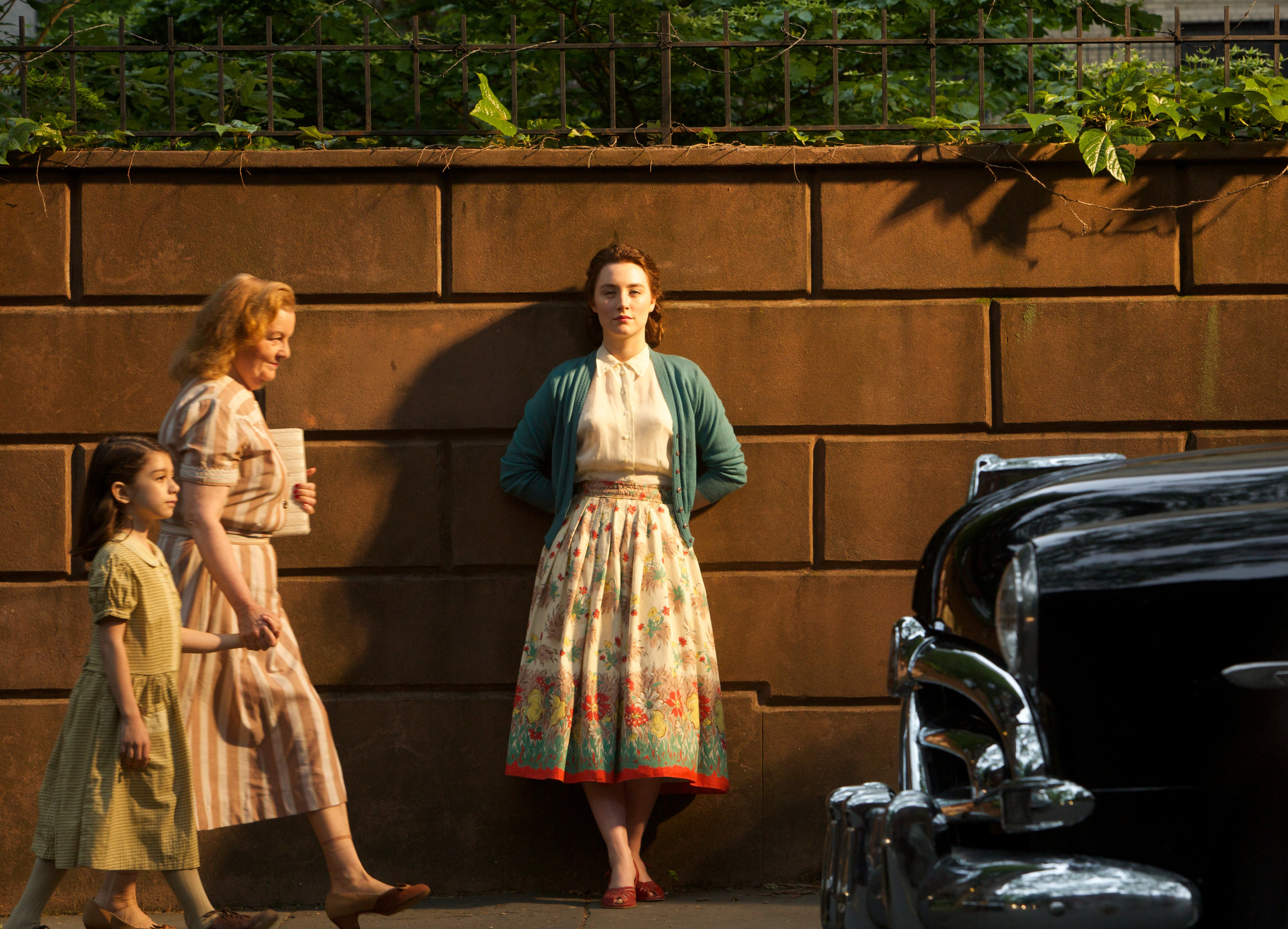
I heard great things about Brooklyn, but I’m glad that I watched it at the end of my first year of college (you’ll find out why by the end). In the film, Eilis, played by the brilliant and elegant Saoirse Ronan, leaves her home country of Ireland to work in Brooklyn, New York City. While she feels sad about leaving her mother and sister behind, her decision to go is greatly in her favor: there’s nothing left for her in Ireland, where she is stuck working for the awful Ms. Kelly and—despite her brains—will never be given the chance to engage in meaningful work.

Yet Eilis’s initial foray into Brooklyn is far from smooth. Wracked by homesickness (well-foreshadowed by her boat sickness), she is advised to “act like an American” in order to fit in, to be amiable at work, and to essentially settle in ASAP.  

But settling in isn’t so easy, and doesn’t get any easier until Eilis meets Tony Fiorello, a charming Italian who asks her to dance at a weekly Irish dance. The two begin dating, Eilis gradually becomes less reserved, and completely blossoms in Brooklyn: she passes her book-keeping classes with flying colors and falls deeper in love. It seems like nothing could be better.

Then, when Eilis’s sister Rose dies, Eilis is struck by the urge to visit home and returns to Ireland. Paradoxically, it seems like life there—for the month that she stays—will be even better than her time in Brooklyn. She has returned “a star,” strikingly competent and beautiful. Her time in New York was like a spell; Ireland appears to be where she belongs. She is courted by the wealthy bachelor Jim Farrell, offered a job, and encouraged by everyone to stay.

She is so preoccupied with wishing that this was the way life was before she left that she forgets—until an unpleasant encounter with the gossipmonger that is Ms. Kelly—what life was like in a small Irish town in the 1950s. Eilis remembers what drove her from Ireland in the first place and remembers that she has left her heart back in Brooklyn.

The film is a beautiful meditation on what it means to find a new home and create a new identity for yourself. It was slightly clichéd at times, but lovely regardless. I’m glad that I watched it after my first year of college because its last line resonates with me in so many ways:
And one day, the sun will come out you might not even notice straight away—it’ll be that faint. And then you’ll catch yourself thinking about something or someone who has no connection with the past. Someone who’s only yours. And you’ll realize that this is where your life is.
I’m not saying that I have immigrated to America and am going to live there forever with an Italian husband, but there are moments when I realize that I have made a life for myself in Chicago, in a library lounge full of swing dancers, in an open gym with people on silks/flipping/juggling/etc, in a room of friends who have become like family.  

And while I have yet to experience genuine homesickness while studying abroad, I resonate with the advice Eilis gives to the new immigrant she meets on the boat:
When you get to immigration, look like you know where you’re going. You have to look like an American.
I remember being nervous when flying to Chicago on my own for the first time, but I'll never forget how happy I was when I landed in Chicago after winter break and took public transport from O'Hare back to my dorm (ft. two luggages and a violin that has become like my fifth limb) while snow paved much of the ground outside. I'm so grateful that I have a life for me and a family in a city almost 8,000 miles away from the one that I live in now.

The next time I’ll be on another long haul flight is late September; who knows what movie I’ll watch and cry to then. Ah well, I’ll write about it when the time comes.


Happy summer!


Thursday, December 31, 2015

Music is something more than an individual possession

The Cambridgeshire Report on the Teaching of Music: Music and the CommunityThe Cambridgeshire Report on the Teaching of Music: Music and the Community by Cambridgeshire Council of Music Education
My rating: 3 of 5 stars

I noticed Music and the Community on a bookshelf six minutes before the public library was about to close and couldn't resist grabbing it.

Originally published by the Cambridgeshire Council of Music Education in 1933, the whole book is a primer for the way music education should be conducted in schools. In the introduction, the importance of this teaching is first made clear: music is a language. Later on in the book, the authors strengthen its connection to literature by saying that "old English music should be as familiar as old English poetry." Yet just as not every English-speaker has to be well-versed in all the nuances and subtleties of poetry, not every person who receives a music education needs to be a virtuoso. The important thing is that the music is learned.

According to the book, however, there are problems that prevent music from becoming "a guiding principle to regulate and illumine all the activities of our existence." Firstly, music deserves to be listened to intensely, but music nowadays is so ubiquitous that
most people who hear music do not really listen to it at all; they let it fall upon their ears as a pleasant succession of sounds, making no effort to understand it and taking their chance of being soothed or stirred by it.
So, the bulk of the book is dedicated to instructing teachers on how to teach music. Music education should begin early with singing (starting from the age of four), be non-restrictive, and quite often be communal because making music together offers "mutual accommodation, a mutual sense of giving rather than of taking, such as no other communal occupation demands in the same degree." At an early age, kids should be taught nursery rhymes, which are important parts of "musical heritage" and have simple melodic structures that help with rhythm retention. Another thing that helps with the "development of the rhythmic sense," the authors note, is dancing - as somebody who has recently caught the jitterbug, I could not agree more. Music learning should also encompass historical and instrumental education as the students progress, and curriculums will differ depending on whether the schools in question are preparatory, public or universities. Yet regardless of the type of institution, "a vigorous musical life is undoubtedly an important factor in improving the tone of a school."

And there are many things that the government sector can do to facilitate the accessibility of music: they should not tax tickets sold at concerts given by local choral or orchestral societies, for example, and public libraries should expand their music sections.

Despite the eagerness with which the book vouches for inclusive music education, however, it also offers words of warning about the extent to which music is perpetuated:
Music should contribute to the life of the community an attitude of social harmony and tolerance; if we do not recognize that there are times when music is out of place we fail in one of the virtues that music is supposed to foster.
And this line made me crack up:
Lovers of music should be most careful not to cause annoyance to others; they may always hope that those who lack fervour will one day see the light, but the change will not come through the antagonizing effect of over-enthusiasm.

So, there is a "danger of making music available at all times" - heard under the "wrong conditions," it will only become an "irritant to nerves."

The whole book is a quick, engaging read. It definitely has a predominantly classical, traditional and British focus concerning music education (it was, after all, published in 1933 by Cambridge), which is perhaps a drawback in modern times, but also presents an interesting point of comparison to today's music scene. Instead of ensuring that every school has a piano, for instance, would a modern-day rendition of Music and the Community insist that every student have an iPod? Or Garageband installed on their computers? Should vocal training take rap into account?

It is fitting that this is the last full-length book I'll read this year (although I'm trying to read a collection of Chinese short stories before I fly out) because it's made me think about all that has changed not only since 1933 regarding music, but everything that has transpired globally and personally in just 2015.

It's been a year of great change and music has continued to be in my life for all of it - experiencing my first snow in Chicago during my orchestra rehearsal, dancing until 1 a.m. in the city to swing music, listening to songs on 15 hour plane rides to and from home.

I started this post as a book review, but as I write this last paragraph I realize that it has also been a way for me to bid goodbye to 2015 and look forward to the new year. I'm excited for the new books I'll read, words I'll write and music I'll hear in 2016!

View all my reviews

Monday, December 28, 2015

This desire to govern a woman--it lies very deep, and men and women must fight it together before they shall enter the garden

A Room with a ViewA Room with a View by E.M. Forster
My rating: 4 of 5 stars

E.M. Forster's A Room with a View is set in Italy and England during the Edwardian era of the 1900s, a time that was less repressive than the Victorian era but still not entirely divorced from its traditionalistic values. The novel opens in the charming and exciting city of Florence, where "all kinds of other things are just outside," but the viewless room in which Lucy Honeychurch finds herself is fashioned so closely after an English drawing room that she feels as if she were still "in London." As Lucy and her cousin Charlotte lament their lack of scenery, two men - Mr. Emerson and his son, George - suddenly offer them their room, which has a view. Yet Charlotte rejects their offer flat-out, "repressing Lucy" throughout their conversation with the Emersons, concluding a brief yet revelatory scene that sets up much of the context and characterization the later events of the novel continue to develop.

Forster writes that "there is much that is immortal in this medieval lady," but that "in her heart also there are springing up strange desires." Lucy, as he says, "does not stand for the medieval lady." She refuses to "be stifled," "would really like to do something of which her well-wishers disapproved" and wants to "care for liberty and not for men." However, she is too easily swept under the domineering arms of her cousin Charlotte, who certainly falls somewhere on the 'medieval lady' spectrum. At the extreme end is Mrs. Honeychurch, Lucy's mother, who thinks that "if books must be written, let them be written by men." For Charlotte,
It was not that ladies were inferior to men; it was that they were different. Their mission was to inspire others to achievement rather than to achieve themselves. Indirectly, by means of tact and a spotless name, a lady could accomplish much. But if she rushed into the fray herself she would be first censured, then despised, and finally ignored.

This is a quote that I reread multiple times because I cannot say that I disagree with all of it. I wholly believe that a woman's mission can be to achieve for herself; however, it is also true that a woman in the Edwardian era would struggle if she "rushed into the fray herself." The first line of Charlotte's statement, however, does show that she is not as repressive as she often appears to be. This is an observation that is also made at the end.

Before all that happens, however, Lucy first locks herself into an engagement with the dreary and conservative Cecil Vyse, who considers it a "test of refinement" to "[despise] the world as a whole," believes that "women revere men for their manliness" and always feels "that he must lead women, though he knew not whither and protect them, though he knew not against what." Unsurprisingly, every time Lucy thinks of Cecil "it's always as in a room" with "no view."

Which brings us back to the men who offered her a view in the first place (got to love that symbolism), the Emersons. Of all the characters in the novel, Mr. Emerson harbors the most advanced and modern ideas. He is against the church, is confident that men and women "shall be comrades" and - instead of praising some divine power - believes in the "holiness of direct desire" - love. It is from him that we hear the boldest, most quote-worthy statements about love:
“It isn't possible to love and part. You will wish that it was. You can transmute love, ignore it, muddle it, but you can never pull it out of you. I know by experience that the poets are right: love is eternal.”

Mr. Emerson is thus the greatest optimist in the novel. On the contrary, his son George is a "young man melancholy because the universe wouldn't fit." When George throws Lucy's blood-stained photographs into the river, we get a sense of his vulnerability. And it is this gesture, as well as his awkwardness, that moves Lucy because such behaviour shows her that "men were not gods after all, but as human and as clumsy as girls; even men might suffer from unexplained desires, and need help."

George and Cecil show us that "men fall into two classes – those who forget views and those who remember them, even in small rooms." Indeed, Mrs. Honeychurch and Lucy also show us that women fall into these classes, too. A Room With a View is a timeless read because we will always be surrounded by Cecils and Mrs. Honeychurches, albeit under ever-evolving political and social circumstances. The ending of this book and the new friends that I have met this year give me hope that more and more people in the world will remember the importance of views, want to have them and not be afraid to accept them when they are offered.


View all my reviews

Tuesday, December 22, 2015

A long time ago in a galaxy far, far away

*ALERT: SPOILERS AHEAD*


The last time I watched Star Wars in a cinema (discounting the 3D version of The Phantom Menace) was 2005, when Revenge of the Sith was released. That was a decade ago, but Star Wars has been in my life for much longer. I remember spending many weekends watching Episodes 4, 5 and 6 in LaserDisc form in the campus library when I was a child and watching Episodes 1 and 2 countless times at home on TV (definitely less of 1, though, which includes a certain long-eared character I cannot tolerate). I remember dressing up as Leia for Halloween in kindergarten and walking down the assembly hall during my high school graduation to the Star Wars theme. I have never been the kind of fan who can rattle off the names of all the droids in the galaxy, but Star Wars - which has been a huge part of essentially my whole life and shaped me in so many ways - has all of my love and affection (as you can probably tell from the url of this blog).

So, I watched The Force Awakens today and felt all the feels and shall express them as intelligibly as I can via this blog post right now. The backdrop of the storyline is this: Luke has gone into retreat after one of his padawans turned to the dark side, submitting to the "First Order" helmed by the evil supreme leader Snoke. The "Resistance," hoping to right the galaxy (and led by none other than Leia herself), aims to destroy the order and find Luke before the stormtroopers can get their hands on the map that leads to him. As usual, this key information is stored in a droid, which in this case is the unbelievably adorable BB-8.

So, Star Wars is still Star Wars - we have our trusty droids, lightspeed-capable ships and, of course, the familiar black-and-white stormtroopers. One minute in, however, I realized that this is the first time I have ever seen storm troopers portrayed so believably - not just clunky, dumb and dull but actually terroristic, savage and humane. When we see blood smeared across FN-2187's helmet, we are reminded that the stormtroopers are human: they bleed. And for the first time, we also get an indication of their backstories, how they were seized from their homes to serve the order. Finn thinks that his decision to flee is an act of cowardice, but it is one of strength.

Speaking of strength, I LOVE Rey. I love her like I love Leia. Both are such smart, independent and capable women. The first thing Rey says is a shout, a command, and that already sets the tone for her character. She can scavenge, fly the actual Millennium Falcon, fix it as well, and clearly needs no hand-holding. But there is more to her than just skill - there is also the force. And it is very strong with her, which of course sets up questions that (I hope) will be resolved in Episodes 8 and 9.

Despite all that is new about The Force Awakens, however, a lot is the same: the classic cinematic transitions between scenes, the familiar shots of X-wing fighters as they zip through the galaxy and, of course, major father-son issues. What distinguishes the rift between Han and Kylo Ren (or Ben) and the one between Vader and Luke is that the latter involves a son hoping to help his father, while it is the son that has turned to the dark side in the former. And while we do not truly witness Vader's internal struggle until he eventually decides to bring down Darth Sidious, we see Kylo Ren's dilemma from the start. Even though he entreats the Dark Side, hoping to remain in its iron grasp, whether or not he truly belongs there (probably not) remains to be seen.

The Force Awakens made me so happy on a myriad occasions. I lost it when I saw the Millennium Falcon (the piece of "garbage," as Rey calls it - of course). I also lost it when Han and Chewie showed up for the first time, when Leia, R2D2 and C3PO turned up, when Han made that golden reference to the trash compacter, when Luke turned around on the cliff at the end.

But naturally, there were also times during the movie when my heart broke. When the First Order tested out their new weapon - that was basically Alderaan x 5. And, of course, when Han died...
I saw it coming when I saw the bridge, but the fact that it happened is heart-wrenching nonetheless. In my eyes, Han has always been invincible. He has survived Jabba and all the smugglers on his tail. He has evolved so much, going from a major force-skeptic to one who says in this movie, "all of it's true." So, watching him being brought down by the dark side of the force was depressing, to say the least. Yet I understand that it wouldn't have been ideal to keep Han on board for the rest of the series, which should focus instead on the new generation. So, Han's death - although devastating to witness - didn't ruin the film for me.

In the days leading up to the premiere of The Force Awakens, we become aware of just how many people in the world (well, galaxy) love Star Wars: film buffs, Jimmy Fallon, kids clutching books about the series, and more. Star Wars has attained the status of legend. There is a 'correct' order in which one 'must' watch the films, everybody knows the sound of Darth Vader's signature breathing, and news that someone has not watched the series is usually followed by an astonished (or outraged) gasp. The seemingly worldwide worship of Star Wars has inevitably led to its immense commercialization in ways that often only succeed in looking cheap. But the films' vast fanbase has also paid tribute to it in wonderfully creative and deserving means, and The Force Awakens is an outstanding example. I cannot wait for Episodes 8 and 9.

May the force be with you!