Showing posts with label ireland. Show all posts

Monday, June 13, 2016

You’ll realize that this is where your life is

Hello, all!

My summer holiday has begun, meaning that this book/film review blog is back in business!
I've accepted the fact that I won't be able to post regularly doing the school year; I still do a ton of reading and writing at school, but mainly for class. When I’m not wrangling with words, I spin poi/tumble with the circus and swing dance instead. All in all, college has been a wonderful time.

Anyway, I wrote most of this yesterday while on a plane back to Hong Kong. I was at an altitude of 31,000, the temperature outside was -56 F, and it was 7:38 pm Chicago time, but since we were flying over The Arctic Bay at that exact minute, who knows what time it really was. I peeked outside the window and saw the ice extend forever. Sunlight scorched the land, making the tributaries look like silver. Snow coated the ridges of dark mountains. The whole terrain was like a lithographic print. I would be on that plane for a total of around 16 hours.

I have yet again managed to watch another emotional, heart-rending film on a long-haul flight (other films I have cried to while in the air: Room, Short Term 12, 海角七號).

~ spoilers ahead ~
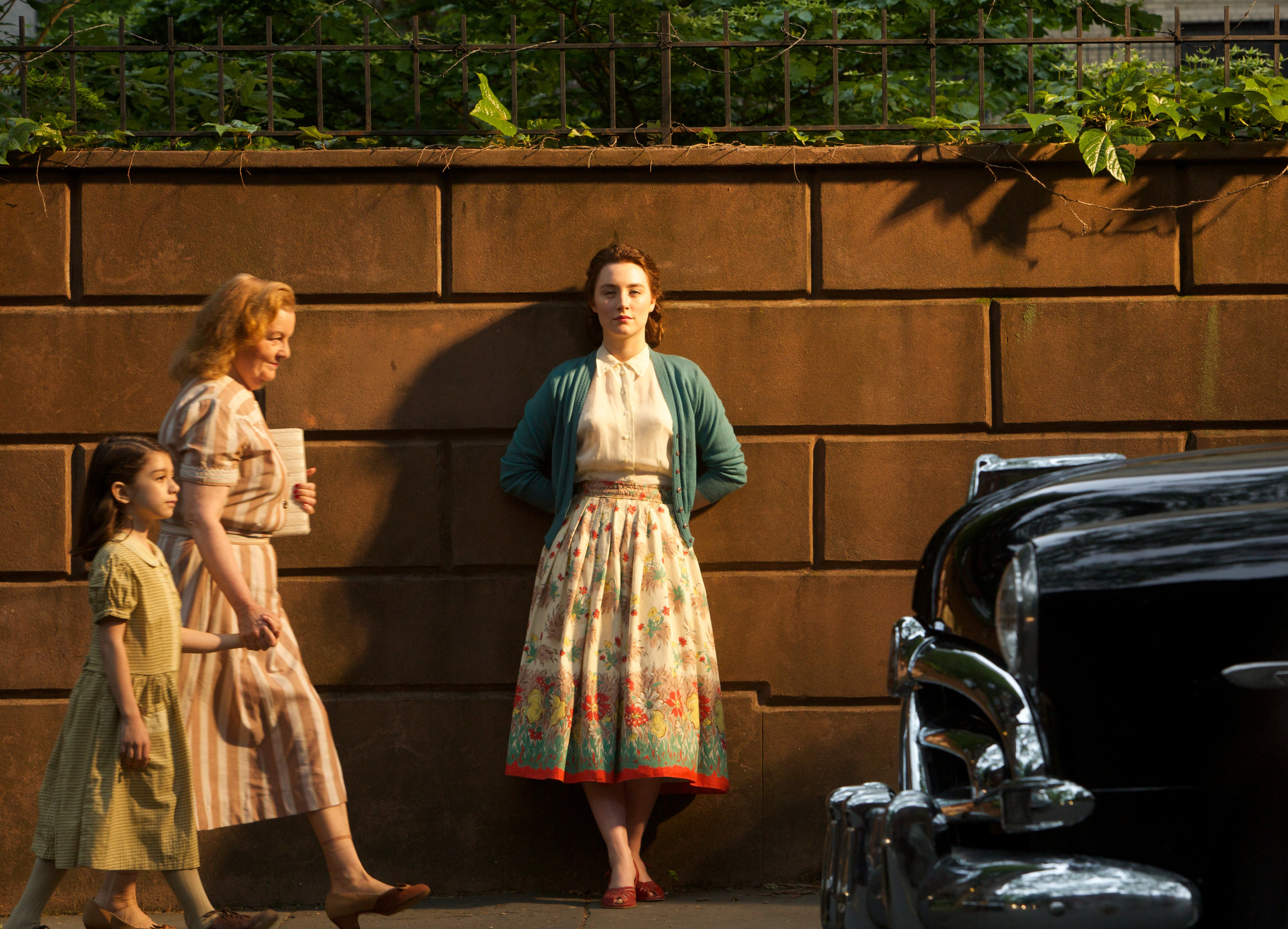
I heard great things about Brooklyn, but I’m glad that I watched it at the end of my first year of college (you’ll find out why by the end). In the film, Eilis, played by the brilliant and elegant Saoirse Ronan, leaves her home country of Ireland to work in Brooklyn, New York City. While she feels sad about leaving her mother and sister behind, her decision to go is greatly in her favor: there’s nothing left for her in Ireland, where she is stuck working for the awful Ms. Kelly and—despite her brains—will never be given the chance to engage in meaningful work.

Yet Eilis’s initial foray into Brooklyn is far from smooth. Wracked by homesickness (well-foreshadowed by her boat sickness), she is advised to “act like an American” in order to fit in, to be amiable at work, and to essentially settle in ASAP.  

But settling in isn’t so easy, and doesn’t get any easier until Eilis meets Tony Fiorello, a charming Italian who asks her to dance at a weekly Irish dance. The two begin dating, Eilis gradually becomes less reserved, and completely blossoms in Brooklyn: she passes her book-keeping classes with flying colors and falls deeper in love. It seems like nothing could be better.

Then, when Eilis’s sister Rose dies, Eilis is struck by the urge to visit home and returns to Ireland. Paradoxically, it seems like life there—for the month that she stays—will be even better than her time in Brooklyn. She has returned “a star,” strikingly competent and beautiful. Her time in New York was like a spell; Ireland appears to be where she belongs. She is courted by the wealthy bachelor Jim Farrell, offered a job, and encouraged by everyone to stay.

She is so preoccupied with wishing that this was the way life was before she left that she forgets—until an unpleasant encounter with the gossipmonger that is Ms. Kelly—what life was like in a small Irish town in the 1950s. Eilis remembers what drove her from Ireland in the first place and remembers that she has left her heart back in Brooklyn.

The film is a beautiful meditation on what it means to find a new home and create a new identity for yourself. It was slightly clichéd at times, but lovely regardless. I’m glad that I watched it after my first year of college because its last line resonates with me in so many ways:
And one day, the sun will come out you might not even notice straight away—it’ll be that faint. And then you’ll catch yourself thinking about something or someone who has no connection with the past. Someone who’s only yours. And you’ll realize that this is where your life is.
I’m not saying that I have immigrated to America and am going to live there forever with an Italian husband, but there are moments when I realize that I have made a life for myself in Chicago, in a library lounge full of swing dancers, in an open gym with people on silks/flipping/juggling/etc, in a room of friends who have become like family.  

And while I have yet to experience genuine homesickness while studying abroad, I resonate with the advice Eilis gives to the new immigrant she meets on the boat:
When you get to immigration, look like you know where you’re going. You have to look like an American.
I remember being nervous when flying to Chicago on my own for the first time, but I'll never forget how happy I was when I landed in Chicago after winter break and took public transport from O'Hare back to my dorm (ft. two luggages and a violin that has become like my fifth limb) while snow paved much of the ground outside. I'm so grateful that I have a life for me and a family in a city almost 8,000 miles away from the one that I live in now.

The next time I’ll be on another long haul flight is late September; who knows what movie I’ll watch and cry to then. Ah well, I’ll write about it when the time comes.


Happy summer!


Saturday, August 8, 2015

In stories we exist // There's a library inside me

History of the RainHistory of the Rain by Niall Williams
My rating: 5 of 5 stars

Niall Williams's History of the Rain is a beautiful novel that, although set in Ireland, has its heart and soul in all the libraries of the world and in the celestial realms of mythology. I hope this review will explain exactly what I mean by that!
The book opens in the present, in which our protagonist, Ruth Swain describes herself as "Not Coming Right, Terribly Weak, Not Herself, and just A Bit Off." As we will later discover, she has lost both her twin brother, Aengus, and her father, Virgil. Yet before we even get there, we are first introduced to Ruth's grandfather - Abraham Swain - who, as his progeny would all be destined to do, subscribed to "the philosophy of the Impossible Standard" (in more colloquial terms, aimed for perfection). In this way, Williams establishes the idea of of inheritance quite early on in the novel. Virgil inherited his father's desire to "soar," a fate that left him most frequently disappointed in his own poetry (how can one live up to Keats and Shakespeare, the greats? It's no coincidence that Virgil is also the name of the poet who wrote Aeneid). Throughout the novel, we are often reminded of what befits the "Swain Way" ("Swains don't do Normal") or what is classic of the MacCarrolls ("We have mixed metaphors and outlandish similes for breakfast").

And speaking of inheritance, the most important things that Ruth has inherited from her father - to be specific, 3,958 things - are his books. Dickens, Austen, Brontë, Eliot - the list goes on. As she determinedly tells us from the start, "I am going to read them all because that is where I will find him." And this is possible, because "my book has in it all the books my father read, and in that way his spirit survives, as mine does." As Ruth puts it, "my father lives now in the afterlife that is a book." So the history of the rain is another way of describing the history of everything that ever was, and everything that continues to pour into the ongoing cycle of life, for
"The rain becomes the river that goes to the sea and becomes the rain that becomes the river. Each book is the sum of all the others the writer has read. Charles Dickens was a writer because his father had a small library and because solitude was not lonely with Robinson Crusoe and Don Quixote. Each book a writer writes has all the others in it, so there's a library that's like a river and it keeps on going."
Aengus drowned in the river, and Virgil threw his poetry into the river. So, the river is where Ruth goes to search for them - although the her "river" is made up of thousands of books, each a raindrop in its own right. And by writing, Ruth is adding her own pellet of rain to this river of family history:
“We tell stories. We tell stories to pass the time, to leave the world for a while, or go more deeply into it. We tell stories to heal the pain of living.”
The style of the book is magical in the way that we do not travel chronologically, or even realistically, experiencing both the concrete and mythological through Ruth's narration. The most distinctive touch about Williams's style, however, is the way Ruth will express a thought/describe something and, in brackets, detail the specifics of the book that inspired her. Williams is not only giving us book recommendations throughout his novel, but also reinforcing, in an innovative and memorable way, the power of books. For example,
Any number of lovely people are married to horrible ones. Read Middlemarch (Book 989, George Eliot, Penguin Classics, London) if you don't believe me. There's something in me that can't just let it be. Goodness is a tidy bow you just can't help wanting to pull loose.
Indeed, I connect with History of the Rain particularly strongly because of Williams's vocal love for reading. He communicates the way I feel towards books in sentences that are at once poetic and spot-on:
“When my father first took me to Ennis Library I went down among the shelves and felt company, not only the company of writers, but the readers too, because they had lifted and opened and read these books. The books were worn in a way they can only get worn by hands and eyes and minds; these were the literal original Facebooks, the books where faces had been, and I just loved it, the whole strange sense of being aboard a readership.”
I read them all, read them one by one with a kind of constant hunger as if they were apples that fed and made you hungry at the same time.
It's been well-thumbed, at least triple-read, there's that smell the fat orange-spine Penguins get when their pages have yellowed and the book bulges, basically the smell of complex humanity, sort of sweat and salt and endeavour. Like all the fat orange Penguins, it gets fatter with reading, which it should, because in a way the more you read it the bigger your own experience of the world gets, the fatter your soul.=
William also expresses relatable thoughts on writing:
There are a parish of particulars, poets. But they all generally agree, a poem is a precarious thing. It is almost never landed clean and whole in one go.
Writing of course is a kind of sickness. Well people don't do it. Art is basically impossible. [...] Thing is, writing is a sickness only cured by writing. That's the impossible part.
You can't be beautiful and a writer, because to be a writer you have to be the one doing the looking; if you're beautiful people will be looking at you.
There are lines in this book that are pure poetry: "I lay in his lap, small as a sonnet, and just as difficult," "Your blood is a river," "When you're young you're protected by a cloud of vagueness." But History of the Rain is by no means accessible. There are allusions in this book that are gems you'll only be able to admire if you've read widely (I caught all the Great Expectations references, but Williams lost me at Robert Louis Stevenson).

Nonetheless, you, "Dear Reader," will find yourself struck by the rhythm, language and creativity of this book. Ruth read and wrote to find her father, just as I do, and in reading this book, I have also found parts of my whole family and myself. History of the Rain will hit you in the book-loving, childhood and family corners of your heart. 

Here are more quotes that are too good to leave out:

Human beings are not seamless smooth creations, they have insoluble parts, and the closer you look the more mysterious they become.

Each family functions in their own way, by rules reinvented daily. The strangeness of each of us is somehow accommodated so that there can be such a thing as family and we can all live for some time at least in the same house. Normal is what you know.

Hope may or may not be a Thing with Feathers. But it's definitely a Thing with Claws.

My brother was in another boat sailing away, and no matter how much I wanted to, no matter what I did or said I would never be able to get to him.

We thought that fatherhood was this immense weight like a great overcoat and there were all manner of things your father had to be thinking of all the time just to keep the overcoat from crushing him.

Before they are broken small boys are perfect creations.

People are so perishable. That's the thing. Because for everyone you meet there is a last moment, there will be a last moment when your hand slips from theirs, and everything ripples outwards from that, the last firmness of a hand in yours that every moment after becomes a little less firm until you look down at your own hand and try to imagine just what it felt like before their hand slipped away. And you cannot. You cannot feel them. And then you cannot quite see them, there's blurry bits, like you're looking through this watery haze, and you're fighting to see, you're fighting to hold on, but they are perishing right before your eyes, and right before your eyes they are becoming that bit more ghost.


View all my reviews