Wednesday, February 5, 2014

The Last Vow

In the last episode of Sherlock, we finally come eye-to-eye with this season's villain:
the glassy-eyed (no pun intended), enigmatic and - frankly - repulsive Charles Augustus Magnussen.


We are introduced to not only him at the beginning of the episode but also his super glasses (take that, Google glass): the privacy-breaching instrument that supplies him with all the information - notably the 'pressure points' of individuals - he needs in order to blackmail anyone under the sun... which makes him inconveniently immune to a number of threats.

Something else we are introduced to at the beginning of the episode - something more bizarre, in fact - is THIS: 
To be honest, I actually had a *thank goodness for the integrity of the show and the inherent nature of Sherlock's character* moment when he revealed that he dated Janine only so that he could "break into her boss’ office," although his biting comment about love being a "human error" was certainly... ouch..

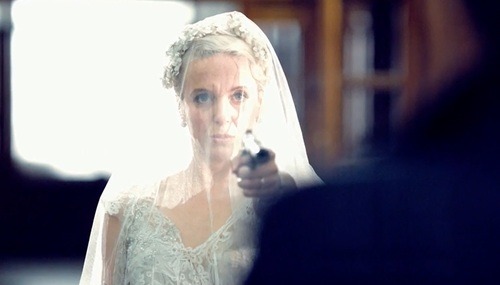
The more significant part about the break-in, of course, is this:
image
At first, I thought mysteriously-disguised-female was almost certainly Lady Smallwood OR EVEN Irene Adler BUT... if one flashbacks to Sherlock's preliminary examination of Mary, 'Liar' surfaced at least 4 times (I did actually notice, okay) - I got over the initial shock pretty quickly and it seemed almost expected that the creators of Sherlock would throw such a twist at us.


Nonetheless, I, like John, felt this way:
I was crushed that Mary couldn't just be the regular civilian wife that John wanted - something 'en dehors de' Sherlock's nutty life; however, on the contrary, precisely what John needs is not that sort of partner. As Sherlock aptly verbalizes what we've subconsciously concluded since Season 2 ended,
John, you are addicted to a certain lifestyle, you're abnormally attracted to dangerous situations and people so is it truly such a surprise that the woman you've fallen in love with conforms to that pattern.
So, Season 3 tells us as much about Watson as it does about Sherlock - the two are truly a 'couple.'
Sherlock pulled himself back to consciousness for John's sake, just as John goes running to look for trouble in a shady-alley because he can't stand missing out on the lifestyle he has with Sherlock.

(tangent: I love the still below from episode 2; very desktop-wallpaper-able)


Both certainly have their 'pressure points' - Sherlock has so many kept buried at the bottom of his mind palace - and I'm glad this episode did more to tap into them (character exploration!). Speaking of mind palace, I can't believe Magnussen's vaults = his brain, although that conveniently gives Sherlock a 'valid reason' to kill him... once again, all for John.

But, as we know from the previous episodes, John is more than merely the 'damsel in distress'-  he himself is also a lifesaver. Speaking of John, that scene in which he was being flicked by Magnussen was HORRID; it was the worse, worse, worse scene in the entire episode but just goes to show how horrible and psycho Magnussen is. Though he is perhaps not as mental as Moriarty, who, I cannot believe is somehow back (!?!?) but at least that gives the British government an excuse to recruit Sherlock (another *thank goodness* moment).

So, in conclusion -

Season 3 of Sherlock has been unquestionably entertaining and insightful. The three episodes have filled in the gaps left by the fanbase, notably by building on Sherlock and John's chemistry, giving more depth to both their characters and ultimately cementing the certitude of their friendship. Best friends. We delve deeper into the Sherlock-world as a whole, e.g. when meeting Redbeard (naw). Even Ms. Hudson's character has been explored; she is not just the old, batty landlady she oft seems to be but one who in fact harbors a dark, not-so-chaste history. Moreover, all this has been done while still preserving the pith of the show: slipping carefully-crafted crimes into each 80 minute segment; crimes that are each, of course, solved by our clever protagonist.

Episode 2 remains my favourite episode from this season, but nonetheless The Last Vow answers earlier questions thrown to us at the beginning of the episode, (naturally) raises new ones and gives us more to look forward to for Season 4.

Much cleverness, much emotion, and much screenwriting/film-making finesse. No wonder the fanbase is swelling! The show deserves it.


Here are my reviews for The Signs of the 3 and The Empty Hearse.


The Sign of the Three

Well, all I can say is that Steven Moffat and Mark Gatiss certainly know how to kill two birds with one stone - in The Sign of the Three, the second episode of the much-awaited Season 3 of Sherlock (if anyone still cares about my overdue opinion), they not only successfully pluck at the fanbase's heartstrings but also manage to spin out an intriguing mystery.

Heartstrings, first: much was done to point this episode in direction of #EMOTION, notably in:
1) The best man speech
2) The Irene Adler cameo
3) Reiterations of "you're my best friend"
4) Even little things such as Sherlock ruffling his hair
Etc.

As I mentioned in my previous Sherlock post, certain decisions - atypical as they may be (but thankfully in moderation)- are inevitably being made during the screenwriting process to satisfy the fans' needs expectations and recognize the existence of the tumblr-populating Sherlockians.


But are such components (e.g. gif above) truly considered atypical anymore? Sherlock BBC is, after all, a 21st century remake of a the classic detective novel. So the drunken scenes

perhaps seem tangential to the Mayfly case/crime but in fact are essential to the pith of the show itself: Sherlock and Watson's friendship, his humanity (yes, to some degree)... plus, such scenes take us deeper into the show and further into character exploration and understanding - not to mention the fact that they're hilarious and contribute greatly to the excellence of the episode.

Moreover, all the delightful flashbacks we are treated to in this episode turn out to not actually be as tangential as we may think (apologies for backtracking on my comments); this is what I mean when I say that Gatiss and Moffat killed two birds with one stone in this episode: all flashbacks/juicy footage of Sherlock-Watson chemistry are IN FACT greatly relevant to the main mystery's unfolding... EVERYTHING ties together - the two seemingly separate cases Sherlock presented in seemingly trivial anecdotes are in fact brother-cases... the WEDDING ITSELF is the crime scene...

Q.E.D. The screenwriters deserve all the awards.

What I love about this episode is also all it does to expose Sherlock's 'soft-side,' notably when his smoothness temporarily goes and sulks in the corner while he struggles to write/deliver the best-man speech. Sherlock, with "an international reputation" (as he drunkendly puts it) is rendered gauche and awkward at John's sunny, yellow-wallpapered wedding (tangent: I loved the set design).

At first, the best man speech does not start of so well -

Sherlock goes on a brief tirade about how marriage is a staple of the "ailing and morally compromised world... etc" "doom of our society" "entire species" etc.

BEFORE he (thankfully) salvages his speech and says (cue fangirl tears):

"The point I'm trying to make is that I am the most unpleasant, rude, ignorant, and all-around obnoxious arsehole that anyone could possibly have the misfortune to meet. I am dismissive of the virtuous, unaware of the beautiful, and uncomprehending in the face of the unhappy. So if I didn't understand I was being asked to be best man, it is because I never expected to be anyone's best friend. Certainly not the best friend to the bravest and kindest and wisest human being I have ever had the good fortune of knowing."

^Certainly not something one would imagine Sherlock saying in Season 1... John has changed him as much as he has changed John. So when Mycroft mockingly asks Sherlock on the phone, "Civilian life suiting you?" he knows that Sherlock has already gotten involved (despite his denial - see gif below).

"involved? I'm not involved!"

His final promise to protect all three Watsons certainly doesn't help his case.
While Sherlock is getting all the more involved, Mrs. Hudson warns John that marriage life will take him away from anyone out of his marriage (e.g. Sherlock). John denies this, of course, and his denial is much more believable than Sherlock's .... as we see in the next episode.

Monday, February 3, 2014

Liebster Award: 2014 Edition

A big thank you to Ajda and Tjaša for nominating me for the Liebster Award! I've heard of it before but certainly never thought it would come to me. Check out their lovely blog here.


Here are the rules:
1. Thank the person who nominated you and link back up to their blog.
2. State 11 facts about yourself.
3. Answer the 11 questions given to you by the nominator.
4. Nominate 11 other bloggers for this award who have less than 200 folowers.
5. Create 11 questions for your nominees to answer.
6. Let the nominees know that they have been nominated by going to their blog and notifying them.

So, without further ado -
11 Facts about me:
        1. I grow restless very easily - I always need something to keep me occupied, be it a book or carry-around task. Yes, this idiosyncrasy has gotten on the nerves of a certain few.
          2. I have only painted all my fingernails (all 10 in one go) twice in my life.
          3. I used to cry at this scene every single time but I think I'm now immune.
          4. I can identify every violin note I hear (except the super super high-register ones) but not the piano ones (I think?).
          5. I started, but never finished, George Orwell's 1984.
          6. I've been using expired cocoa powder to make myself a mug of hot chocolate every morning for the past week.
          7. I LOVE eating mushy foods - yams, avocados, pumpkins...
          8. I can't stand Bubble Tea (although I'm Taiwanese).
          9. I have recently embarked on a listen-to-French-Disney-songs phase.
          10. I watched Sherlock S3E02 ... in the car
          11. I've been reprimanded for 'reading too much.'

Ajda and Tjaša's questions:

1. Are you scared of death?
I fear an end to life (coming at this question from a slightly different angle). I can't be afraid of death itself, since is something I don't understand. So perhaps it is 1) the ending of something I understand and love (life) or 2) the inevitability of the unknown (death) that worries me.
2. If you would be able to meet a famous person, who would it be?


3. The food you can't live without?
RICE.
4. You won a gift certificate for plastic surgery, what would you change?
Nothing!
5. Your dream honeymoon destination?
The Mackenzie Basin in New Zealand.
6. Favourite app on your phone?
Ah... I own a dinosaur-age Nokia so my favourite app is perhaps simply my phone's calculator.
7. Your favourite memory?
8. Your favourite web store?
I literally only know the Chrome web store.
9. Favourite book series/ TV series?
Harry Potter (or LoTR or the Border Trilogy) is my favourite book series. The TV series I have the most appreciation for right now is Sherlock.
10.Your favourite childhood cartoon?
Oh, this is taking me back........ *blanking out*
11. What or who can you not live without?
(one of the things) my violin.

Nominated bloggers:


My questions for the bloggers I've nominated:
  1. Pick your favourite mug cake from this list.
  2. You're making trail mix. Which 5 ingredients do you include?
  3. 3rd word of the 5th line of the current page you're on for whatever book you'r reading:
  4. What's the first word that comes to mind when you hear/see the word FLOUR? Now, write a haiku on it.
  5. If you were to have a love/hate relationship with one book, that book would be...
  6. Favourite classical piece:
  7. What's the first instrument that comes to your mind and what would you describe it as?
  8. Somebody you admire:
  9. Best thing you did today (so far):
  10. Last movie you watched and loved:
  11. Most recent worthwhile purchase:


Friday, January 31, 2014

Nothing existed except murder and lust

Thérèse RaquinThérèse Raquin by Émile Zola
My rating: 2 of 5 stars

Q: What do you get when you cross Macbeth with Madame Bovary?
A: Thérèse Raquin

Zola's chef-d'œuvre isn't a pleasant read; then again, with any novel that (quote the blurb) explores the "darkest aspects of human existence," fair doses of morbidness and enormity are expected.

Abandoned by her father and left motherless at an early age, Thérèse Raquin's spends her childhood under the oppressive custody of her aunt, the haberdasher Madame Raquin, and in the same sickly bed as her frail cousin, Camille. Stifling her two children in her overbearing clutches and loving her son all the more for his weakness, Madame Raquin is determined to never lose Thérèse or Camille and decides to marry them. The two - Camille, in his "sickly languor and his saintly, self-centered calm" and Thérèse with her "mild indifference, [...] terrifying in her impassivity" wordlessly accept the future their aunt has drafted for them. Yet when the family moves to Paris and settles in the "acrid dampness" of Passage du Point Neuf, Thérèse is introduced to Laurent, Camille's colleague, and the two plunge into the "grim throes of adultery." Laurent entered it originally only to satisfy the appetites of his "bohemian existence" and find a woman who would "cost him nothing;" Thérèse, struck by the sudden arrival of "a real man," tired of putting up with a husband "shivering with fever" and resentful of the sickly home in which she had been kept in all her life, uses the affair as an outlet to unleash "passion dormant" within her.

Yet as the affair continues, both are unable to overcome the insatiable nature of their intimacy. The bulwark to their attachment suddenly reveals itself in the feeble, puny form of ... Camille. So, out of a wild, impetuous desire to cement their relationship, the two commit the crime that casts them into the anguish of a "desolate, intolerable, existence:" MURDER.

They are henceforth titled by Zola as "the two murderers" and between them, where 'love' should have flourished instead stems "an affinity of blood and lust." And the "terrifying disease" they contradict, "a sort of hysteria of murder,” drives them to hallucinations, abuse and - eventually - suicide.

Hence the Macbeth//Madame Bovary parallel.

If this novel were a proverb, it would probably be: "be careful of what you wish for." Indeed, drowning Camille did not give Laurent the idle life he desired or the freedom for romance he had envisioned. Moreover, after the repercussions of murder give him the "astonishing sensibility" he lacked before as an artist, he destroys his work because all the portraits he paints, although brimming with potential, manifest in each line and figure the contorted figures of the dead Camille.

In fact, everything the novel's characters hope to achieve arrives at the opposite effect. There is an overarching theme of karma. Camille secretly hoped for one of his colleagues to die so that he could take his post - he dies instead. Laurent, greedy for a life of gluttony and idleness, orchestrates a murder that haunts him forever. Madame Raquin, out of selfishness and an urge for self-preservation, encourages Laurent and Thérèse's marriage yet unwittingly bestows her life's savings to her murderers (at least she got her 'revenge.' Perhaps the only one in the novel who really did). The novel is poisoned by disparities. Elements such as blood and lust, meant to be sitting at the opposite ends of a table, find themselves sharing the same seat instead. The characters in the novel show their ugliest sides. Even Madame Raquin, after learning of her children's treachery ("my child was killed by my children"), loses faith in God and takes pleasure in the horrifying hobby of watching Laurent and Thérèse slowly but surely kill themselves.

Moreover, there is the theme of encasement. Whether it is exhibited in the way Thérèse has an "immense capacity for calm that hid[es] violent fits of passion," the morbid way in which Laurent locks himself in his studio out of fear of an imaginatined spectre, or the effing chilling manner in which the paralysed Madame Raquin foments her inner hatred, everything - from people to emotions - are entombed. There is an unsettling parallel between 1) Thérèse complaining that her aunt "buried [...her] alive in this vile shop" and 2) being “seized with hallucinations, [...thinking that] she was buried in some vault together with a lot of puppet-like corpses which nodded their heads and moved their legs and arms when you pulled the strings.”

So morbid, and to think that I actually read the morgue descriptions over breakfast.

The whole novel is founded on sickliness, disease. There is Camille, the physically weak, and then there is the affair between Laurent and Thérèse, equally feverish in its short-lived ardour. The "mean, soiled shadows" of Passage du Point-Neuf do not contribute to any sort of convalescence, either.

So this is not a novel you would take with you to read on the glowing beaches of Hawaii or when eager for a zen weekend. And the parts of the novel sort of falls int 'etc. mode,' where the reader is treated to extended (and to great effect) details of Laurent and Thérèse's suffering and insanity.

Yet we watch them descend into madness, plagued by fear. Perhaps not the same way François the cat does, eerily and silently, and definitely not the way Madame Raquin does towards the end of the novel ("a bright spark of joy glowed in her eyes when Laurent raised his broad hand against Thérèse's head"), but us readers observe nonetheless. And with each turned page, we are exposed to anguish, horror, madness... then with the speed of a "shaft of lightning," like their passion, it is all over.


View all my reviews

Tuesday, January 7, 2014

Hemingway x Rand

Hemingway wrote this:
True mysticism should not be confused with incompetence in writing which seeks to mystify where there is no mystery but is really only the necessity to fake to cover lack of knowledge or the inability to state clearly.
I love how it encapsulates what Ayn Rand was saying about Lois Cook.