Showing posts with label benedict cumberbatch. Show all posts

Sunday, February 8, 2015

Sometimes it is the very people who no one imagines anything of who do the things that no one can imagine.

Morten Tyldum's The Imitation Game is a beautifully shot, sequenced and acted film about Alan Turing, the unsung British hero who saved 14 million lives by breaking the German Enigma machine during the Second World War.

The word "game" fittingly belongs in the title; at once, it suggests both the eagerness with which the geniuses approach their task as they say, "let's play," and the complexity of a puzzle that master linguists have deemed impossible to crack. War itself is also a game, but no one wins. Turing, who finally succeeds in building his incredible machine - what does he win in the end?


Turing (Benedict Cumberbatch at his best) is a character who is "out of the ordinary." At a professional level, he thinks differently from his colleagues by insisting on designing a machine to decrypt German codes: by using "a machine" to "defeat another machine."

Although it is his success in building "Christopher" that turns him into a hero, Turing has, in many ways, been a hero all his life. Knowing that one sometimes "can’t do what feels good" but instead "what’s logical," Turing lets the first British ship that they discover is in danger sink, tells Joan he doesn't care about her in an attempt to protect her, and even as a child refused to cry in front of his principal in a fierce attempt to hide his feelings for Christopher, his childhood love.

Yet such heroism is not immediately perceptible by those around him, for in taking on the endeavour of building "Christopher," Turing isolates himself, is perceived as narcissistic by his colleagues and also considered a great mystery. Thus, it makes sense that Graham Moore has not structured the film in a linear way, but instead reveals the puzzle pieces of Turing's life through moments from his childhood as the film progresses: the threads of his life are being sewn together because the man, like the codes he cracks, is an enigma. He even seems to understand "electrical brains" better than the subtleties human speech. "I can't judge you," Detective Nock says with a air of stupefaction after he interrogates Turing. "You’re holding on to more secrets than the best of [spies]," Stewart Menzies, the head of MI6, tells him.

Indeed, Turing is considered "different" for another reason in the film: his homosexuality, which is well-foreshadowed through the scenes we see of him as a child with Christopher. The film indeed takes a dark turn at the end by addressing this secret, showing how Turing - a man who had helped end the war early and swore to keep that a secret - cannot even properly use his hands to write out the answers to a crossword puzzle. It is heartbreaking to see how he is being forced to reject what made him capable of such success in the first place: his differences.

The highest commendations must be paid to the actors in the film. Notably, Cumberbatch is extraordinary. He is well-suited for playing sophisticated and calculating British geniuses (Holmes and Turing), and all of his emotional scenes are heartrending. Alex Lawther, the young man who plays young Alan Turing, is also astounding.  Keira Knightley delivers a sharp performance as Joan Clarke, although I sometimes did not buy into her role, just as Turning's running scenes seemed oddly out of character. Yet I think this film takes a bold (and just) stance on women's rights: who says a lady cannot outwit a room of men?

The screenplay maintains a sublime balance of suspense and humor; there is never a dull moment. Both elements are even mixed when Turing has his epiphany about cracking the code, for in doing so, he inadvertently spoils Hugh's date.  "Love just lost the Germans the whole bloody war!"

Similarly, the cinematography of the film is stunning. A particular striking scene is when the rotating wheels of the Enigma machine translate into the wheels of British tanks on the warfront as both rotate in time to a crescendoing ticking clock. Through interspersing clips from the warfront into the film, Tyldum ensures that the audience knows - just as Peter, the youngest codebreaker, does - that "there are actual soldiers  out  there  trying  to win an actual war."

But The Imitation Game is more than just a "war movie" or a "British biopic." It is an important film about remembering, as we are so often reminded in the movie, that it is sometimes "the very people who no one imagines anything of who do the things that no one can imagine." Such a line is true for Turing, true for Joan Clarke and the results that follow when one heeds it are extraordinary.


Wednesday, February 5, 2014

The Last Vow

In the last episode of Sherlock, we finally come eye-to-eye with this season's villain:
the glassy-eyed (no pun intended), enigmatic and - frankly - repulsive Charles Augustus Magnussen.


We are introduced to not only him at the beginning of the episode but also his super glasses (take that, Google glass): the privacy-breaching instrument that supplies him with all the information - notably the 'pressure points' of individuals - he needs in order to blackmail anyone under the sun... which makes him inconveniently immune to a number of threats.

Something else we are introduced to at the beginning of the episode - something more bizarre, in fact - is THIS: 
To be honest, I actually had a *thank goodness for the integrity of the show and the inherent nature of Sherlock's character* moment when he revealed that he dated Janine only so that he could "break into her boss’ office," although his biting comment about love being a "human error" was certainly... ouch..

The more significant part about the break-in, of course, is this:
image
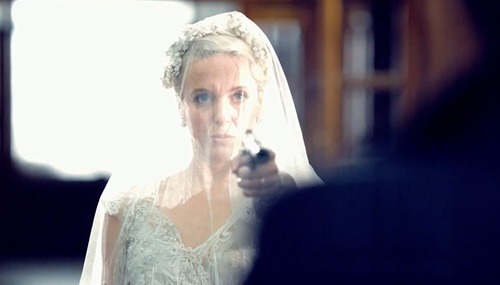
At first, I thought mysteriously-disguised-female was almost certainly Lady Smallwood OR EVEN Irene Adler BUT... if one flashbacks to Sherlock's preliminary examination of Mary, 'Liar' surfaced at least 4 times (I did actually notice, okay) - I got over the initial shock pretty quickly and it seemed almost expected that the creators of Sherlock would throw such a twist at us.


Nonetheless, I, like John, felt this way:
I was crushed that Mary couldn't just be the regular civilian wife that John wanted - something 'en dehors de' Sherlock's nutty life; however, on the contrary, precisely what John needs is not that sort of partner. As Sherlock aptly verbalizes what we've subconsciously concluded since Season 2 ended,
John, you are addicted to a certain lifestyle, you're abnormally attracted to dangerous situations and people so is it truly such a surprise that the woman you've fallen in love with conforms to that pattern.
So, Season 3 tells us as much about Watson as it does about Sherlock - the two are truly a 'couple.'
Sherlock pulled himself back to consciousness for John's sake, just as John goes running to look for trouble in a shady-alley because he can't stand missing out on the lifestyle he has with Sherlock.

(tangent: I love the still below from episode 2; very desktop-wallpaper-able)


Both certainly have their 'pressure points' - Sherlock has so many kept buried at the bottom of his mind palace - and I'm glad this episode did more to tap into them (character exploration!). Speaking of mind palace, I can't believe Magnussen's vaults = his brain, although that conveniently gives Sherlock a 'valid reason' to kill him... once again, all for John.

But, as we know from the previous episodes, John is more than merely the 'damsel in distress'-  he himself is also a lifesaver. Speaking of John, that scene in which he was being flicked by Magnussen was HORRID; it was the worse, worse, worse scene in the entire episode but just goes to show how horrible and psycho Magnussen is. Though he is perhaps not as mental as Moriarty, who, I cannot believe is somehow back (!?!?) but at least that gives the British government an excuse to recruit Sherlock (another *thank goodness* moment).

So, in conclusion -

Season 3 of Sherlock has been unquestionably entertaining and insightful. The three episodes have filled in the gaps left by the fanbase, notably by building on Sherlock and John's chemistry, giving more depth to both their characters and ultimately cementing the certitude of their friendship. Best friends. We delve deeper into the Sherlock-world as a whole, e.g. when meeting Redbeard (naw). Even Ms. Hudson's character has been explored; she is not just the old, batty landlady she oft seems to be but one who in fact harbors a dark, not-so-chaste history. Moreover, all this has been done while still preserving the pith of the show: slipping carefully-crafted crimes into each 80 minute segment; crimes that are each, of course, solved by our clever protagonist.

Episode 2 remains my favourite episode from this season, but nonetheless The Last Vow answers earlier questions thrown to us at the beginning of the episode, (naturally) raises new ones and gives us more to look forward to for Season 4.

Much cleverness, much emotion, and much screenwriting/film-making finesse. No wonder the fanbase is swelling! The show deserves it.


Here are my reviews for The Signs of the 3 and The Empty Hearse.


Monday, January 6, 2014

The Empty Hearse

While I certainly don't fall into this category of Sherlockians upon watching Saturday night's episode of BBC's Sherlock, I nonetheless understand the hype. Having suffered a long wait (and on a cliffhanger, oh God) for The Empty Hearse's debut, conspirators and cynics alike spent the past two years
1) drawing their own deductions on how Sherlock survived the Reichenbach fall and
2) building a steadily-growing fandom.

 So, how did Sherlock survive? With help from his tramp connections? By a carefully-timed leap? Episode 1 of season 3 tells all.

 ...Or does it?

 The episode opens with a glimpse into Life After Sherlock. Some toast to his memory:

Others undergo the I've- grown-facial-hair-out-of-grief transformation:

Ah, yes.

At the beginning of the episode, Sherlock accuses Mycroft of enjoying watching him being tortured. This same harsh comment is applicable to Sherlock himself, who let John grieve and wither and grow facial hair although others knew he had faked his death.

Commenting on how Watson would react to finding out Sherlock was still alive, Gatiss said, "I always found it a little unlikely that Dr. Watson's only reaction was to faint for instance—as opposed to possibly a stream of terrible swear words." I’m glad Gatiss did bear in mind the 21st-century-aspect of it (f bombs, etc.) Sherlock certainly deserved to get attacked.

Moreover, the way he announced his presence, although humorous, was immature and improbable. Considering how the show has always been – to the best of its ability – realistic, or at least excusably purported when it comes to scientific evidence/mind palace technicalities, much of Episode 1’s screenplay seems drastically tailored to suit the show’s fan base.

Don’t even get me started on the gay kiss and ruffle-hair-then-kiss-Molly scenes. Episode 1 really indulged in some un-Sherlock-y lovey-dovey-ness that sent fangirls fangirling, as if they weren’t already. There was also a segment of wasted footage dedicated to the ‘deduction’ game between Mycroft and Sherlock. Ok, it’s been two years and fans have missed it, but really?

I’ve seen great shows ruined because the screenwriters decided to start writing for a collective, squealing fan base and not for the integrity of the show itself. Moffat and Gattis are definitely aware of the cult following their show has spawned – look at Anderson. He is the mascot for each conspiring Sherlock fan on tumblr. I just hope such recognition does not lead to the degradation of what is now BBC's most popular miniseries.


Yet this episode is nonetheless one that satisfies. Watson has found himself a fiancée who is great for him (and the show, I think). The train sequence at the beginning and the text-crossovers (I apologize for my lack of cinema terminology) show that Moffat and Gatiss still include classic BBC-Sherlock cinematography. So many scenes are laugh-worthy, especially the montage but perhaps not the ending scene – is it just me, or did Sherlock go too far in pretending to not know how to defuse the bomb? 

Anyhow, 1.5 hours spent being entertained by Cumberbatch and Freeman’s natural chemistry and being wowed by clever dialogue/deductions/plot twists is always time well spent.

2 more episodes left until the tumblr fandom is reduced to: