Sunday, July 19, 2015

Because I have been on a steady diet of words since the age of three

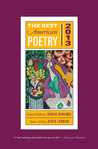
The Best American Poetry 2013The Best American Poetry 2013 by David Lehman
My rating: 2 of 5 stars

A short review this time -

A poetry anthology is like a great, big international conference: you have poems from various states, countries and cultures present, each sitting in their respectful pages, their presence contributing to the literary atmosphere of the room. Some poems are absolutely outstanding, the kind of people you want to talk to over and over again at such a gathering. Some are the guests you speak to once and then forget about soon afterwards. Others seem like they are putting on airs, trying too hard, communicating at you from a level that is both inaccessible and convoluted. Yet as it always is with meeting new people, it is always a matter of personality - I don't blame the poems any more than I blame myself.

From this collection, notables include "Foundling" by the ever-reliable Billy Collins, the very relatable "Why I Write Poetry" by Major Jackson, the stunningly powerful "The Kind of Man I Am at the DMV." Anthologies offer such a wide variety of different styles and voices that one reads not only for pleasure, but also for discovery and guidance.

View all my reviews

Saturday, July 18, 2015

Prejudice, a dirty word, and faith, a clean one, have something in common: they both begin where reason ends.

Go Set a WatchmanGo Set a Watchman by Harper Lee
My rating: 2.5 of 5 stars

Before I start anywhere with this review, let me just say: To Kill a Mockingbird is one of my favorite books ever. Of all time. It confirmed my love for bildungsromans, fuelled my interest in said genre, and warmed my heart in so many ways. When it was announced that Harper Lee - who has famously only published that ONE book - would be releasing a sequel, Go Set a Watchman, I knew at once that I would have to read it.

Whereas Mockingbird is perfect for a young audience, Watchman comes across as an adult-geared book. It deals with the same difficult themes through not the eyes of young "Scout," but rather the now 26-year old, cigarette-smoking, New Yorker Jean Louise Finch. Everything (and everyone) is different. The famous court case, around which which Mockingbird largely revolved, is only given a couple of paragraphs in Watchman. Dill is in Italy, Jem died of a heart stroke years ago, Henry Clinton wants Jean Louise's hand in marriage, and the almost prophet-like Uncle Jack is suddenly a principal character. And to many readers’ dismay, the legendary Atticus Finch is 72, has arthritis and - as nearly all online reviews boldly declare in their titles - is racist.

Atticus Finch, arguably the most respected father in American literature—a racist? In Watchman, Jean Louise returns from New York to discover that her father is suddenly on the board of directors on the Maycomb County Citizens’ Council, a union that holds KKK meetings and is viciously pro-segregation. Instead of echoing his “equal rights for all, special privileges for none” philosophy, Atticus instead asks his daughter, “do you want them in our world?” A priori, such a turn defies everything Mockingbird stood for and stamps out its very heart and soul. Such change is best captured by Jean Louise's own words:
“You who called me Scout are dead and in your grave.”
“I am their blood and bones, I have dug in this ground, this is my home. But I am not their blood, the ground doesn’t care who digs it, I am a stranger at a cocktail party.”

Yet Atticus’s racist views, framed by cold pragmatism and a harsh sort of “balance out the equities” approach, urges us to think about racism on a deeper level because this sort of prejudice differs from the more conspicuous and easier-to-criticize violence presented to us in Mockingbird. In Watchman, the racism we encounter is spoken by good people, explained in sophisticated ways and pronounced without raised voices. “The Negroes down here are still in their childhood as a people,” says Atticus. That is why it is so difficult to agree, as Jean Louise herself lashed out, that the Atticus we once knew is now a “coward as well as a snob and a tyrant.” Indeed, there are moments in the novel when Atticus is defended (the notion that his motive is to observe the racism, and hence understand how to combat it, is raised a couple of times). Regardless, one cannot depart from the novel with the same reception of Mockingbird’s Atticus.

Yet just as we are given deeper insight into Atticus’s beliefs, we are also enlightened as to Jean Louise's own shortcomings. Interestingly enough, she has a flaw that is and isn’t a flaw:
“You have never been prodded to look at people as a race, and now that race is the burning issue of the day, you're still unable to think racially.”
Lee seems to have taken the sweet innocence of Mockingbird and whammed it with a heavy dose of real-world bitterness.

More significantly, as Uncle Jack explains, Jean Louise's biggest problem is that she had always confused her father “with God:”
The most potent moral force in her life, was the love of her father. She never realized what made her dig in her feet and stand firm whenever she did was her father.
Which is why,
If a man says to you, “This is the truth,” and you believe him, and you discover what he says is not the truth, you are disappointed and you make sure you will not be caught out by him again.
But a man who has lived by truth — and you have believed in what he has lived — he does not leave you merely wary when he fails you, he leaves you with nothing.

So, whereas Mockingbird is a bildungsroman, a coming of age novel, Watchman is, to use Uncle Jack's words, a "coming into this world" novel. It is a story about having deep-rooted beliefs shattered, of struggling to reconcile with the people you love whose principles oppose yours completely. When Jean Louise screams at Atticus, therefore, she is—according to Uncle Jack—reducing her father “to the status of a human being.” Readers are forced to do that too, eroding the legendary status of one of literature’s most memorable heroes.

And it is in this complex father-daughter relationship that the significance of the title unravels itself:
For thus the Lord said to me: “Go, set a watchman; let him announce what he sees." 
“I need a watchman to lead me around and declare what he seeth every hour on the hour. I need a watchman to tell me this is what a man says but this is what he means, to draw a line down the middle and say here is this justice and there is that justice and make me understand the difference.”
To set a watchman is to follow your own moral compass despite the disillusionment you suffer; it is to be surrounded by a county of people who think differently from and but still be able to discern what is right by your own standards. The title "To Kill a Mockingbird" is hypothetical, suggesting a scenario, but"Go Set a Watchman" is a direct command. In all walks of life, we need to set our own watchman—to set us straight.

Watchman asks bigger questions than Mockingbird does. We read about a more complicated form of prejudice—not simply discrimination against a different race—but a fixed-mindset that brutally labels even the nicest of people. For example, Henry points out that Jean Louise is entitled to a certain wildness because she is a “Finch” and “all Finches” are “mad.” On the other hand, he is obliged to toe the line because any false step would  mean that it is the "red-necked" “trash” within him rearing its ugly face.

Towards the end of Watchman, when everything turns unwelcomingly dialogue-heavy, and Jean Louise keeps interrupting everything Atticus and Uncle Jack was saying, the conversations becomes overdramatized and excessively vicious (sadly, I think Jean calling Atticus a “son of a btch” is going to be permanently ingrained in my memory). Another thing I don't like about the novel is Uncle Jack's oracle-esque, all-knowing role. Yes, he has his charm, but his character’s wisdom and insight seemed purported and unconvincing at times. Overall, Watchman lacks the warmth and imaginative plot of its prequel.

Nonetheless, despite everything that is different in Watchman, Lee still includes a couple of "throwback" chapters in the novel that recount stories from Jean Louise's childhood and are written in the same young and humorous voice I loved so much in Mockingbird. Lines such as "Atticus was in bed reading" (215) do take on back. If you don't read the whole book, do read Chapter 11 - it is an absolute gem.

So, I appreciate Watchman for its depth and exploration. Yet thankfully, despite everything, Mockingbird will still have a special place in my heart forever.


(P.S. Every time I typed "Jean Louise" in this review, I was aching to type "Scout")


View all my reviews

Wednesday, July 8, 2015

Des traces subsistent dans des registres et l'on ignore où ils sont cachés et quels gardiens veillent sur eux et si ces gardiens consentiront à vous les montrer

Rue des boutiques obscuresRue des boutiques obscures by Patrick Modiano
My rating: 4 of 5 stars

"Je ne suis rien. Rien qu'une silhouette claire, ce soir-là, à la terrasse d'un café."
Ainsi commence (thus commences) Rue des boutiques obscures de Patrick Modiano - a blank, a void, a man without an identity.

Guy Roland is an amnesiac detective who, now retired, decides to embark on his most puzzling case yet - the search for himself. Along the way, a myriad clues serve as his compass. Some are factual information, like addresses and telephone numbers provided by Hutte (his old employer); others are vague sentences dropped here and there by strangers who are not as distant as they seem; and some are material, like an old photo of friends found in a box of memories ("tout finissait dans de vieilles boîtes de chocolat ou de biscuits. Ou de cigares.").

The reader is immediately pulled into our narrator's search for his own past. We scrutinize every hint he receives, sympathize with him when he loses a lead, and struggle to connect the constellation of people, places and locations that dots the obscure sky of his journey. In a way that adds nuanced layers to the storyline, Guy's memory seems to return as he makes progress: he recalls "des bribes" (snatches, fragments) of his past, and the road becomes less obscure.
Oftentimes, Guy is quick to believe that a certain man he learns about is him, only to suffer disappointment soon after (reinforcing my belief that the question of "who am I?" is one of the most poignant in literature).

At first, it seems that we are only dealing with a personal history (Guy's). As the novel evolves, however, and as more characters are pulled into the web of this complex search for identity, we are beset with mysteries from every angle: an assassination. A suicide. A couple separated in a snowstorm in 1943. Indeed, we come face to face with a vaster history still: the Nazi-occupation of France.

In English, this book is (unjustly) titled, Missing Person.  Perhaps this gives readers the expectation that the ending should bring around closure, and that a person should be found. Yet, as the French title fittingly reveals, we are still somewhat wandering "une rue des boutiques obscures" at the end of the novel. Such an ending (which I've become used to, in fact e.g. Murakami's Colorless Tsukuru Tazaki), however, is always the most striking. With Guy pursuing a past that is still somewhat shrouded in a veil of obscurity, while heading to Rome to locate the exact "Rue des Boutiques Obscures" itself, the novel concludes with mystery - like it began - but also with renewed hope and purpose. Rue des Boutiques is a compelling narrative about memory, history, and uncovering what is deeply personal to us - despite the fact that our lives are quick to dissipate into the night, "se dissiper dans le soir."

“Je crois qu'on entend encore dans les entrées d'immeubles l'écho des pas de ceux qui avaient l'habitude de les traverser et qui, depuis, ont disparu. Quelque chose continue de vibrer après leur passage, des ondes de plus en plus faibles, mais que l'on capte si l'on est attentif.”

"I think we still hear, in the entrances of buildings, the echo of the footsteps of those who used to cross them, but have since disappeared. Something continues to vibrate after their passage, waves that grow increasingly weak, but that one picks up if one is paying attention. "


View all my reviews

Sunday, July 5, 2015

42

The Hitchhiker's Guide to the Galaxy (Hitchhiker's Guide to the Galaxy, #1)The Hitchhiker's Guide to the Galaxy by Douglas Adams
My rating: 5 of 5 stars

The Hitchiker's Guide to the Galaxy by Douglas Adams (henceforth fondly referred to as HG2G) has been on my High-School-Texts-I-Never-Read-But-Must list for the longest time - until this morning, that is. The book is an absolute, intergalactic, devour-in-one-sitting gem.

Our protagonist is Arthur Dent, a humble earthling whose longtime friend, Ford Prefect, turns out to be an alien from another planet entire. Yet there are perks to such a friendship, for Arthur is the only human who is whisked away to 'safety' when the hulking and poetry-loving Vogons implode his little green and blue home. The rest of the characters are a fascinating bunch - there is Zaphod Beeblebrox, the brilliant and bizarre Galactic present, Trillian, a human who was fleetingly Arthur's potential love-interest on Earth before being "picked up" (quite literally) by Zaphod, Marvin, a comically depressed robot ("paranoid android"), an enigmatic old man on a legendary planet, a chatty computer... the list goes on.

The norm is twisted, warped and contorted in HG2G. Poetry - an elegant, melodic art form - is a torture mechanism; the possibility of being "late" is interpreted as the threat of being "late, as in the late < insert your name here >;" and most memorably of all, "what's so unpleasant about being drunk" is something only "a glass of water would know."

We, like Arthur, keep HG2G's top-notch life advice in our minds as we read on: Don't Panic.

On the one hand, HG2G delivers the joyously imaginative: we meet the mind-bogglingly useful Babel Fish, are inside the head of a confused/existentialist spermwhale for a brief moment, and learn that Norway's fjords are design-award-worthy.

At the same time, the novel also invites us to question the profound, which is often masked in the simplest of terms:
“Isn't it enough to see that a garden is beautiful without having to believe that there are fairies at the bottom of it too?”
“On the planet Earth, man had always assumed that he was more intelligent than dolphins because he had achieved so much—the wheel, New York, wars and so on—whilst all the dolphins had ever done was muck about in the water having a good time. But conversely, the dolphins had always believed that they were far more intelligent than man—for precisely the same reasons.”
“He felt that his whole life was some kind of dream and he sometimes wondered whose it was and whether they were enjoying it.”
“All through my life I've had this strange unaccountable feeling that something was going on in the world, something big, even sinister, and no one would tell me what it was." "No," said the old man, "that's just perfectly normal paranoia. Everyone in the Universe has that.”
Throughout the story, there are times when the characters jump into hyperspace - similarly, we also make leaps from our mundane lives into absolute absurdity. We go from Arthur's house being demolished, for instance, to a whole planet being pulverized, just as we go from having a pint on earth to having tea on a spaceship (or at least "something that is almost, but not quite, entirely unlike tea"). All of a sudden, telephone numbers seem to have an otherworldly purpose that is on par with the most unlikely of possibilities (infinity minus one?)

There is so much about HG2G that is unforgettable, such as the hilarious "proof" of God's non-existence via the Babel fish, the utterly quotable “So long, and thanks for all the fish,” and the sheer wackiness of suddenly becoming prey to two white mice (who are the guinea pigs, now?)

Yet the the one thing readers will never forget about this book - the two-digit number we all know by heart - is the bafflingly simple and incomprehensible answer to the "life the universe and everything": 42. It is ironic how a book involving concepts of astronomical scale boils down the solution to The Ultimate Question to 6*7... but is that truly all that it is?

As we age, it seems that we “demand rigidly defined areas of doubt and uncertainty" by default; however, Adams expands these areas to wild and thrilling proportions in the novel. We read on, believing nothing (debatable) but loving everything. I shall be reading the sequels. It is little wonder HG2G has achieved the status of legend.


View all my reviews

Tuesday, June 30, 2015

Everyone, at some time, is a continent of one

Falling Off the MapFalling Off the Map by Pico Ayer
My rating: 3 of 5 stars

Having taken a growingly serious interest in travel writing, and having wanted to read Pico Iyer ever since I came across this quote, "Kindness is water, religion is like tea. You can survive without tea, you can't survive without water," I decided to pick up Falling Off the Map: Some Lonely Places of the World two days ago.

In six eloquently crafted essays, Iyer introduces us to six different places, each fascinating and lonely in its own right.

What makes a lonely place? According to Iyer, lonely places
  • have no seat at our international dinner tables
  • all are marching to the beat of a different satellite drummer
  • develop tics and manias and heresies. They pine, they brood, they molder
  • are generally sure that their time is about to come
  • are often poor places, because poverty breeds wonkiness and a greater ability to visualize than to realize dreams  
  • are often small countries, because smallness gets forgotten
and, most poignantly of all:
  • attract lonely people
Unsurprisingly, the enigmatic and remote North Korea tops the list of lonely places in this collection. Argentina is there, too, a place with people "living in a dream" despite the economic collapse happening around them. It is followed by Cuba, which carries a "sense of wistfulness, of a life arrested in midbreath." Iyer captures the "seduction" of Cuba's loneliness, describing how "the whole island has the ramshackle glamour of an abandoned stage set." Then, there is Iceland, which has a mystic quality to it; we, like Iyer, are swept away by its "certain kind of magic" as well as struck by its darkness.  Bhutan is the "hidden kingdom" that, like North Korea, shuts itself from the outside world (both are vastly different, however). Vietnam is beautifully described as "a pretty girl with her face pressed up against the window of the dance hall, waiting to be invited in." Paraguay is the "orphaned land," and the title of the essay - "Up for sale, or adoption" - is sadly fitting. Finally, we have Australia, which perhaps does not strike the modern reader as that much of a "lonely place" yet nonetheless comes across as "a country that feels as if it has fallen off the planet" in Iyer's essay.

In all essays, Iyer shows how the busiest of regions have a lonely face to them (e.g. the touristy Saigon side of Vietnam vs the abandoned Hanoi). He sews together every place's people, history and geography to present a portrait of loneliness to which local residents may not even be attuned. Iyer also alludes to other writers, such as Márquez and Lawrence (this is something I have noticed travel writers often do).

The reason why it is so lovely to read Iyer is because he comes across as a bold explorer, deciding "to try one last time to walk across the deserted street" in Pyongyang, and daring to accept a stranger's offer to board a new (and risky) plane to Bhutan. He has a keen eye for details, missing nothing about the different dimensions of a city. And he is as much of an intensely involved observer as he is an outsider, a unwelcome guest at certain Korean restaurants in Paraguay. We are often reminded of the fact that lonely places attract lonely people.

Yet beyond the loneliness of deserted landscapes and oblivious dreamers, there are also evolving cultures and reinvented people, foreign influences and more travelers. This book was published in 1993, and not all the places it describes are so lonely anymore. Yet as Iyer reminds us, "there will never be a shortage of Lonely Places, any more than there will ever be of lonely people."

View all my reviews