Saturday, May 17, 2014

Writing motivates you to look closely at life, at life as it lurches by and tramps around

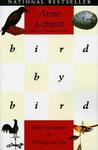
Bird by Bird: Some Instructions on Writing and LifeBird by Bird: Some Instructions on Writing and Life by Anne Lamott
My rating: 3 of 5 stars

I've been meaning to read Anne Lamott's Bird by Bird for some time now, especially as it is always being quoted on Brainpickings.com.
It's a witty, absorbable read, easily devourable in a couple of hours. Offering advice on facets of writing that range from perfectionism to libelling real-life people in your work ("Give the character a small penis," Lamott suggests. "Then he won't come forward."), Lamott is both honest - and witty. I would say that the book's weakest element is perhaps its pithiness; in some chapters, I wish Lamott had chosen to extend her scope a bit further and to tap into other stories and other dimensions of the writing life. Nonetheless, Bird by Bird is a genuine and honest 'writer's guide' that inspires and encourages one to pick up the pen - and take the writing process "bird by bird."
“Writing and reading decrease our sense of isolation. They deepen and widen and expand our sense of life: they feed the soul. When writers make us shake our heads with the exactness of their prose and their truths, and even make us laugh about ourselves or life, our buoyancy is restored. We are given a shot at dancing with, or at least clapping along with, the absurdity of life, instead of being squashed by it over and over again. It's like singing on a boat during a terrible storm at sea. You can't stop the raging storm, but singing can change the hearts and spirits of the people who are together on that ship.”
To be a good writer, you not only have to write a great deal but you have to care. You do not have to have a complicated moral philosophy. But a writer always tries, I think, to be a part of the solution, to understand a little about life and to pass this on.
“For some of us, books are as important as almost anything else on earth. What a miracle it is that out of these small, flat, rigid squares of paper unfolds world after world after world, worlds that sing to you, comfort and quiet or excite you. Books help us understand who we are and how we are to behave. They show us what community and friendship mean; they show us how to live and die.”
“Perfectionism is the voice of the oppressor, the enemy of the people. It will keep you cramped and insane your whole life, and it is the main obstacle between you and a shitty first draft. I think perfectionism is based on the obsessive belief that if you run carefully enough, hitting each stepping-stone just right, you won't have to die. The truth is that you will die anyway and that a lot of people who aren't even looking at their feet are going to do a whole lot better than you, and have a lot more fun while they're doing it.”


View all my reviews

I am who I am, she would say, I live as I do because of you.

The LowlandThe Lowland by Jhumpa Lahiri
My rating: 4 of 5 stars

Rooted in the political history of India in the 1960s, Jhumpa Lahiri's The Lowland is a powerful story about the impact of the Naxalite movement on future generations and family relationships.

Subhash and Udayan are two brothers growing up in Calcutta in the 1960s, a time when the Naxalite movement was heralding immense social and political change. Although both brothers are near-identical and inseparable in childhood, the rebellious Udayan becomes politically involved with the Naxalites while the cautious Subhash decides to pursue his studies in the States as both enter adulthood.

All changes when Udayan is assassinated for challenging the government. Subhash weds Udayan's pregnant wife, Guari, to help the both of them seek a more stable life in America. The child, Bela, grows up unaware of her origins. All characters adapt to their new lives post-Naxalism in the shadow of their shared past.

Yet Udayan does not dissolve from the story after his death; his presence continues to pervade the lives of the kin he leaves behind. Guari's fear of the child being born a son, a mirror of its father, reflects Udayan's undercurrent throughout the novel; likewise, Bela's adolescent inclination towards nomadic lifestyle also seems to echo that of her late father.

A strong sense of time and repetition is compellingly conveyed throughout the novel. The structure is well-conceived and allows the content it carries to transcend time and distance, from the lowlands of India to the 'land of the free' in America. In this way, the ending - which brings readers back to the root of the conflict - is a fitting conclusion. It reminds us - not that Lahiri makes it necessary - the core of every detail that has passed before.

The novel encompasses also rooted cultural beliefs, exhibited especially in the Calcutta home-base where Udayan's mother conforms to strict rituals to honor her deceased son. Lahiri's acute portrayal of the Saris and the customs of the Indian people also adds to this effect, indeed binding the novel together the way Arundhati Roy does in The God of Small things. Both writers present familial themes that are universal and timeless - yet the cultural and historical backdrop that serves as their starting point endows their novels with an irreplaceable, and very magnetic, sense of specificity.

Nonetheless, Lahiri offers us a streak of the modern, perhaps most tellingly exposed through Guari's relationship with Lorna and Guari's adaption into American life. Mugs of Coffee, sweats - certainly not elements of the lifestyle that her mother-in-law would allow. Guari is a complex character; the first time readers are aware of her, she is but a photograph, an enigma. By the end, Lahiri has given her a form and purpose. Out of all characters in the novel, perhaps Guari is the one who has taken the broadest leap away from the horror of the lowlands into her version of the future.

Despite such progress, however, and regardless of the 'growth' the characters experience as time takes them farther away from Udayan's death in the lowlands, their grudges, development and decisions are all shaped by their common history.

Such a pervasive influence, which captures the core of Indian society at the time as it does the essence of the characters' familial conflicts, is what makes The Lowlands a compelling read.

Lahiri writes with clarity and perceptiveness. She has the astonishing power of drawing readers into the childhood hearts of Udayan and Subhash in the first pages, and to seemingly out of nowhere draw up Bela, for whom readers instantly sympathize. I remember Vikas Swarup once saying that Indian literature was the next big thing - I wasn't sure what he meant then, but reading The God of Small Things and The Lowlands certainly changes my perspective.
“Most people trusted in the future, assuming that their preferred version of it would unfold.”


View all my reviews

Friday, April 18, 2014

"nobody teaches life anything.”

RIP to Gabriel Garcia Marquéz, writer of elegant prose and nuanced perceptions,
- many of whose works are still queued up on my to-read list


My Love in the Time of Cholera review was one of the most thorough posts I've put
up here: http://may-theforcebewithyou.blogspot.hk/2013/04/love-in-time-of-cholera.html
and indeed one of the review-writing experiences that nudged me further down la rue du blogging

Indeed it is never easy to frame the right words in memory of one who has written so much for us.

Monday, March 31, 2014

Il faut vous accrocher à l'humain qui est en vous et vous survivrez

After suffering a stroke in December 1995, Jean-Dominique Bauby - the former editor in chief of the magazine Elle - found himself a victim of 'locked-in-syndrome:' fully paralysed, trapped inside his diving-bell-esque rigid chamber of a body and only able to blink his left eyelid.

Yet instead of wallowing in self-remorse, Bauby composed The Diving Bell and the Butterfly in his head over the course of his paralysis and then proceeded to 'write' it via (for medical terminology's sake) "partner assisted scanning." Here's how it worked: a very patient and dedicated nurse/significant other would read the alphabet out-loud (an alphabet rearranged in order of letter usage frequency) and Bauby would simply blink his left eyelid to select letters and spell out sentences.

Such a system resulted in the publication of Le Scaphandre et le Papillon in 1997, and the production of a film (I am about to review) 2007. I decided to watch The Diving Bell and the Butterfly over the weekend primarily because I'm reading the original text in French class but also because I wanted to justify staying up late. Plus, who can resist the temptation of watching a film that was nominated for 4 Academy awards?

In the beginning of the film, we observe the world through Bauby's lens - through his blinking (and sometimes wandering, men's gaze-esque if you know what I mean) left eye. There's an incredible, instantly gripping dialogue sequence where Bauby zones half in/out of consciousness while doctors and nurses peer at him and repeatedly speak to him in assuaging tones - and all the while Bauby is muttering in the background, trying to piece together his own conclusions.

Then, one can't admire the genius camera work that ensues when Bauby blinks - and opens his eyes again to reveal to us audiences a snapshot of his past, of his moving/fast-paced life as editor in chief of Elle. Throughout the film, such 'clips' recur to not only add a bit of much-welcomed movement to the film but to also reveal much about Bauby before his stroke. Indeed, there's a part in the book where he wonders to himself whether the nurses around him know anything of his identity before he became paralysed. Perhaps the movie's visual flashbacks are attempts to reconstruct some of that identity.

Above all, the film - like the book - highlights two main facets to Bauby's situation: firstly, it reveals how his condition affects his life and relationships. Indeed, there is a brilliant scene where a fly lands on Bauby's nose and he - unable to lift a finger - watches it with a wild eye before it is swatted away. On a more emotionally-striking level, the one-sided phone calls he has with his father and lover are heart-wrenching .... not to throw in a major plot spoiler but when Inès calls and he responds "chaque jour je t'attends," have your tissues ready.

Secondly, Bauby's story compellingly reveals the indisputable force of imagination, without which the book would have never been written. And it is imagination that sends Bauby on mental holidays and fantasies, scenes the film pays particular attention to.

Another little detail the film honed in on was capturing tiny symbolic motifs - from the corner of the camera frame, one will see a tiny butterfly flutter by the window...

Also, the soundtrack is fabulous and I haven't been able to get La Mer out of my head for a week already.

All in all, The Diving Bell and The Butterfly is a stunning film, one that certainly does the book justice (although perhaps not Bauby himself, as his friends seem to argue).


There is no doubt that Bauby sits on the highest tier of human competence - it is remarkable that his strenuous internal-editing, determination and focus evolved into a 100+ page novel. And upon reading the novel and watching the film, one may understand how Bauby's imagination, free as a butterfly, was what kept him tethered to reality - and will inspire readers and audiences for generations.

Saturday, March 29, 2014

That moment when what you read/watch = your life

"Most of the miseries of the world were caused by wars, and when the wars were over, no one ever knew what they were about." Gone With The WInd, 1939


Me when I attempt to assess the effects of WW2...