
Sunday, March 3, 2013

Metaphors are dangerous. Love begins with a metaphor.
I finished reading The Unbearable Lightness of Being! There were moments when I found it unbearable (ha...ha ha) and also times when I was blown away by it.
Something you should know about this book - Deep, deep, deep.
This is the recurring question throughout:
So be prepared to come across the words 'unbearable,' 'weight,' and 'lightness,' MANY times.
Overall, I didn't really 'get' this book - I didn't love it, did not have the spirit to delve into it, but it definitely DOES express very profound ideas (perhaps if I reread in a couple year times I'll see it in another light). The conciseness with which Kundera expresses these ideas through his book is one of its most noticeable traits; personally, I prefer it when writers churn out/explore ideas a tad more clearly in their books.
Nonetheless, there was this SWELL CHAPTER on kitsch -
I generally have issues with profanity in literature (it's a besmirching of the English language; see quote 3 paragraphs below that rejects this, though) but then again there have been time when it is used so appropriately/perfectly (e.g. Of Mice and Men, Fraction of the Whole, etc.) so when shit popped up I thought I'd read on... and it was absolutely worth it!
Kitsch (I understand that there are more connotations now, though) is the act of not accepting that life sucks... Sabina lives with the old couple, listens to beautiful music, and in that moment, is undergoing Kitsch, but as Kundera explains, this is inevitable as kitsch is an "integral part of the human condition."
Then, he started talking about TOTALITARIAN KITSCH which is a lot more complicated but basically the communist sense of it - individualism, doubt and irony banished.
In conclusion: Didn't particularly connect with this novel but it is written fluidly and has a brilliant chapter on Kitsch.

Currently: Listening to the Return of the King soundtrack (I'VE MISSED IT) and re-reading Sylvia Plath (despite my 3 month no-intense-Plath rule, because her depression is a tad contagious). This is the 2nd time this anthology has sat in my home but I'm reading it in a different light... I'm noticing new rhyme schemes (and being mind-blown, yes)... so many soft constants and "liquid vowels" as Ted Hughes eloquently put it.
Rediscovering my old favorites, like Daddy and Lady Lazarus (more recent, yes), but
http://allpoetry.com/poem/8498383-Trio_Of_Love_Songs-by-Sylvia_Plath
IS INCREDIBLE; I DIDN'T LOVE IT THIS MUCH BEFORE! Perfect puns everywhere, so delicate (yet strong, esp. the 1st one); love it.
Something you should know about this book - Deep, deep, deep.
This is the recurring question throughout:
The heaviest of burdens is therefore simultaneously an image of life's most intense fulfillment. The heavier the burden, the closer our lives come to the earth, the more real and truthful they become. Conversely, the absolute absence of burden causes man to be lighter than air, to soar into heights, take leave of the earth and his earthly being, and become only half real, his movements as free as they are insignificant. What then shall we choose? Weight or lightness?”All the characters are either light/heavy or torn between both. It's interesting.
So be prepared to come across the words 'unbearable,' 'weight,' and 'lightness,' MANY times.
Overall, I didn't really 'get' this book - I didn't love it, did not have the spirit to delve into it, but it definitely DOES express very profound ideas (perhaps if I reread in a couple year times I'll see it in another light). The conciseness with which Kundera expresses these ideas through his book is one of its most noticeable traits; personally, I prefer it when writers churn out/explore ideas a tad more clearly in their books.
Nonetheless, there was this SWELL CHAPTER on kitsch -
"kitsch is the absolute denial of shit both in the literal and figurative senses of the word; kitsch excludes everything from its purview which is essentially unacceptable in human existence."
I generally have issues with profanity in literature (it's a besmirching of the English language; see quote 3 paragraphs below that rejects this, though) but then again there have been time when it is used so appropriately/perfectly (e.g. Of Mice and Men, Fraction of the Whole, etc.) so when shit popped up I thought I'd read on... and it was absolutely worth it!
Kitsch (I understand that there are more connotations now, though) is the act of not accepting that life sucks... Sabina lives with the old couple, listens to beautiful music, and in that moment, is undergoing Kitsch, but as Kundera explains, this is inevitable as kitsch is an "integral part of the human condition."
Then, he started talking about TOTALITARIAN KITSCH which is a lot more complicated but basically the communist sense of it - individualism, doubt and irony banished.
You can't claim that shit is immoral, after all! The objection to shit is a metaphysical one. The daily defecation session is daily proof of the unacceptability of Creation. Either/or: either shit is acceptable (in which case don't lock yourself in the bathroom!) or we are created in an unacceptable manner.
In conclusion: Didn't particularly connect with this novel but it is written fluidly and has a brilliant chapter on Kitsch.

Currently: Listening to the Return of the King soundtrack (I'VE MISSED IT) and re-reading Sylvia Plath (despite my 3 month no-intense-Plath rule, because her depression is a tad contagious). This is the 2nd time this anthology has sat in my home but I'm reading it in a different light... I'm noticing new rhyme schemes (and being mind-blown, yes)... so many soft constants and "liquid vowels" as Ted Hughes eloquently put it.
Rediscovering my old favorites, like Daddy and Lady Lazarus (more recent, yes), but
http://allpoetry.com/poem/8498383-Trio_Of_Love_Songs-by-Sylvia_Plath
IS INCREDIBLE; I DIDN'T LOVE IT THIS MUCH BEFORE! Perfect puns everywhere, so delicate (yet strong, esp. the 1st one); love it.
Hearing a white saint rave
About a quintessential beauty
Visible only to the pargon heart,
I tried my sight on an apple-tree
That for eccentric knob and wart
Had all my love.
Monday, February 25, 2013


Sunday, February 24, 2013
Eddie Vedder - Rise
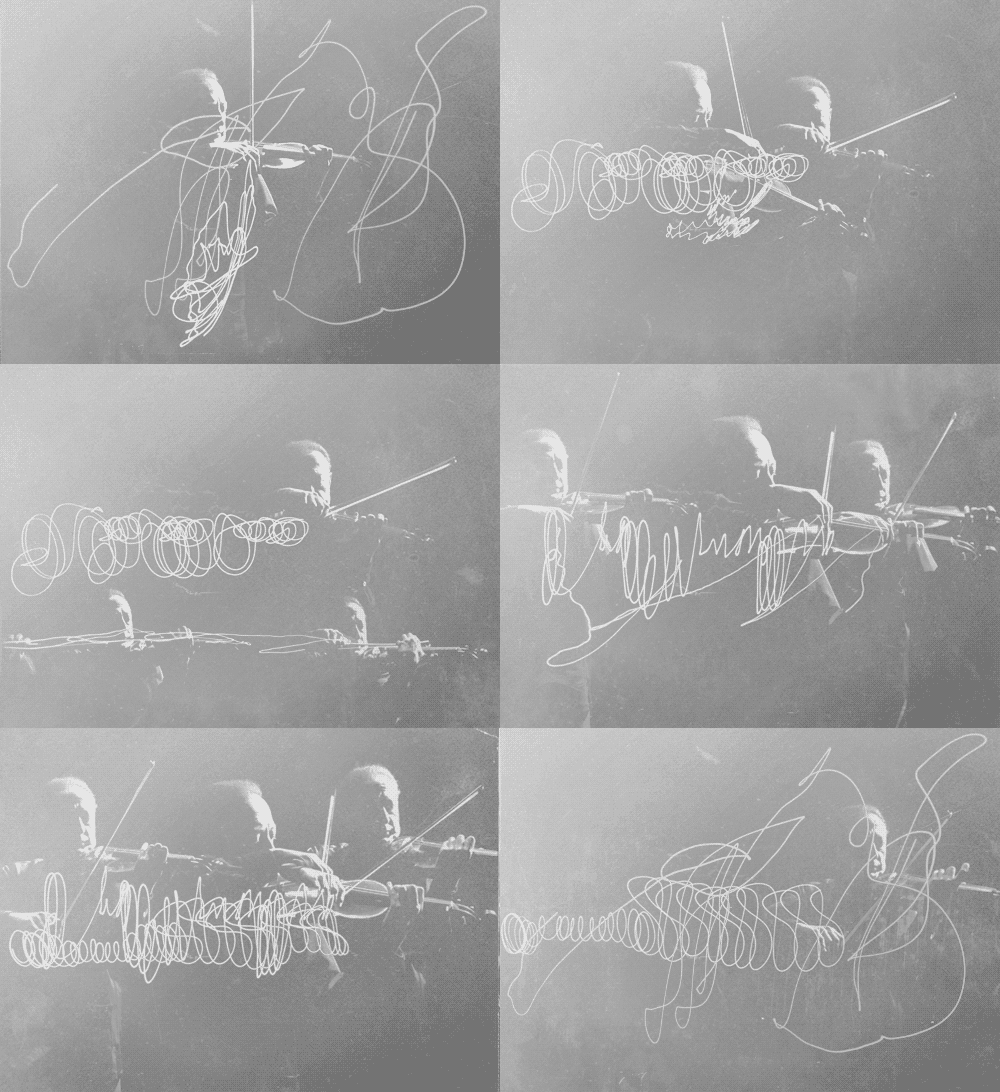
This is possibly a gif. of the maestro Jascha Heifetz. I am about to go on a house cleaning rampage, as means of dealing with the stress-mites that have clotted in my noggin (I have 5 impending assessments, 3 of which are French).
I am reading The Unbearable Lightness of Being and not loving it (sorry LMY if you are reading this) and am brainstorming my next book to tackle...
Friday, February 15, 2013
All great and precious things are lonely
ALERT: THIS POST CONTAINS LEGIT SPOILERS
I would not say that I absolutely adored and treasured this book, or that it was full of love and goodness - because it wasn't (and that was sort of the point of it) - but Steinbeck, with his fluid style and clearly drawn parallels, certainly had me hooked throughout. Of Mice and Men, due to its brevity (and killer [no pun intended] ending), perhaps remains most memorable for me, yet East of Eden was definitely (due to its length), the more developed and fledged story.
One of the most expatiated themes in the novel = the idea of one's capability to CHOOSE between greatness and evil, expressed via the word: TIMSHEL
This word bore massive significance in the novel (I mean, it was even the last spoken word). Here are its connotations/ramifications explained, as told by Lee (Lee is perhaps the most interesting character in the entire novel; more on that later):
‘Thou shalt,’ meaning that men will surely triumph over sin. But the Hebrew word, the word timshel —‘Thou mayest’—that gives a choice. It might be the most important word in the world. That says the way is open. That throws it right back on a man. For if ‘Thou mayest’—it is also true that ‘Thou mayest not.’ Don’t you see? [...] 'I said that word carried a man's greatness if he wanted to take advantage of it.'
I feel that a man is a very important thing—maybe more important than a star. This is not theology. I have no bent toward gods. But I have a new love for that glittering instrument, the human soul. It is a lovely and unique thing in the universe. It is always attacked and never destroyed—because ‘Thou mayest.’
'I believe when you come to that responsibility the hugeness and you are alone to make your choice. On one side you have warmth and companionship and sweet understanding, and on the other—cold, lonely greatness. [...] it’s nice for a mediocre man to know that greatness must be the loneliest state in the world.'"Greatness must be the loneliest state in the world." This state is realized by Lee when he leaves (shortly) to attempt his long-buried/half-imagined dream of starting a bookstore. Honestly, by this time in the book:
- Every single potential dream of all the other characters have NOT turned out well
- This is just Steinbeck's classic theme, reflective of the great depression/American dream; people make great pilgrimages/go to war in hopes of finding God/going to heaven but does that pan out?
Nearly everything Lee says in the book is accepted as legit. Adam runs to him for counsel; he brings up Cal and Abel; Abra looks to him as a father; he knows everything and has seen everything. So, of all characters, perhaps he has the greatest chance of fulfilling his dream - and does he? The fact that he returns, beaten, 150% certain of the loneliness of greatness, further embellishes the theme of a unreachable Eden that Steinbeck explores in this novel.
Reason for Lee's lapse in judgment?
“I’d rather you saw for yourself and thought for yourself,” Lee said. “You know whena man lives alone as much as I do, his mind can go off on an irrational tangent just because his social world is out of kilter.”
Anyhow - back to Timshel and greatness -
FACTOID: I know for a fact that Marcus Mumford's favorite authour is JOHN STEINBECK and guess which band has a song titled timshel...?Throughout the entire novel nearly all characters are torn between self-conflicts evil and goodness, and at the end, when Adam says 'Timshel' to Cal, that is his way of enunciating that Cal is free to make a choice, to choose greatness, and forget his sins (that Cal believes he inherited from his mother) - his indirect causing of his brother's (and mother's) death (another biblical reference), for example. It is also Adam's acceptance of Cal (an acceptance of love that Lee recognizes that Cal NEEDS to be able to go on).
The importance of sins, though:
“The ways of sin are curious,” Samuel observed. “I guess if a man had to shuck off everything he had, inside and out, he’d manage to hide a few little sins somewhere for hisown discomfort. They’re the last things we’ll give up.”“Maybe that’s a good thing to keep us humble. The fear of God in us.”Adam was the one his father preferred, and out of his two sons, he would go on to prefer Aron... There is a uber handy table from Wikipedia that shows all major biblical references.
Another huge theme in the novel is LOVE:
Cyrus's love for Adam, Charles's love for Cyrus (and also Charles's lack of receiving love that makes him violent)
Adam's love for Aron, Cal's love for Aron (and also Cal's lack of receiving love that ALSO makes him violent).
Adam's mad, (almost) self-dreamed love for Cathy, her lack of love for anyone in general (except possibly Aron)
Lee's love for Abra (IN THE FATHERLY WAY), her love for him
Aron's mad (almost) self-dreamed love (aha) for Abra, her gradual transitioning love for Cal (due to Aron's intenseness...)
All this love (or lack thereof) is extremely pertinent to how the characters grow, how they dream, and how they eventually die.

Other interesting mini-themes in the book that I won't delve into but want to mention:
1) The significance of 'Joes' and their correlation to modern outputs like the automobile.
2) The representation of Alice (in Wonderland) as Cathy's childhood spark.
Final lovely quote:
When you’re a child you’re the center of everything. Everything happens for you.Other people? They’re only ghosts furnished for you to talk to. But when you grow up you take your place and you’re your own size and shape. Things go out of you to others and come in from other people. It’s worse, but it’s much better too.
I'll give it a year, maybe, and then take on THE GRAPES OF WRATH.
Subscribe to:
Posts (Atom)