Saturday, August 31, 2013

Edward Sharpe and the Magnetic Zeros


Released on July 23rd, Edward Sharpe and the Magnetic Zeros's new album (titled, funnily enough, Edward Sharpe and the Magnetic Zeros) has been heeded by the band's front man, Alexander Ebert, as the most "rawest, most liberated, [and] most rambunctious" album he's ever produced. One may initially feel slightly disheartened, however, upon listening to the much-anticipated album. Edward Sharpe and the Magnetic Zeros's previous albums, Up from Below and Here both had distinctive stand-out songs - Home (which is still one of the band's most popular songs) for the former and Man on Fire for the latter.

Better Days, the first single on the album, somehow doesn't strike the same infectiously catchy chords as Home does; nor does it emanate the gentle, guitar-produced ambience of Man on Fire. Nonetheless, one cannot dispute that the track, along with the rest of the album, embodies all the core elements of an Edward Sharpe and the Magnetic Zeros song.

Listening to Edward Sharpe and the Magnetic Zeros, one will hear the distinctly soulful and wide-ranged voice of Ebert, as well as thick backing harmonies (perks of having a 10-person band) and pulsing, echoing beats. Ebert's voice is without a doubt the band's most prized asset. Those who have listened to Home will already be aware that Ebert is a more than adequate whistler; his singing voice carries the same soaring fluidity as does his whistling.

Given the presence of all classic Edward Sharpe and the Magnetic Zeros’s qualities, the album is ultimately infectious. Initially not wowed by Better Days, I eventually found myself helplessly listening to the album on repeat. You’ll find yourself listening to Two, appropriately named as it is a duet between Ebert and the band's other lead singer, Jade Castrinos, whose voice is sonorous, easy to listen to, and featured beautifully on the album's 11th track, Remember to Remember. The album closes with the sentimental This Life, which is different from the other songs on the album because it is slower and distinctively more melancholic. Give Me a Sign, a track from the deluxe edition of the album (and a personal favourite), presents similarly sentimental lyrics yet maintains an upbeat rhythm.

Despite the fact that 4 years – a length of time that has led certain mainstream artists to completely revamp their styles – have passed since the release of its first album, Edward Sharpe and the Magnetic Zeros still produce songs that resonate with the depth and warm-heartedness of its first album.

Friday, August 30, 2013

Seamus Heaney

The first time I heard of Seamus Heaney was around three years ago, when I purchased a Wordsworth collection and saw that he had written the preface. Later on, I would read his poems in several anthologies. Sadly, it is only now that I begin to look for more of his own collections. Rest in Peace, Seamus Heaney. Your poetry and prose will delight bookshelves for generations to come.


Taught me between the hammer and the block
To face the music. Teach me now to listen,
To strike it rich behind the linear black.

Monday, August 26, 2013

Carefully caught regrets


Next to familiarizing oneself with a poet's style, the best part about reading a poetry collection is culling favourites. 'The Lovesong of J. Alfred Prufrock' won me over immediately, as did the 4 Quartets (especially Dry Salvages). As seen in The Waste Land, T.S. Eliot certainly has a penchant for using 'death' imagery and writing about dry and barren things. He also explores the idea of the "shared agony" of life and death (I definitely prefer his commentaries to Jose Saramango's), and the passage of time. I will never forget how he refers to life as the "dreamcrossed twilight between birth and dying."

I have to resist the urge to copy/paste massive chunks of quotes in.
"It seems, as one becomes older,
That the past has another pattern, and ceases to be a mere sequence—
Or even development: the latter a partial fallacy
Encouraged by superficial notions of evolution,
Which becomes, in the popular mind, a means of disowning the past."
^my favourite passage from The Dry Salvages. What an astounding Quartet - in a matter of lines TS Eliot reflects upon time, the human perception of its passing and happinness.
The voice returns like the insistent out-of-tune
Of a broken violin on an August afternoon:
^I'm so accustomed to out of tune violins in August.
And youth is cruel, and has no remorse
And smiles at situations which it cannot see.
^ from The Portrait of a Lady, one of the most memorable poems from this collection.

Thursday, August 22, 2013

So excited


Cameron Diaz as the leopard... Javier Bardem with his hair all gelled up... I CANNOT WAIT
Also:
child-of-god-pictures-3
James Franco directing Child of God - amalgamation (?) of two of my favourite people.

Sunday, August 18, 2013

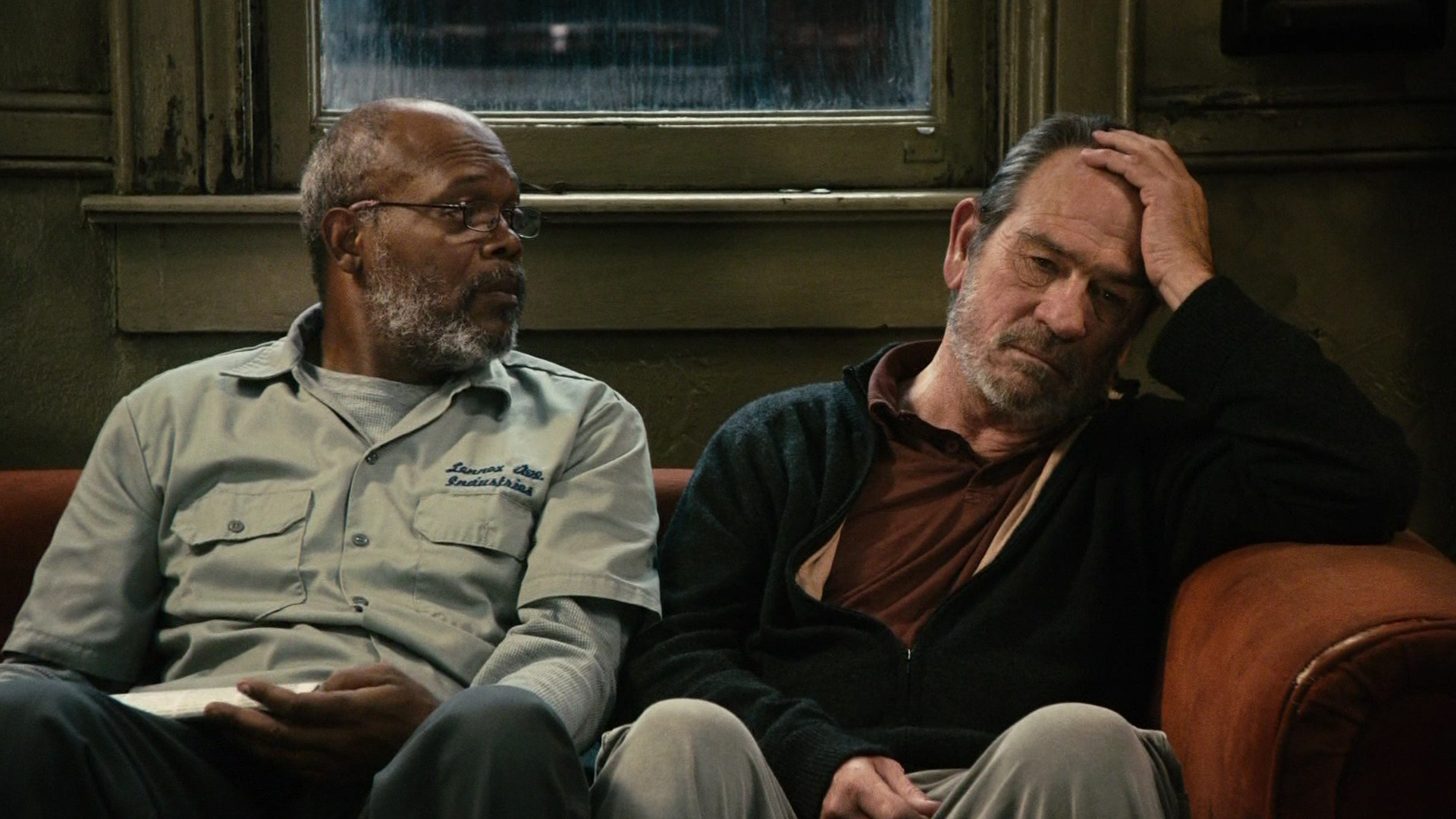
The Sunset Limited

The first attractive factor of The Sunset Limited is the fact that it's based on the screenplay written by Cormac McCarthy (who, if it isn't already evident from here, here, here, etc.), is one of my favorite authors); in other words, the whole movie is essentially a gamut of golden (like 24 carat) lines.

The second factor (and truly the only other one required to pull you in if the first factor wasn't tempting enough) is the fact that the movie stars Tommy Lee Jones (who is also the director) AND Samuel L. Jackson, aka AGENT K AND MACE WINDU, delegates from two nations on the map of my childhood (MIB and Star Wars)!!

I've never seen Mace Windu  Samuel L. Jackson more animated/passionated than he was in this film; neither have I seen Tommy Lee Jones looking so despondent (not even when Laura returns to Zartha).
Essentially, like all plays, The Sunset Limited's success depends on its screenplay and its actors'  performance; therefore, as the three people involved are Cormac McCarthy, Agent K and Mace Windu, the film didn't go very wrong.

The Sunset Limited opens with Black and White (I'm not being racist, those are really their names) sitting at a table, White looking depressed and Black consolatory. We learn that White planned on jumping in front a train, the Sunset Limited, and would have succeeded had Black not yanked him out of harm's way.

For the remainder of the night, the two dispute over many thing, at the core of which is the veracity of the Bible. Perhaps the most expedient way of understanding the film is to simply make the direct (albeit pithy) connection that the Sunset Limited = death, yet to White, death = more than just the Sunset Limited. In a line that will remain in my head forever, White claims that all despondent beings are merely "terminal commuters in a moral leper colony" and death is the  reprieve. Black disagrees, and attempts (with a slew of jailhouse stories) to waylay White's escape attempts and convert him. But White is resolute and acclimatized to sorrow. Ultimately, he is the one 'wins' the argument, leaving Black alone to wonder why the God he trusted did not arrive to settle the conflict. in his favor.


I don't regard my state of mind as some pessimistic view of the world. I regard it as the world itself. Evolution cannot avoidbringing intelligent life ultimately to an awareness of one thing, and one thing above all else. And that one thing is futility.
Show me a religion that prepares one for nothingness, for death. That's a church I might enter.Yours prepares one only for more life, for dreams and illusions and lies. Banish the fear of death from men's hearts...They wouldn't live a day. Who would want this nightmare but for fear of the next? The shadow of the axe hangs over every joy. Every road ends in death, every friendship, every love. Torment, loss, betrayal, pain, suffering, age, indignity, hideous lingering illness...and all of it with a single conclusion for you and every one and every thing you have ever chosen to care for. That is the true brotherhood, the true fellowship. And everybody is a member for life. You tell me that my brother is my salvation? My salvation? Well, then damn him. Damn him in every shape and guise and form. Do I see myself in him? Yes, I do. And what I see sickens me.

I want the dead to be dead - forever. And I want to be one of them. Except that of course you can't be one of them. You can't be one of the dead, because what has no existence can have no community.

White is not repudiating the antediluvian beliefs known to men, neither is he merely 'upset.' Cognizant that death is the terminus for everything on earth, the one for which we are not prepared for, perhaps he seeks death simply (ok, understatement) because the passage of life is a redundancy. To White, death is a nostrum for the "futility" of life. In Black's perspective, White's presentiment is a dark pessimism, but to White, it is the truth. Who is correct? As it is aptly stated on the film's epigram, "nothing is ever Black or White."


Ah, McCarthy gives one such substance to mull over.